
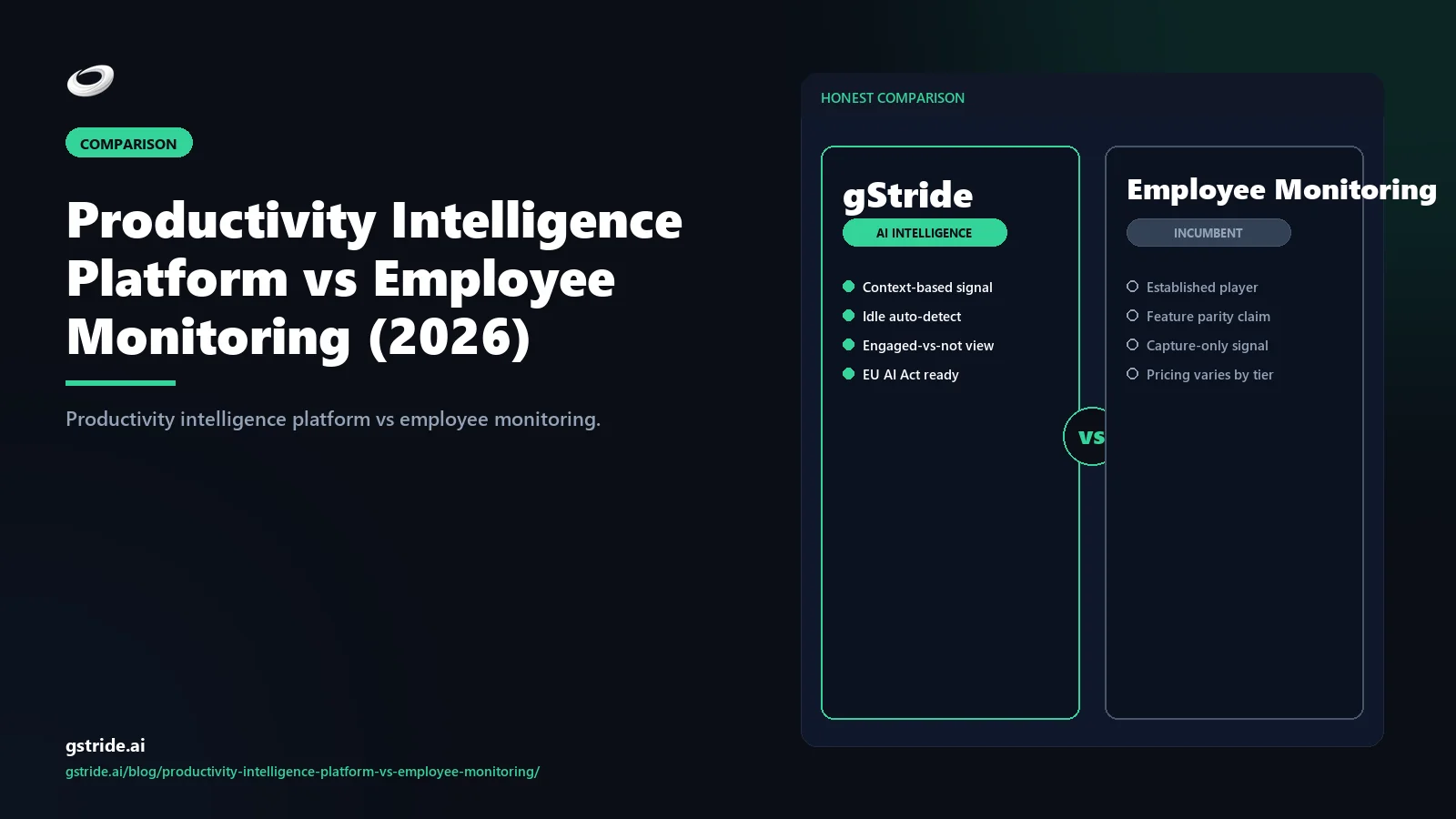
Side-by-side: the two categories defined
Before the full 7-point split, here is the side-by-side definition buyers paste into evaluation docs:
| Dimension | Productivity intelligence platform | Employee monitoring software |
|---|---|---|
| Definition | Measures the shape of work — focus density, meeting load, ticket flow, AI-classified activity — and recommends interventions to managers and employees. | Records the act of work — screenshots, keystrokes, URLs, idle time — and reports the capture to managers. |
| Core question | "Is the work shape healthy, and where can both sides intervene?" | "What is this employee doing right now?" |
| Default output | Team-level aggregated signal; capture features off by default. | Individual-level real-time capture; on by default. |
| Who sees it | Manager and the employee being measured, in the same dashboard. | Manager only; employee learns via notice or access request. |
| 2026 regulatory posture | Lighter EU AI Act / GDPR proportionality burden; governance package as standard collateral. | Heavier conformance burden; necessity-and-proportionality documentation falls on the buyer. |
Why the category split matters now
Until about 2023, "employee monitoring" and "workforce analytics" sat on the same software shelf — most product comparisons cheerfully mixed Teramind with ActivTrak with Microsoft Viva Insights with a half-dozen timer-led tools, and the buyer was expected to sort out the differences from a feature checklist. That collapse no longer holds. Three forces have separated the categories on the buyer side:
- Regulatory. The EU AI Act (Regulation 2024/1689) classifies workplace AI used to evaluate, allocate tasks to, or monitor employees as high-risk under Article 6. Its enforcement window for high-risk systems opens 2 August 2026. Monitoring-led tools that classify behaviour at the capture layer trigger a much heavier compliance burden than signal-led platforms that classify aggregated metadata. The same compliance gap is widening under GDPR proportionality — see our GDPR-compliant employee monitoring 25-point checklist for the article-by-article breakdown.
- Buyer-side procurement. CISOs, DPOs, and works councils are now reviewing vendors on what we call the four procurement gates — SAML SSO + SCIM, EU AI Act package, EU residency DPA, configurable defaults — and the rubric for each gate is different across the two categories. A monitoring tool's "configurable defaults" answer is "you can dial it down." A productivity intelligence platform's answer is "it ships dialled down." Those are different procurement narratives.
- Employee surface. Reddit r/managers, r/sysadmin, and r/cscareerquestions threads through 2024 to 2026 show a consistent pattern: candidates and current employees ask in interviews and onboarding whether the employer uses keystroke logging or screen capture. Productivity intelligence platforms answer "no, here is what you see in your own dashboard." Monitoring tools answer something slower and less honest. The category split is no longer just compliance — it is talent.
Below is the 7-point split that procurement teams, DPOs, and works councils are now using to decide which category a vendor sits in. The framework is built from a synthesis of EDPB guidance, EU AI Act conformance work, ICO 2023 monitoring guidance, and the procurement language buyers have started using in RFPs since H2 2025.
The 7-point category split
The 7 points are sequenced from the easiest to fake (capture) to the hardest (employee surface). Vendors who genuinely belong on the productivity-intelligence side clear all 7; vendors who belong on the monitoring side may clear the first two and slip on the others.
| # | Layer | Productivity intelligence | Employee monitoring |
|---|---|---|---|
| 1 | Capture | Operational metadata: calendar density, application focus, ticket flow, commit cadence. Screenshots optional and off by default. | Direct content: keystrokes, screen capture, URL logs, clipboard, content-aware DLP. On by default. |
| 2 | Signal | Aggregated, team-level by default. Individual-level requires documented purpose and audit-logged enable. | Individual-level by default. Real-time stream to manager dashboard. |
| 3 | Recommendation | AI-classified activity feeds back recommendations to both manager and employee — focus blocks, meeting consolidation, workload rebalance. | Rules-engine alerts to manager only. Recommendation surface is "investigate this user." |
| 4 | Action | Workflow surface: AI-assisted timesheets, payroll, leave, shift coverage. Action lives inside the platform. | Action lives elsewhere — HR investigation, IT ticket, legal hold. Tool is a forensic input, not an operational layer. |
| 5 | Defaults | Monitoring features ship disabled. Enable per role with documented justification and audit trail. | Monitoring features ship enabled. Buyer is expected to dial them down per jurisdiction. |
| 6 | Governance | EU AI Act conformance package, FRIA template, transparency notice template, Article 28 DPA with default EU residency. | Conformance posture varies. DPA addenda often required. FRIA artefacts rarely standard collateral. |
| 7 | Employee surface | Employee sees their own signal, classifications, and recommendations in a personal dashboard. Right to object is operationalised. | Employee surface is the monitoring notice and the access request workflow. Real-time view is manager-only. |
The first two rows describe what most buyers expect to see in a comparison table. The five rows below are where the categories actually diverge. Our deeper definition piece walks through each layer with worked examples; this article keeps the focus on the procurement-binding consequences of the split.
Point 1 — Capture: metadata vs content
The capture layer is where the two categories share the most surface area. Both observe work. The difference is what they observe. A productivity intelligence platform captures operational metadata: how dense is the calendar, which applications are in focus, how many tickets moved through the pipeline today, how long since the last commit. The capture is structurally limited to signal that is already legitimate for a manager to see in a properly run review.
An employee monitoring tool, by contrast, captures content — the text the employee typed, the screen they were looking at, the URL bar of the browser. That capture is what the EU AI Act and GDPR proportionality reviews now scrutinise most heavily, because content capture is harder to defend against the necessity test in Article 6(1)(b) and the data-minimization principle in Article 5(1)(c). See our alternative-to-keystroke-tracking guide for the technical mechanics of metadata-first capture.
Point 2 — Signal: team-level by default vs individual-level by default
The signal layer is the most measurable single difference between the categories. A productivity intelligence platform's default signal is aggregated — team-level focus density, team-level meeting load, team-level deep-work hours. Individual signal is available, but the path to it requires documented purpose, role-based access, and audit logging.
A monitoring tool's default signal is individual. The manager dashboard shows person A's keystroke rate, person B's idle minutes, person C's last screenshot. The category defaults are the inversion. Under EDPB Guidelines 4/2019 and the proportionality balancing test in Article 6(1)(f), the team-level default is far easier to defend than the individual-level default. Our piece on productivity without surveillance walks through the signal-aggregation pattern in detail.
Point 3 — Recommendation: feedback to both sides vs alert to manager only
This is where the categories start to look genuinely different. A productivity intelligence platform's recommendation surface is bidirectional. The AI classifies activity, identifies workload imbalance or focus erosion, and surfaces interventions — block this calendar window, consolidate these meetings, rebalance this assignment — to both the manager and the employee being measured. The employee sees the same recommendation feed the manager sees.
A monitoring tool's recommendation surface is unidirectional. The rules engine fires an alert to the manager — user X is idle, user Y triggered the prohibited-terms rule, user Z exfiltration pattern — and the employee learns about it later, often in an HR conversation. The asymmetry is the category's defining feature. Removing it is functionally a different product.
Point 4 — Action: workflow surface vs forensic input
Action is where buyers most often discover they are looking at two different categories of product. A productivity intelligence platform is an operational layer. It runs the timesheet, the approval workflow, the leave register, the shift coverage, the payroll handoff. Action lives inside the platform; the signal feeds straight into the operational decisions it already drives. Our AI timesheet scoring enterprise pillar walks through this as a specific workflow.
An employee monitoring tool is a forensic input. The data feeds an HR investigation, an IT incident ticket, a legal hold, or a contract-driven audit deliverable for an external client. Action lives outside the tool. The platform is the camera; the consequence is somewhere else. Enterprises that try to run their operational stack on top of a monitoring tool typically run a second WFM platform alongside, which is why the Teramind-replacement TCO math usually favours the bundled productivity-intelligence path.
Point 5 — Defaults: off by default vs on by default
The defaults row is the single most predictive line in the table. It will tell you almost everything about the rest of the product. Productivity intelligence platforms ship monitoring features disabled — every screenshot capture, every URL log, every idle classifier. Turning a feature on requires a documented justification, a role-based scope, an audit-log entry, and (in the better platforms) an employee notice trigger.
Employee monitoring tools ship the inverse. Default policy templates enable keystroke capture, screen capture, content-aware rules, and idle classifiers from day one. The buyer is expected to dial them down per jurisdiction. This is the part that fails GDPR proportionality reviews and triggers the heaviest EU AI Act conformance work, because the burden of necessity-and-proportionality documentation lands on the buyer for every feature they leave on. The vendor that ships off-by-default exports much less of that compliance overhead to the buyer.
Point 6 — Governance: package as standard collateral vs negotiation per deal
Governance is where procurement timelines diverge by weeks. A productivity intelligence platform on the modern shape of the category publishes a governance package as standard procurement collateral: an Article 28 DPA with EU residency as a default clause, an EU AI Act conformance statement covering the Article 6 high-risk classification, an FRIA template the buyer can adapt, a transparency-notice template the employer can hand to employees, a documented data-subject-rights workflow, and bias and accuracy testing artefacts for any AI scoring model.
Employee monitoring tools, by contrast, generally treat each of these as deal-stage negotiation. The DPA needs a residency addendum, the EU AI Act conformance is in progress, the FRIA template is not yet published, and the transparency notice is left to the buyer to draft. The procurement round-trip on a regulated buyer can stretch four to eight weeks before signature, and many EU buyers are now hard-coding "must clear governance gate in 14 days" into their evaluation cycle to filter out the slower category.
Point 7 — Employee surface: self-view vs invisibility
The seventh layer is the one buyers ignore until a works council asks. Productivity intelligence platforms expose the same signal to the employee being measured that they expose to the manager. The employee can open their own dashboard, see their own focus density, see how their activity has been classified, see the recommendations the platform is feeding their manager, and exercise an Article 21 right to object inside the product. The right to push back is operationalised, not just documented.
Employee monitoring tools, in their current shape, leave the employee surface to the monitoring notice and the access-request workflow. The employee learns what was captured by asking for it under Article 15. Real-time visibility is manager-only. This is the structural feature that drives the strongest works-council resistance in Germany, Austria, the Netherlands, and France — and it is the feature that hardest separates the two categories on a Reddit-and-Glassdoor talent signal. Our piece on Article 22 explainability walks through what the self-view surface actually has to expose to satisfy GDPR's automated-decision-making rights.
What this means for 2026 RFPs
If your team is writing a workplace-software RFP in 2026, the most useful thing the 7-point split lets you do is separate the questions. The questions a productivity intelligence platform should be asked are different from the questions an employee monitoring tool should be asked. Mixing them on the same form produces vendors who answer the easy half and ignore the hard half.
For a productivity intelligence RFP, the binding questions are:
- What is the default state of every capture feature? (Answer should be: off.)
- What is the default aggregation level of the signal layer? (Answer should be: team, not individual.)
- What is the employee's self-view surface, and does it expose the same classifications the manager sees?
- What is the published EU AI Act conformance package — statement, FRIA template, transparency notice template, bias-and-accuracy testing artefacts?
- What is the Article 28 DPA's default residency clause, and is it contractual or configurational?
- Does the platform run the operational workflow (timesheets, approvals, payroll, leave) or does it feed a separate WFM stack?
- What is the audit trail of every feature enable, role scope change, and policy template change?
For an employee monitoring RFP, the binding questions are different — content-aware rule coverage, OCR-based DLP, exfiltration alerting, retention policy on raw capture, and how the forensic input is handed to HR or IT or legal. Both categories are legitimate; they are just not the same buy. Our time tracking vs productivity intelligence decision-criteria piece is the companion read for buyers still mapping which side of the split fits the actual operational need.
The honest disqualifier
The 7-point split lets a vendor self-identify but it also lets a buyer disqualify. Productivity intelligence is not the right pick if the binding operational requirement is insider-threat DLP, contract-driven screenshot audit deliverables, or regulated-industry forensic capture. Those needs are real, and a monitoring tool is the right answer for them — productivity intelligence platforms do not match Teramind feature-for-feature on the DLP layer and should not pretend to.
Employee monitoring is not the right pick if the binding operational requirement is signal that feeds the manager-and-employee feedback loop, an EU AI Act high-risk conformance posture without a sub-processor renegotiation, or a unified workflow that includes timesheets, payroll, shift coverage, and leave. The categories are complementary, not substitutable. The category split lets buyers pick the right one for the operational shape they actually have.
Where gStride sits
gStride is an AI productivity intelligence platform on every row of the 7-point split. Capture defaults to operational metadata; screenshots are off by default and configurable per role with audit trail. Signal defaults to team-level aggregation; individual-level access requires documented purpose. Recommendation surface is bidirectional — manager and employee see the same activity classifications and intervention prompts. Action lives inside the platform — timesheets, approvals, payroll, leave, shift coverage are all native. Governance package is published collateral. Employee surface exposes the same signal to the employee being measured. The full architectural detail is in our productivity intelligence platform pillar guide; the procurement-side framing is in our CISO procurement questions piece.
What gStride is not, and does not claim to be: a content-aware DLP product, a regulated-industry forensic capture tool, or a one-tool answer for buyers whose binding operational requirement sits on the monitoring side of the category split. Those buyers should pick a monitoring product. The category split is the framework that helps both sides of the table avoid a wrong-shape purchase.
Free: CISO Procurement Checklist for AI Productivity Vendors
10 questions every CISO should ask before signing — data residency, DPIA, AI auditability, breach SLA, retention, SCIM/SSO, sub-processors, right to audit. Includes scoring rubric and pass / hold / walk thresholds.
Further reading on gStride
- AI productivity intelligence platform — the pillar guide
- What is productivity intelligence? — the category definition
- GDPR-compliant employee monitoring — 25-point checklist
- EU AI Act & employee time tracking — compliance checklist
- Time tracking vs productivity intelligence — decision criteria
- Explainable AI under GDPR Article 22 — the employee-surface obligation
- The anti-surveillance productivity stack
- Teramind alternatives for enterprises — 6 platforms compared
- CISO procurement questions for AI productivity vendors
Free: 5-Signal Productivity Self-Audit Worksheet
30-min audit on your team. Focus depth + commit cadence + meeting load + flow-state + blocker recovery. PDF + Google Sheets calc. For Ops Heads, Founders, Eng Managers.
Frequently asked questions
What is the difference between a productivity intelligence platform and employee monitoring software?
A productivity intelligence platform and employee monitoring software occupy different categories because they answer different questions. Monitoring asks "what is the employee doing at this moment?" and produces capture (screenshots, keystrokes, URL logs). Productivity intelligence asks "is the work shape healthy and where can the manager and the employee both intervene?" and produces signal (focus density, meeting load, ticket flow, AI-classified activity) plus recommendation and action. Productivity intelligence treats capture as one optional input among many; monitoring treats capture as the product. Under EU AI Act and GDPR proportionality reviews this distinction is increasingly procurement-binding in 2026.
Is gStride a productivity intelligence platform or an employee monitoring tool?
gStride is an AI productivity intelligence platform. Monitoring features (screenshots, app and URL classification, idle detection) ship off by default and are configurable per role with documented justification and an audit trail. The product surface is built around four layers — capture, signal, recommendation, action — and the signal and recommendation layers are visible to the employee being measured, not just to the manager. This inversion is what places gStride on the productivity-intelligence side of the category split rather than the monitoring side.
Why do procurement teams now treat productivity intelligence and employee monitoring as different RFPs in 2026?
Three regulatory and procurement forces converged in 2025 to 2026. The EU AI Act enforcement window for high-risk workplace systems opens 2 August 2026 and requires conformance documentation, an FRIA template, and a transparency notice — far easier to satisfy on a signal-led platform than on a capture-led monitoring tool. GDPR proportionality reviews increasingly fail surveillance-forward defaults under EDPB Guidelines 4/2019 (Article 6(1)(b)). And buyer side, CISOs, DPOs, and works councils are now reviewing vendors on the four procurement gates — SAML SSO + SCIM, EU AI Act package, EU residency DPA, configurable defaults — which monitoring tools struggle to clear in their standard tier.
Can a vendor be both a productivity intelligence platform and an employee monitoring tool?
A vendor can ship features that span both categories, but the category placement is determined by the defaults, not the feature checklist. If the default policy template enables screen capture, keystroke logging, and individual-level signal by default, the vendor is a monitoring tool — regardless of whether it also publishes a "productivity intelligence" marketing page. If the default policy template ships capture disabled and signal aggregated, the vendor is a productivity intelligence platform — even if it has optional monitoring features available. The 7-point split is decided by the defaults row, not the capability checklist.
How do I tell which category a vendor is in during a 30-minute demo?
Three questions during the demo will land any vendor on one side or the other of the split. First — "open a new tenant from scratch and show me the default policy template": if screen capture, keystroke logging, or individual signal are pre-enabled, the vendor sits on the monitoring side. Second — "open the employee self-view": if the employee dashboard shows the same activity classifications the manager sees, the vendor is on the productivity intelligence side. Third — "show me the published EU AI Act conformance package": if the FRIA template and transparency notice template are standard collateral, the vendor is signal-led; if they are deal-stage negotiation, the vendor is capture-led.
Does the category split matter outside the EU?
Yes, but the binding force is different. In the EU the split is regulatory — EU AI Act high-risk classification, GDPR proportionality, works-council co-determination. In the UK the ICO's October 2023 Monitoring workers guidance lands close to the EDPB position. In the US the split is increasingly state-driven: Connecticut, Delaware, New York, and Illinois notice laws plus post-Quebec Law 25 reasonableness in Canada produce the same proportionality conclusion through different statutory language. And globally, the split is now a talent-side signal — candidates ask, and employer brand on Glassdoor and Reddit reflects the answer.
What is the best productivity intelligence platform for Indian teams in 2026?
It depends on the binding requirement. gStride is built productivity-intelligence-first for Indian and EU-exposed teams — monitoring off by default, team-level signal, DPDP and EU AI Act governance collateral, and native timesheets, payroll, and leave workflow. Teams whose binding requirement sits on the monitoring side of the split — forensic capture, content-aware DLP, insider-threat alerting — are better served by monitoring-category tools such as Teramind or ActivTrak. Shortlist on the defaults row: ask each vendor for the out-of-the-box policy template and the published governance package before booking demos, and match the category to the operational need rather than the marketing page.
See a productivity intelligence platform from the configurable side of the split
Capture off by default, signal aggregated, recommendation bidirectional, action native to the workflow, governance package published as standard collateral. Walk the 7-point split against a 15-minute live tour.
Book a 15-min demo Read the pillar guideThis article is a category framework, not legal advice. EU AI Act conformance and GDPR proportionality positions evolve through new EDPB guidance, AI Act delegated acts, and national DPA decisions. Verify vendor claims against the current DPA, conformance package, and transparency-notice template before procurement signature.