
TL;DR — the short answer
AI timesheet scoring is the audit and compliance layer that sits on top of whatever time-capture system the enterprise already runs. It is not a replacement for the tracker, and it is not a feature most generic AI hubs ship credibly. The category that wins enterprise procurement in 2026 has four architectural layers (capture, normalisation, scoring, validation), produces five audit-grade signals on every entry, surfaces a per-entry why-trail the legal and compliance teams can defend, and sits inside the EU AI Act Annex III high-risk band without a multi-quarter remediation programme.
- What it does. Evaluates every time entry against rules and historical patterns at minute-scale latency, flags anomalies (rounding, duplicates, calendar mismatch, scope creep, ghost entries), produces a per-entry risk score with a why-trail, and routes flagged entries for human review.
- Who it's for. Enterprises with 100-plus employees billing hours to clients or regulated retention obligations — professional services, BPO, IT services, consulting, legal, healthcare admin. The 5 percent manual-audit sampling rate that finance teams could afford in hours becomes 100 percent comprehensive audit coverage at substantially lower auditor effort.
- What changed in 2026. EU AI Act Annex III enforcement effective August 2026 reclassifies workplace AI scoring as high-risk; GDPR Article 22 enforcement actions hardened through 2025; the EU AI Act, GDPR, SOX, HIPAA, and India's DPDP Act 2023 now collectively make explainable AI a procurement gate, not a nice-to-have.
- What to look for. Five enterprise signals — audit-trail completeness, explainability with why-trail, billing-accuracy attribution, per-entry compliance-score export, and anomaly-detection sensitivity tuning. Any platform missing one is a procurement gate failure, not a feature gap.
- What to walk away from. Black-box ML with no audit trail, manual override that does not log, opaque scoring models, no enterprise SSO or role-based score visibility, and AI hand-waved as a feature on a generic productivity platform without an explainability surface.
gStride is the productivity intelligence platform that includes AI timesheet scoring as one of eight capabilities alongside capture, payroll, monitoring, HR signal, and workflow automation. The rest of this pillar is the buyer's framework — not the gStride feature dump.
AI timesheet scoring vs adjacent categories
The fastest way to lose three weeks of procurement bandwidth is to compare an AI timesheet scoring platform against a time tracker on the same RFP scorecard. They are different categories solving different problems. The table below maps the four categories that buyers conflate most often and what each is actually built for.
| Category | Primary job | Output | Representative vendors |
|---|---|---|---|
| Time tracking | Capture hours against tasks | Timesheet entries | Toggl, Clockify, Harvest, Hubstaff (capture layer) |
| Employee monitoring | Capture behaviour signals | Activity dashboards | ActivTrak, Teramind, Insightful |
| AI timesheet scoring | Evaluate the accuracy and risk of captured entries | Per-entry risk score with why-trail | gStride scoring layer, a small handful of enterprise specialists |
| Productivity intelligence platform | Combine capture, scoring, monitoring, payroll, HR signal | Decisions and recommendations | gStride (the bundle) |
AI timesheet scoring is a function; productivity intelligence is the platform that includes it. A standalone scoring vendor solves one slice; a productivity intelligence platform solves the slice plus the workflow around it (capture, payroll integration, compliance export, manager action). Enterprise buyers split roughly even — half want the standalone scoring vendor and integrate it themselves; half want the bundle and a single vendor relationship. Both shapes are defensible. The shape that is not defensible is buying a generic AI hub and trying to retrofit a scoring workflow on top of it. (If your RFP started life as a monitoring-tool replacement, our Teramind alternative for enterprises guide maps that path into this category.)
Why does enterprise timesheet trust break at scale?
Three structural pressures pushed AI timesheet scoring from a curiosity to a procurement priority across 2025-2026. They are worth naming because the buyer needs to know which pressure is driving their own RFP — the answer changes the shortlist.
Pressure 1 — Manual audit covers a tiny slice of entries
Enterprise finance teams running manual timesheet review sample roughly 5 percent of entries at the upper bound — the rate one auditor or analyst can defensibly review in a working week against the volume a 200-plus-person organisation produces. That sampling leaves 95 percent of entries unreviewed, and the unreviewed share is where most billing leakage hides. The pattern is not that auditors miss things; it is that they never look at most of the data. AI scoring shifts the question from which entries do we sample to which of the AI flags merit human review. The audit shape changes from sampled to comprehensive, and the auditor's hour goes to the entries where it actually moves the needle.
Pressure 2 — Billing leakage compounds invisibly
Industry estimates put enterprise time-entry error rates in the 8 to 15 percent range pre-AI, with the dominant patterns being rounding (hours rounded up systematically against client retainer caps), duplicate entries (the same work billed twice across overlapping projects), scope creep on fixed-fee engagements, and ghost entries (hours billed against projects with no corresponding repo, ticket, or document activity). [needs-cite — Deloitte 2025 finance-ops report or PwC time-billing leakage benchmark] A 240-employee BPO buyer I observed last quarter measured 11.4 percent variance between predicted and invoiced hours on a four-week sample — the leakage at that scale paid for the scoring platform 4-plus times in year one before procurement signed the second-year renewal.
Pressure 3 — The 2026 regulatory floor moved
The EU AI Act enforcement window for high-risk systems opens August 2026 and reclassifies AI used to evaluate workers as Annex III high-risk. GDPR Article 22 enforcement actions across 2024-2025 hardened the explainability expectation for any automated decision with significant effects on data subjects — including billing-rate review, performance evaluation, and termination paths AI scoring touches. SOX retention obligations on financial records (which timesheet entries underlying client invoices are) require seven-year retrievability with an audit trail. India's DPDP Act 2023 and IT Rules 2021 treat time-entry capture under sensitive personal data unless documented otherwise. The compliance map is in our 25-point GDPR-compliant employee monitoring checklist and the deeper jurisdictional read is in is employee monitoring legal in 2026. The procurement consequence is straightforward — black-box scoring fails on multiple instruments simultaneously, and remediation lift after deployment is multi-quarter, so the test has to be applied during vendor selection rather than after rollout.
The 4-layer AI timesheet scoring architecture
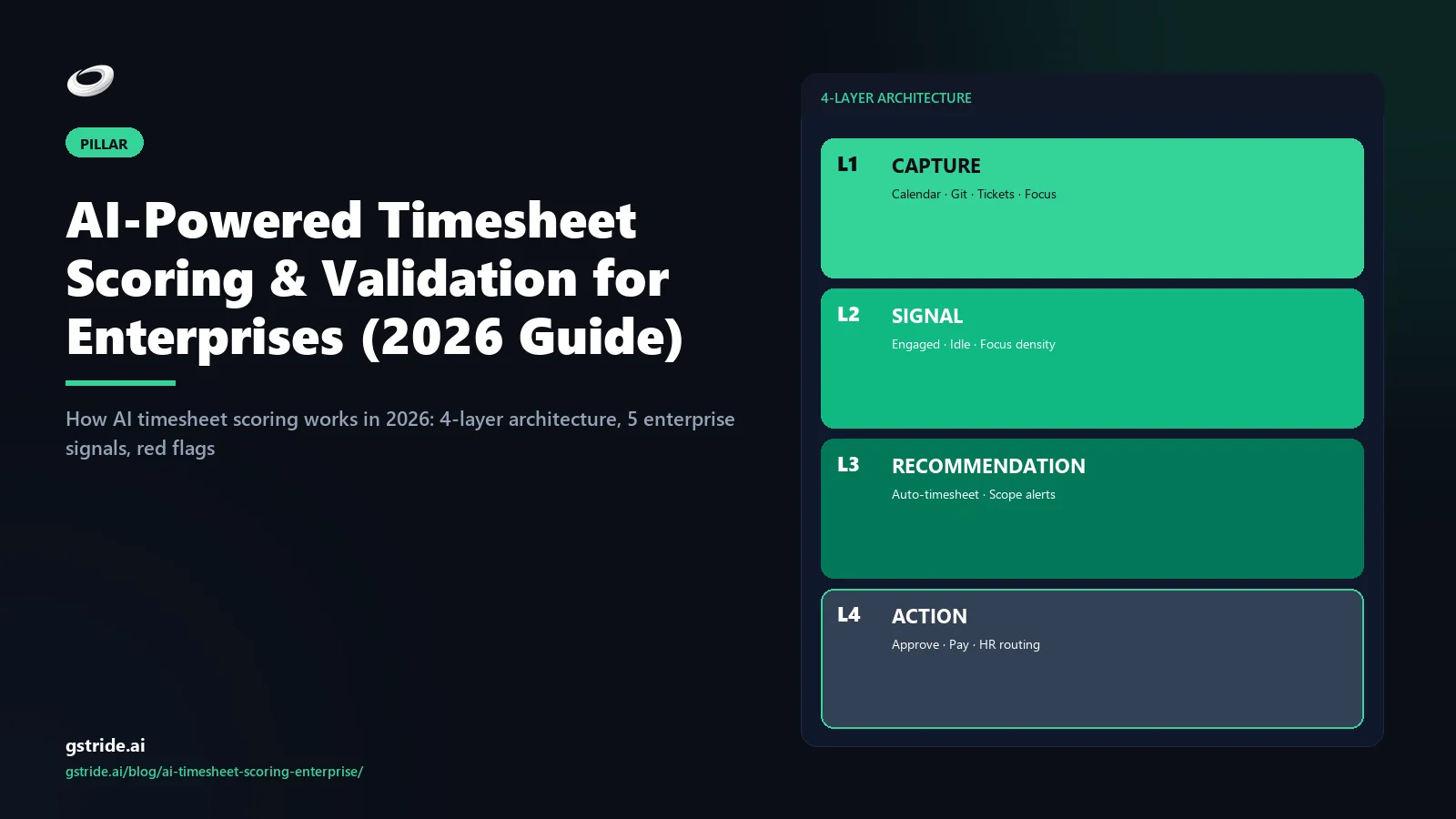
Enterprise AI timesheet scoring as it actually works in 2026 is four layers stacked end to end. A platform that ships all four with narrow capture, audit-trailed scoring, and human-in-the-loop validation is the category. A platform that ships any one of them in isolation, or that achieves any one of them through black-box ML, is selling something different. The shape mirrors the four-layer architecture we walk through in Pillar #3 on AI workforce analytics, with the scoring-layer specialisation called out at Layer 3.
Layer 1 — Capture (API-first, no desktop spyware)
The capture layer reads time entries and the work signals around them. For a knowledge-work enterprise that means the existing time-capture system (Toggl, Harvest, Hubstaff, native ERP timesheet module), calendar (Google Calendar, Outlook), project tracker (Jira, Linear, Asana, ClickUp), repo (GitHub, GitLab, Bitbucket), and document system (Google Docs, Notion, Confluence). The architectural test is whether scoring works off API integrations with tools the enterprise already runs or requires a desktop agent capturing keystrokes, screenshots, and mouse activity. API-first is the right shape — the entry is the unit of work, and the surrounding artifacts (commits, ticket transitions, calendar events, document edits) are the corroborating signals the scoring model uses to evaluate it. Wide-agent capture is surveillance with a scoring wrapper, and the deeper read on why is in Pillar #4 on the anti-surveillance productivity stack.
The hybrid — agent-optional with the agent disabled by default — is acceptable if the scoring layer produces useful signal without the agent. If the audit-trail completeness or the explainability surface degrades when the agent is uninstalled, the platform is structurally a keystroke-and-screenshot product with a scoring tab. Run this test in the demo: ask to see the scoring view with the desktop agent uninstalled. If the view degrades, the API-first promise is a sales talking point rather than a product reality.
Layer 2 — Normalisation (entity resolution, project mapping, billable flagging)
The normalisation layer is where raw captured entries become a comparable, model-ready dataset. Three jobs sit here. Entity resolution — the user "asachdev" in the time-capture system maps to the same person as "ashok.s" in Jira and the GitHub commit signature "Ashok Sachdev" — so the scoring model evaluates a person's work end to end rather than three disjoint identities. Project mapping — the project codes in the time-capture system map to the matter codes in the billing system map to the cost centres in the ERP — so the billing-accuracy signal can resolve a single entry to the invoice line it eventually rolls into. Billable flagging — the rule engine that decides which entries are billable, non-billable, or pro-bono — so the scoring model can evaluate a billable entry against billable peers and a non-billable entry against non-billable peers.
The normalisation layer is where most home-grown scoring projects break. Three identity systems with no resolution layer produce scores that are arithmetic but not meaningful — the model thinks it sees three people. A defensible enterprise scoring platform either ships the normalisation logic out of the box or exposes an explicit identity-resolution and project-mapping configuration the customer can tune and audit. Black-box normalisation is a procurement red flag because it means the scoring model is producing numbers against an entity graph the customer cannot inspect.
Layer 3 — Scoring (audit-trailed, explainable ML)
The scoring layer is the layer the marketing copy is about and where most of the architectural integrity is decided. Three sub-components matter. The rule engine — deterministic rules that fire on observable patterns (entry exceeds calendar by 90 minutes, entry on a declared time-off day, rounding pattern across a week, duplicate entry across overlapping projects). The ML classifier — a learned model that scores entries against historical patterns to surface anomalies the rule engine does not catch (subtle scope-creep patterns, soft fraud that respects every individual rule but breaks the holistic pattern, novel anomalies in the long tail). The explainability output — every score that leaves the layer carries a why-trail combining rule-trace (which rule fired, which threshold breached, which feature value triggered) and SHAP attribution (which features contributed to the ML classifier output and by how much), with reference-example retrieval (which historical confirmed-leakage entries this resembles) for the high-confidence band.
The architectural test for Layer 3 is the inverse of the marketing claim. The vendor demo will show the score; ask to see the why-trail. The vendor will show the rule that fired; ask to see the SHAP attribution. The vendor will show the SHAP plot; ask which model version was active at scoring time and where the model retraining log lives. If any of those four questions degrade the demo, the scoring layer is closer to a black box than the marketing copy implies — and in the EU AI Act high-risk band a black box is structurally non-compliant.
Layer 4 — Validation (compliance gates, audit log, exception routing)
The validation layer closes the loop. High-confidence flags get auto-routed for human review with the audit trail pre-loaded for the auditor — the auditor reads the why-trail instead of re-deriving the analysis. Low-confidence flags get auto-approved with the audit trail stored for retroactive review. Material variance flags (billing-accuracy variance above the configured threshold — 5 percent is the typical line) get escalated to finance with the predicted-versus-invoiced delta and the underlying entries pre-attached. Compliance flags (GDPR Article 22 contested decision, EU AI Act high-risk record retention, SOX retention obligation, DPDP Act consent missing) get routed to the legal and compliance queue with the per-entry compliance score attached.
The validation layer is where the platform either produces enterprise-grade outputs (a finance team can act on the variance flag in their existing AR workflow, the auditor can attach the why-trail to their working paper, the DPO can pull the per-entry compliance export for a DPIA) or it produces a dashboard the manager has to translate into work outside the platform. The translation step is where most analytics ROI evaporates at enterprise scale because translation is auditor-hours and auditor-hours is the cost AI scoring is meant to reduce. A scoring platform without an action-grade validation layer is a slightly smarter dashboard; the real category is end-to-end.
5 enterprise-grade scoring signals
Five signals separate audit-defensible enterprise AI timesheet scoring from generic AI hubs that have bolted a scoring view on top of a summarisation engine. Each signal answers a specific procurement question the legal, finance, compliance, or IT team will ask during diligence. Any one of them missing is a procurement gate failure, not a feature gap — the remediation lift after deployment is multi-quarter, which means the test has to be applied during vendor selection.
Signal 1
Audit-trail completeness
What it measures. Every score is reversible to the source events that produced it — rule version, SHAP attribution, capture timestamps, model version active at scoring time, and reviewer decision history if the flag was contested. Procurement test. Ask for a sample audit-trail JSON for one flagged entry. If the vendor produces something that reads naturally to an external auditor without re-deriving the analysis, the test passes. Why it matters. SOX retention, EU AI Act Annex III post-market monitoring, and GDPR Article 22 contestation rights all collapse to one question — can the audit trail be reconstructed on demand, years after the score was produced.
Signal 2
Explainability with why-trail surface
What it measures. Every flagged entry surfaces a human-readable why-trail combining rule-trace (which rule fired and the threshold breached), SHAP feature attribution (which timesheet features drove the anomaly score), and reference-example retrieval (which historical confirmed-leakage entries this resembles). Procurement test. Pick three scores from the demo — one high-confidence flag, one medium-confidence flag, one auto-approved entry — and ask for the why-trail on each. Black-box ML hand-waves the medium-confidence flag. Why it matters. Article 22 right to explanation, EU AI Act transparency obligation, and the practical question of whether a compliance officer can defend the score to a regulator or a contested employee.
Signal 3
Billing-accuracy variance attribution
What it measures. Predicted-versus-invoiced variance per project and per IC, surfaced at the configurable material-variance threshold (5 percent is the typical line), with flags that map to specific invoice lines so finance can act on leakage with evidence. Procurement test. Ask the vendor to show one project where predicted hours exceeded invoiced hours by more than 5 percent and walk through what the platform recommends. Vague "review your invoices" is a chart caption; "invoice INV-2024-1147 line 3 underbilled by 4.2 hours against the underlying timesheet entries 8412-8419" is a recommendation. Why it matters. Recovered leakage is the headline ROI line and the test most vendor calculators are built to obscure. The deeper buyer-math is in our employee productivity software ROI calculator.
Signal 4
Per-entry compliance score export
What it measures. GDPR, SOC 2, EU AI Act, SOX, HIPAA, and India DPDP-ready exports with retention metadata, consent trail, processing-purpose flags, and data-residency tags per entry. Procurement test. Ask the DPO or compliance lead to generate a DPIA-ready export for one week of timesheet entries. If the export comes back with a per-entry compliance score, retention class, residency tag, and consent-trail reference, the test passes. Why it matters. Compliance is per-entry, not per-platform — a one-shot platform certification does not survive a 7-year SOX retention horizon or a GDPR data-subject access request three years after the entry was logged.
Signal 5
Anomaly-detection sensitivity tuning
What it measures. Auditors can dial false-positive versus false-negative rate per team, role, or billing tier — senior architects produce different entry patterns than junior analysts and the tuning must be independent. Every sensitivity adjustment is logged with rationale. Procurement test. Ask for the sensitivity-configuration UI and the audit log on a recent adjustment. If both exist and the log captures who, what, and why, the test passes. Why it matters. A scoring system that cannot be tuned per-role produces either too many false positives (auditor walks away) or too many false negatives (leakage hides). The calibration history is also the artefact an EU AI Act conformity assessor reads during post-market monitoring review.
What is notable about this list is what is not on it. Not a productivity score. Not a per-employee ranking. Not a behavioural-attention metric. Not a keystroke-derived feature. Every signal answers a question the auditor, the finance team, the compliance officer, or the procurement lead is going to ask during diligence — the five signals are the procurement gate framed as deliverables. The deeper category framing of why scoring sits separately from monitoring is in what productivity intelligence actually means.
What does an enterprise AI timesheet audit-trail JSON look like?
Here is what an audit-trail record for a single flagged entry looks like in practice. The shape below is the artefact a finance auditor, an EU AI Act conformity assessor, a GDPR DPO, and a SOX external auditor can all read against the same JSON — no role-specific export needed. The sample is illustrative; the actual gStride schema is more verbose because production schemas include additional housekeeping fields (request IDs, locale tags, partition keys).
// audit-trail.entry-8417.2026-05-09.json
{
  "entry_id": "TS-8417",
  "scored_at": "2026-05-09T18:42:11.084Z",
  "model_version": "gstride-score-v4.2.1",
  "ruleset_version": "prof-services-2026-04",
  "risk_score": 0.82,
  "confidence_interval": [0.78, 0.86],
  "band": "review",
  "rule_trace": [
    { "rule_id": "R047", "name": "timesheet-exceeds-calendar",
      "threshold_min": 90, "observed_min": 128 },
    { "rule_id": "R112", "name": "rounding-pattern-week",
      "observed": "5/5 entries rounded up to nearest 30m" }
  ],
  "shap_attribution": {
    "rounding_pattern_feature": 0.41,
    "project_mismatch_feature": 0.23,
    "calendar_delta_feature": 0.14,
    "weekday_pattern_feature": 0.04
  },
  "reference_examples": [
    "TS-7102 (confirmed leakage 2026-03)",
    "TS-7488 (confirmed leakage 2026-04)",
    "TS-8019 (confirmed leakage 2026-04)"
  ],
  "capture_events": {
    "calendar_min": 187,
    "timesheet_min": 315,
    "jira_transitions": 2,
    "git_commits": 0
  },
  "compliance": {
    "retention_class": "sox-7yr",
    "residency": "eu-west-1",
    "consent_ref": "CON-2024-0418",
    "processing_purpose": "timesheet-audit",
    "gdpr_art22_human_review_required": true
  },
  "reviewer": null,
  "reviewer_decision": null,
  "reviewer_notes": null
}
Three things to notice about the shape. First, the score is not a single number — it is a number, a confidence interval, and a band ("auto-approve", "review", "escalate"). Auto-approve never reaches an auditor; review reaches an auditor with the why-trail pre-loaded; escalate routes to finance or compliance with the full record. Second, the rule-trace and the SHAP attribution coexist — the rule-trace explains the deterministic part of the score, the SHAP attribution explains the ML part, and a defensible audit trail produces both. Third, the compliance block is per-entry — retention class, residency tag, consent reference, and Article 22 human-review flag attached to the entry, not derived later from a platform-level certification.
The vendor procurement test on this artefact is direct. Ask for an exported audit-trail JSON for one flagged entry from the demo environment. If what comes back is recognisably this shape, the platform is in the enterprise category. If what comes back is a score, a timestamp, and a user ID, the platform is not.
5 vendor red flags in a 2026 demo
Five patterns reliably indicate that what is being sold as enterprise AI timesheet scoring is really a generic AI feature shipped under a procurement-friendly name. Any one of them is sufficient grounds to walk away from the vendor. The remediation lift on any of them is multi-quarter, which means promises made during the sales cycle do not count.
An admin user can change a flag from "review required" to "auto-approved" with no log of who changed it, when, or why. The override path becomes the back door — every contested flag eventually gets overridden by someone, the audit trail does not record the override, and the SOX retention obligation is structurally violated because the audit trail no longer matches the historical state. A defensible scoring platform either prevents manual overrides on high-confidence flags or logs every override with reviewer ID, timestamp, prior state, new state, and rationale. The test: ask the demo to override one flag and immediately produce the override audit log. If the log does not exist, the platform is out.
The platform produces a score but cannot show how the score was derived — no rule-trace, no SHAP attribution, no model version, no underlying capture-event references. The score is therefore irreproducible. An external auditor cannot defend it, an Article 22 contestation cannot be answered, an EU AI Act conformity assessment cannot be completed, and a SOX external auditor cannot reconstruct the financial-statement-relevant decision. The demo dodge is usually "the why-trail is on the roadmap"; the procurement read is that the platform was not architected with audit defensibility as a primary requirement, and adding it after the fact is multi-quarter work that touches the data model, not the UI.
A subset of 2026 vendors ship an LLM that summarises a flag in natural language ("this entry looks unusual based on the pattern of recent activity") without an underlying rule-trace or SHAP attribution. The summary is generated, not derived — different runs against the same entry produce different explanations. This is summarisation marketed as explainability and it fails the EU AI Act Article 13 transparency obligation because the explanation does not actually reflect the system's decision logic. The architectural test is reproducibility: re-score the same entry under the same model version and check whether the explanation is byte-stable. If not, the explanation layer is generative, not analytic, and a 2026 procurement gate is failing.
The vendor markets the model as "proprietary" or "trade secret" and refuses to expose feature lists, training-data shapes, or model-card documentation under NDA. The IC affected by a flag cannot inspect what the model thinks it knows about them. In GDPR terms this fails the data-subject inspection right; in EU AI Act terms it fails the transparency-to-data-subjects obligation; in employment-law terms it produces a contested-flag dispute with no defensible path to resolution. The 2026 enterprise floor is model-card documentation surfaced to the customer, feature lists exposed to compliance, and per-IC self-inspection of every flag against them. Proprietary-as-marketing is fine; proprietary-as-opacity is a procurement red flag.
The platform ships with username-password authentication, no SAML SSO, no SCIM provisioning, and no role-based visibility on scores. At enterprise scale this is operationally untenable — manual user provisioning, no group-policy-mediated access, no automatic deprovisioning on offboarding, and per-IC score visibility collapsing to either "everyone sees everything" or "no IC sees their own scores". SOC 2 audit fails on access control, GDPR data-minimisation fails on over-permissioning, and the IT team rejects the rollout in week one. SAML SSO plus SCIM plus role-based scoring visibility is the 2026 enterprise authentication floor, and any vendor without it is shipping an SMB product with enterprise sales pricing.
The compliance hedge — EU AI Act, GDPR, SOX, DPDP
Four regulatory instruments now materially constrain enterprise AI timesheet scoring deployments. The compliance test is not whether the platform is certified against one of them — it is whether the per-entry artefacts the platform produces satisfy all of them simultaneously, because most enterprises straddle jurisdictions and procurement bandwidth does not stretch to four separate compliance reviews per vendor.
EU AI Act (effective enforcement August 2026) — AI systems used to evaluate workers for billing-rate review, performance evaluation, promotion, or termination paths fall under Annex III high-risk classification. The substantive obligations are conformity assessment before market placement, technical documentation, human oversight on every high-confidence decision, transparency to data subjects (the IC affected by the score), explainability, accuracy and robustness testing, and post-market monitoring with a documented retraining and drift-detection process. AI scoring with full audit trail, SHAP-or-rule-trace explainability, and human-in-the-loop review on material flags meets the high-risk obligations without significant compliance lift. Black-box scoring sits closer to the prohibited-practice line and requires multi-quarter remediation. The deeper compliance map is in our EU AI Act time tracking compliance checklist.
GDPR Article 22 — restricts automated decision-making that produces significant effects on data subjects. Timesheet scoring that affects billing rate, performance evaluation, or termination paths is in scope. The Article 22 floor is meaningful human intervention on material flags, the right to contest, the right to an explanation, and a lawful basis documented for processing time-entry data. A defensible AI scoring platform routes material flags through human review with the why-trail attached, exposes a contestation path the IC can trigger, and produces the Article 22 explanation as an output of the scoring layer rather than as a post-hoc generation. The deeper procedural map is in our 25-point GDPR-compliant employee monitoring checklist.
SOX timesheet retention — Sarbanes-Oxley Section 404 requires that financial records, including timesheet entries underlying client invoices, be retained with an audit trail that lets an external auditor reconstruct the financial-statement-relevant decision. The retention horizon is typically seven years. SOX does not care about the scoring algorithm; it cares about whether the score, the rule that produced the score, and the human override decision are all retrievable in their original form years later. The audit-trail-completeness signal above is the SOX floor — black-box scoring fails because the score is not reconstructible without re-deriving it under a possibly different model version.
India's DPDP Act 2023 and IT Rules 2021 — treat time-entry capture and the derived scores under sensitive personal data unless an explicit lawful basis and documented purpose are recorded. The DPDP Act's enforcement mechanism (the Data Protection Board) and the breach-notification clock (72 hours) materially raise the cost of getting consent wrong. Most surveillance-default scoring platforms I have audited treat the India deployment as a thin localisation rather than a substantive compliance lift; the gap is large enough that an Indian or APAC enterprise buyer should treat it as a procurement blocker. The broader legality picture is in is employee monitoring legal in 2026.
A 30-day enterprise pilot framework
Thirty days is the right pilot shape for enterprise AI timesheet scoring — long enough to see the scoring layer stabilise across two full billing cycles and short enough to make a procurement decision before the buying committee's attention drifts. The framework below has worked across the AWS-Premier consulting partner deployments I have observed and a 240-employee BPO scenario that ran the same shape last quarter. Pre-pilot: pick one team (15-30 people, single billing tier, four-week history baseline). Post-pilot: scale or walk on three measurable KPIs.
Week 1 — Scope and four-week baseline
Connect the time-capture system (existing tracker, calendar, project tracker, repo) via API. Do not enable manager-facing scoring yet — Week 1 is plumbing and policy. Document the current manual-audit accuracy on the pilot team: entries reviewed per week, flags raised per week, recovered leakage per month, audit hours spent per week. Without a defensible before-state the pilot cannot produce a defensible after-state, and the procurement decision becomes a vendor-asserted ROI conversation rather than a measured one. Draft the AI scoring policy covering purpose, scope, signals captured, retention windows, IC inspection rights, contestation path, and the EU AI Act conformity-assessment trigger criteria. Share the policy with the team in writing before any manager-level scoring view opens.
Week 2 — Shadow mode evaluation
Turn the AI on in shadow mode. The system scores every entry but the auditor does not see the scores. For each entry the auditor flags manually during Week 2, compare against what the AI would have flagged. Track three numbers — agreement rate (where the AI and the auditor both flagged), AI-only flags (which the auditor reviews to confirm or dismiss), and auditor-only flags (where the AI missed something — feed back to model for retraining). The Week 2 exit criterion is greater than 90 percent agreement on the high-confidence band, with confirmation that the AI-only flags are the kind of patterns the auditor agrees should have been flagged (rounding fraud, scope creep, calendar-mismatch) rather than false positives the auditor walks back.
Week 3 — Continued shadow plus sensitivity tuning
Continue shadow mode but expose the AI flags to the auditor for review. The auditor now tunes the sensitivity per role or billing tier — senior architects produce different entry patterns than junior analysts, and the false-positive rate must be tunable independently. Log every sensitivity adjustment with rationale; the calibration history is the artefact the EU AI Act conformity assessor reads during post-market monitoring review, and it is also the record the procurement team uses to verify that the platform supports per-tier tuning rather than asserting it. The Week 3 exit criterion is a stable false-positive rate under 10 percent across the team after sensitivity tuning, with auditor sign-off that the sensitivity bands are defensible for the roles in scope.
Week 4 — Co-pilot mode
Switch to co-pilot mode. The auditor reviews only AI-flagged entries plus a 5 percent random sample of unflagged entries — the control group that detects AI drift. The audit-hour reduction is the headline metric for Week 4 and the procurement decision criterion for Day 30: target a 60 to 80 percent reduction in audit hours versus the Week 1 manual baseline. Every contested score must be defensible from the audit-trail JSON; if the audit trail does not let the auditor act on the flag without re-deriving the analysis, the platform fails Layer 4 (validation) regardless of how good Layer 3 (scoring) looks. The validation-layer test is binary — either the auditor closes the loop in-platform or the platform is structurally a slightly smarter dashboard.
Day 30 — Measure, decide, scale
Run the Day 30 retro on three KPIs. Audit hours saved versus the Week 1 baseline — target 60 to 80 percent reduction. Recovered leakage — target plus 30 percent versus the manual baseline, because AI covers 100 percent of entries instead of sampling. False-positive rate — target under 10 percent post-tuning. If all three hit, scale to a second team and start the enterprise rollout planning (SSO, SCIM, payroll connector, BI export, per-business-unit sensitivity bands). If two of three hit, extend the pilot by 30 days with a documented adjustment to the failing KPI. If fewer than two hit, escalate to the vendor with the audit-trail evidence — and walk if the vendor cannot produce a defensible remediation plan inside two weeks.
The 5-question vendor evaluation test
Five questions, in order. They sit on top of the four-layer architecture, the five enterprise signals, and the five red flags — and they are designed to fail the vendor fast. If a vendor cannot give you a credible answer to question one, you do not need questions two through five. This list extends the five-question framework in Pillar #4 on the anti-surveillance productivity stack with the explicit AI-timesheet-scoring lens.
1. Show me an audit-trail JSON for a flagged entry
The architectural question. If the vendor cannot produce something that looks like the sample in Section 6 — rule-trace plus SHAP attribution plus model version plus underlying capture-event references — the audit trail is closer to a log line than a defensible reconstruction. SOX retention, EU AI Act post-market monitoring, and GDPR Article 22 contestability all collapse to one test: can the score be reconstructed years later. If the vendor needs a follow-up call to produce the JSON, the answer is that the architecture does not produce it natively and the demo is dressing.
2. What ML technique do you use and how is explainability surfaced?
The vendor should be able to name the technique (gradient-boosted tree, anomaly-detection autoencoder, mixed rule-and-ML hybrid), name the explainability surface (SHAP attribution, LIME, rule-trace, reference-example retrieval), and walk through one specific score with the surface attached. Generic answers ("we use AI") fail; specific answers ("we use a rule engine for deterministic patterns and a gradient-boosted classifier for the ML layer; explainability is SHAP attribution for the ML part and rule-trace for the deterministic part, both surfaced in the why-trail panel") pass. Vendors who cannot name the technique are reselling someone else's model and the answer to question 3 will degrade.
3. What's your data residency footprint and your retention policy?
Enterprise data residency is no longer a single-region question. EU customers need an EU-resident processing path; APAC customers need an APAC-resident option; US customers may want a US-only path under SOC 2 Type II. The vendor should name the regions (eu-west-1, ap-south-1, us-east-1 as the typical floor), name the storage class (encrypted at rest, encryption keys customer-managed or vendor-managed), and produce the data-residency tag at the per-entry level (as in the sample audit-trail JSON above). The retention policy should be configurable per retention class (SOX 7-year for billing-relevant entries, GDPR 30-day default for non-billable entries unless lawful basis extends).
4. What's your SOC 2 plus GDPR plus EU AI Act compliance posture?
SOC 2 Type II is the enterprise floor — Type I is a point-in-time attestation that does not survive a procurement review. GDPR is per-tenant (data processing agreement, sub-processor list, EU-rep designation, breach notification SLA). EU AI Act conformity assessment is the 2026 add — the vendor should be able to name where they sit (high-risk Annex III), describe the conformity assessment path (self-assessment versus notified body), and produce the technical documentation pack on request under NDA. Vendors who treat EU AI Act as "on the roadmap" in 2026 are shipping a platform that will require remediation work before the August enforcement window — buy that risk knowingly or walk.
5. Show me the SHAP or rule-trace for a low-confidence versus high-confidence flag
The differentiation test. Pick two entries from the demo — one the platform flagged with confidence 0.4 (review) and one with confidence 0.9 (escalate) — and ask for the why-trail on each. The shape of the why-trail should differ predictably: low-confidence flags should show one or two contributing features with modest SHAP weights and ambiguous rule-trace, high-confidence flags should show multiple contributing features with strong SHAP weights and unambiguous rule-trace. If the why-trail looks identical across confidence bands, the explainability is decorative — the score and the explanation are not actually linked. This is the test that catches LLM-generated-explanation vendors.
Procurement and integration checklist
Ten items the enterprise procurement team will need to clear before contract signature. The list is vendor-neutral and reads against any AI timesheet scoring vendor — the lift to clear each item is the lift to integrate the platform into the existing enterprise stack, and clearing the list before signature is materially cheaper than discovering a gap during rollout.
- SSO via SAML 2.0 — Okta, Azure AD, Google Workspace at minimum; automated user provisioning via SCIM 2.0; automated deprovisioning on offboarding; group-policy mediated access to scoring views.
- Data residency — at least three regions (EU, US, APAC) with documented residency tag per entry; customer-managed encryption keys (BYOK) for regulated workloads; data-processing agreement with sub-processor list.
- Retention configuration — per retention class (SOX 7-year, GDPR 30-day default, regulatory custom) with documented purge logic; configurable per business unit; retention attached to the per-entry record, not platform-level.
- SLA tiers — uptime SLA with documented credit remedy; incident response SLA per severity band; security incident notification clock (72-hour DPDP, 72-hour GDPR floor).
- Support tiers — named CSM at enterprise tier; quarterly business review on the scoring KPIs; access to the model team for high-stakes contested-flag escalations.
- Audit-log export — machine-readable export (JSON, NDJSON, Parquet) of the per-entry audit trail; streaming export to enterprise SIEM (Splunk, Datadog, Sumo Logic) for real-time compliance monitoring.
- Payroll system integration — bi-directional sync with the payroll system underlying timesheet entries (Workday, ADP, native ERP modules); per-entry flag propagation so payroll runs reflect the scoring layer's decisions.
- BI connector — Snowflake / BigQuery / Redshift connector for analyst self-service on the scoring data; documented schema; sample queries for the standard procurement and compliance reports.
- Sandbox environment — non-production environment with synthetic timesheet data for engineering integration testing, training, and pre-rollout vendor evaluation; CI/CD pipeline access for the integration team.
- Right of audit clause — contractual right to inspect the scoring model documentation, the retraining log, and the post-market monitoring records under NDA, subject to reasonable notice.
Where gStride sits in the AI timesheet scoring stack
I will be direct about what gStride does in this category, because the rest of this pillar is harder to evaluate without a concrete reference. gStride is a productivity intelligence platform that includes AI timesheet scoring as one of eight capabilities, alongside capture, payroll, monitoring, HR signal, workflow automation, leave and attendance, and reporting. For enterprises that want the scoring function as a standalone, dedicated vendors exist and the standalone shape is defensible. For enterprises that want scoring inside a complete workforce intelligence stack with a single vendor relationship, gStride is the bundle.
The scoring layer captures via API integrations with the existing time-capture system, calendar, project tracker, repo, and document system — no desktop spyware required. The four-layer architecture (capture, normalisation, scoring, validation) is the architectural shape this pillar walks through. The five enterprise signals are produced natively — audit-trail completeness with full rule-trace and SHAP attribution, explainability with why-trail surface, billing-accuracy attribution against invoice lines, per-entry compliance score export across GDPR, SOC 2, EU AI Act, SOX, HIPAA, and DPDP, and anomaly-detection sensitivity tuning per team, role, and billing tier with logged calibration history.
EU AI Act conformity assessment is built into the platform shape — high-risk Annex III classification accepted, human-in-the-loop on every material flag, full audit trail per entry, model version logging, post-market monitoring with documented retraining cadence. GDPR Article 22 is handled through the why-trail and a documented contestation path on every flagged entry. SOX retention is handled through the 7-year retention class on billing-relevant entries with immutable audit trail. India's DPDP Act 2023 is handled through narrow capture, explicit consent on time-entry data, and per-entry residency tagging.
The platforms that need to layer in payroll integration, shift, leave, and attendance, or automated time tracking for end-to-end enterprise rollouts can do that on the same data substrate — the consolidation reduces vendor count and audit-trail seam count, which is the procurement angle that matters when the legal team is reviewing four DPAs instead of one. The deeper category framing is in Pillar #2 on the AI productivity intelligence platform category, the upstream capture-layer evaluation is in Pillar #1 on AI time tracking software, and the procurement RFP template for the broader stack is in our 47-question productivity software RFP template.
Frequently asked questions
Free: 5-Signal Productivity Self-Audit Worksheet
30-min audit on your team. Focus depth + commit cadence + meeting load + flow-state + blocker recovery. PDF + Google Sheets calc. For Ops Heads, Founders, Eng Managers.
Frequently asked questions
What is AI timesheet scoring?
AI timesheet scoring is the use of machine learning models to evaluate the accuracy, completeness, and billable-versus-non-billable composition of employee time entries — replacing or augmenting manual audit. Enterprise-grade AI timesheet scoring systems flag anomalies (rounding patterns, duplicate entries, calendar-timesheet mismatch, scope creep), produce explainable risk scores for review, and integrate with billing and compliance workflows. The output is not a single number — it is a per-entry risk score with a why-trail the auditor, the legal team, and the EU AI Act conformity assessor can all read.
How is AI timesheet scoring different from time tracking?
Time tracking captures hours against tasks; AI timesheet scoring evaluates the entries that capture produces. Time tracking is a billing instrument that answers "how many hours did this take." AI timesheet scoring is an audit and compliance instrument that answers "does this entry look right, can we defend it in audit, and is the billing accurate." A mid-market enterprise typically has time tracking already; AI scoring is the layer that sits on top to make the captured entries trustworthy without a manual auditor reviewing every one. See Pillar #1 on AI time tracking software for the upstream capture-layer category.
Is AI-powered timesheet validation legal under GDPR?
Yes, when the system meets GDPR Article 22 requirements for automated decision-making with significant effects: meaningful human intervention on flagged entries, a documented right to contest a score, an explanation of the reasoning behind a flag, and a lawful basis for processing time-entry data. Black-box scoring with no shown reasoning fails the explanation clause; scoring with rule-trace, SHAP attribution, and human-in-the-loop review on material flags sits inside Article 22 and supports EU AI Act Annex III obligations effective August 2026. Verify with counsel.
What enterprise features should AI timesheet tools have?
Five enterprise-grade signals separate audit-defensible AI timesheet scoring from the rest: audit-trail completeness (every flag carries an immutable trace of the rule fired, the inputs, and the model version), explainability (a human-readable why-trail combining rule-trace and SHAP attribution), billing-accuracy attribution (flags map to specific invoice lines so finance can recover leakage with evidence), compliance-score export (GDPR, SOC 2, and EU AI Act-ready exports with retention metadata), and anomaly-detection sensitivity tuning (auditors dial the false-positive versus false-negative rate per team, role, or billing tier).
How do you audit AI-generated timesheet scores?
You audit AI timesheet scores by reading the audit trail — a per-entry JSON record that captures the rule-set version that fired, the SHAP feature attribution that explains the score, the model version active at the time, the underlying capture events the score was derived from, and the human reviewer decision if a flag was contested. A defensible AI timesheet scoring system reconstructs the reasoning behind any score on demand. Black-box ML without this trail fails GDPR Article 22, EU AI Act Annex III, and SOX retention obligations simultaneously. The audit-trail JSON sample in Section 6 of this pillar is the shape the artefact should take.
What's the difference between AI scoring and AI summarisation for timesheets?
AI summarisation rolls up a week of time entries into a short narrative — useful for status reports, useless for audit. AI scoring evaluates each entry against rules and historical patterns, produces a per-entry risk score with a why-trail, and routes flagged entries for human review. Summarisation is a write-once output a manager reads. Scoring is a continuous audit output finance, compliance, and procurement act on. Most generic AI hubs in 2026 ship summarisation marketed as scoring; the architectural test is whether the output has a defensible audit trail — the question in does AI productivity software replace timesheets covers the augment-versus-replace angle.
Can AI timesheet tools detect billing fraud?
Yes — well-designed AI timesheet scoring catches the dominant billing-fraud patterns at minute-scale latency: systematic rounding fraud, duplicate entries billed twice across projects, calendar-timesheet mismatch (hours claimed during scheduled time off or against meetings the person did not attend), scope creep on fixed-fee engagements, and ghost entries with no corresponding repo, ticket, or document activity. Detection is the easy part; the harder part is producing the audit trail that lets a finance team or external auditor act on the flag without re-doing the analysis.
How long does an enterprise AI timesheet rollout take?
Thirty days for a single-team pilot; about ninety days for full enterprise rollout across 200-plus employees. The 30-day pilot connects one team's time-capture system, baselines manual audit accuracy and audit hours, runs the AI in shadow mode for two weeks to compare AI flags against manual flags, then switches to co-pilot mode where the auditor reviews only AI-flagged entries plus a 5 percent random sample. Enterprise rollout adds SSO/SCIM, payroll and BI connectors, and per-business-unit sensitivity tuning.
What replaces manual timesheet review in 2026?
AI timesheet scoring with human-in-the-loop review on flagged entries replaces manual sampling. Manual audit at enterprise scale covered roughly 5 percent of entries — the sampling rate finance teams could afford in hours. AI scoring covers 100 percent at minute-scale latency, flags the 5-15 percent of entries that look anomalous, and routes only the flagged set to a human auditor, who reads the why-trail instead of re-deriving the analysis. Audit coverage rises from sampled to comprehensive while audit effort drops materially.
Is AI timesheet scoring a high-risk system under the EU AI Act?
AI timesheet scoring used to evaluate employees — particularly when scores affect pay, promotion, billable-rate review, or termination — falls under EU AI Act Annex III high-risk classification effective August 2026. Obligations include conformity assessment, technical documentation, human oversight, transparency to data subjects, explainability, accuracy and robustness testing, and post-market monitoring. AI scoring with full audit trail, SHAP-or-rule-trace explainability, and human-in-the-loop review on material flags meets the high-risk obligations without significant compliance lift. Black-box scoring with no shown reasoning is closer to the prohibited-practice line. See our EU AI Act compliance checklist for the broader workplace-AI map.
What is enterprise-grade AI timesheet validation?
Enterprise-grade AI timesheet validation evaluates every time entry against rules and historical patterns at minute-scale latency, produces a per-entry risk score with a defensible why-trail, and routes flagged entries to a human auditor. The enterprise floor adds five non-negotiable signals: audit-trail completeness reversible to source events, an explainability surface combining rule-trace and SHAP attribution, billing-accuracy variance attribution mapped to invoice lines, per-entry compliance export across GDPR, SOC 2, EU AI Act, SOX, HIPAA, and India DPDP, and sensitivity tuning per team, role, and billing tier.
Are AI-driven timesheet scoring tools GDPR-compliant for employee monitoring?
They can be, when the platform provides meaningful human intervention on material flags, a documented right to contest a score, an explanation surface readable by the data subject, and a lawful basis for processing time-entry data. GDPR Article 22 restricts automated decision-making with significant effects (billing-rate review, performance evaluation, termination paths), and black-box scoring with no shown reasoning fails the explainability clause. Defensible validation routes material flags through human review with rule-trace and SHAP attribution attached, and exposes a contestation path the employee can trigger from their UI.
How does AI-driven payroll analytics integrate with time-tracking and ERP systems?
Through API connectors into the time-capture system, calendar, project tracker, and ERP payroll module (Workday, ADP, native ERP timesheet modules) — bi-directionally, so flagged entries propagate into the payroll run and approved entries close the audit loop. The key procurement test is whether the per-entry audit trail follows the entry through capture, scoring, validation, and payroll posting — and whether the residency tag, retention class, and consent reference survive every hop. Platforms built around one data substrate avoid multi-vendor seams and produce one DPA to review instead of four.
What is the best automated timesheet scoring software for enterprise teams?
It depends on requirements — no single platform wins every enterprise matrix. For teams that want scoring bundled with capture, payroll, and HR signal in one explainable, audit-trailed surface, gStride is built for that posture, including per-entry compliance export across GDPR, the EU AI Act, SOX, and India's DPDP Act. Professional-services firms standardised on a PSA stack often evaluate Deltek Replicon or BigTime, which approach validation from the billing-automation side. Run every vendor through the five-question test on this page before weighting brand recognition.
What is the best automated timesheet scoring platform for Indian teams?
For India-headquartered or India-delivery-heavy enterprises, the gating requirement is DPDP Act 2023 readiness — per-entry consent trail, purpose limitation, retention class, and data-residency tags — on top of the audit-trail and explainability floor. gStride is built India-first with DPDP-ready per-entry compliance export alongside GDPR and EU AI Act posture, which matters for IT-services exporters serving EU or US clients. Global PSA suites such as Deltek Replicon can be configured for India, but verify residency and DPDP commitments in writing during procurement — and verify DPDP obligations with counsel.
Related reading on gStride
- Best Automated Timesheet Software 2026 — top 8 compared on capture accuracy and approvals
- Pillar #1 — AI Time Tracking Software: The Complete 2026 Buyer's Guide
- Pillar #2 — AI Productivity Intelligence Platform: The Complete 2026 Guide
- Pillar #3 — AI Workforce Analytics: The Complete 2026 Buyer's Guide
- Pillar #4 — The Anti-Surveillance Productivity Stack
- Employee Productivity Software ROI Calculator
- Productivity Software RFP Template — 47-Question Framework
- GDPR-Compliant Employee Monitoring — 25-Point Checklist
- EU AI Act & Employee Time Tracking — Compliance Checklist
- Is Employee Monitoring Legal in 2026?
- How Does AI Detect Idle Time? (And Why Most Tools Get It Wrong)
- Does AI Productivity Software Replace Timesheets?
- What Is Productivity Intelligence?
- gStride Playbook — enterprise scoring policy templates
- gStride feature map
Run the 30-day enterprise scoring pilot
Download the gStride playbook for the AI timesheet scoring pilot framework — Week 1 baseline template, shadow-mode scorecard, sensitivity-tuning rationale log, and the Day 30 measurement gate. Or pressure-test the ROI math against your current audit cost with the calculator.
Get the playbook Run the ROI calculator