
The short answer
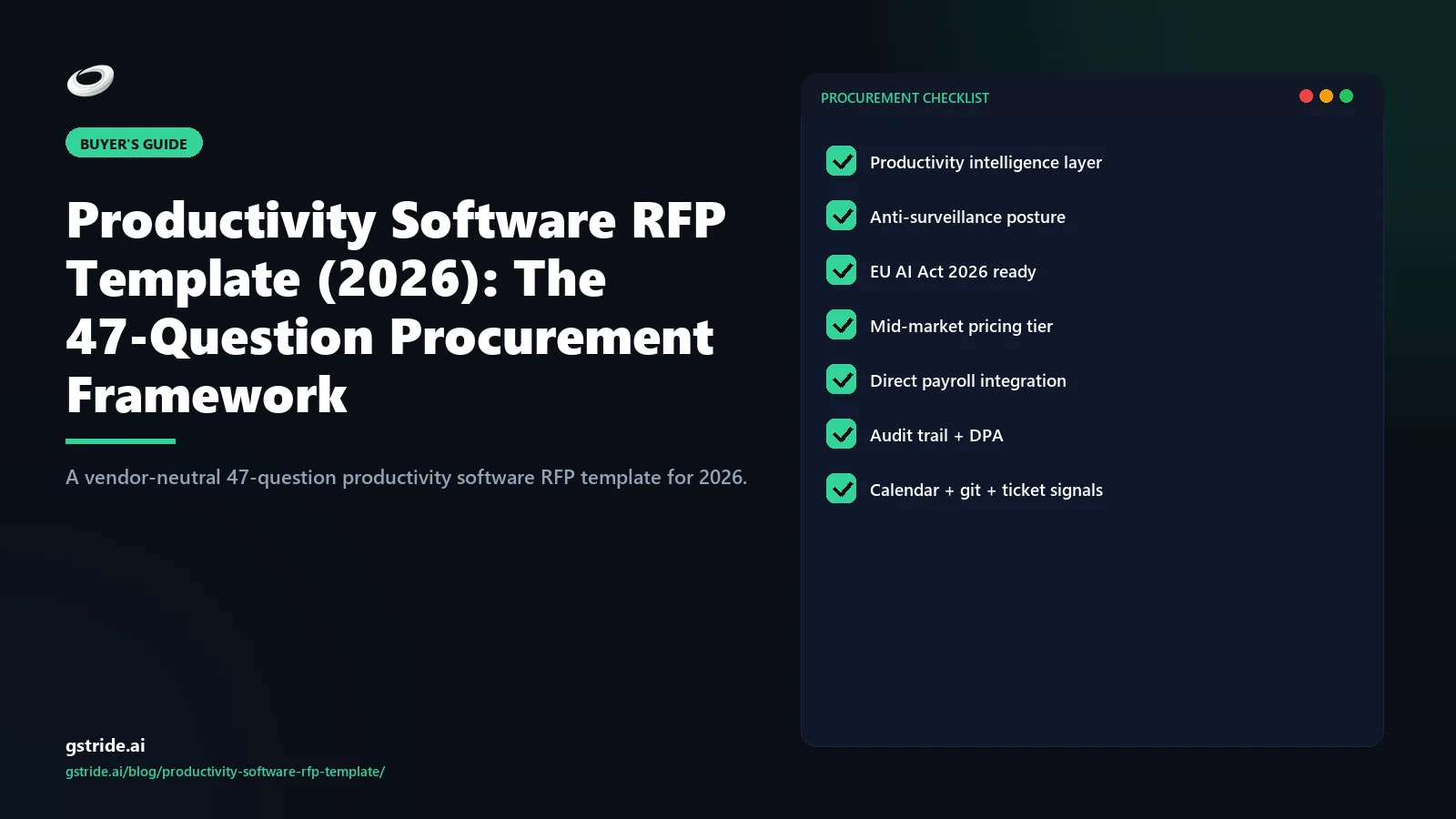
A productivity software RFP template is the structured questionnaire mid-market buyers send to shortlisted vendors to compare them on the same dimensions in writing, rather than from sales-call memory. The vendor-neutral 2026 version covers seven sections in 47 total questions — 8 functional requirements (capture, signal, recommendation, action, payroll, leave, monitoring, integrations), 10 compliance and security (SAML SSO, SCIM, DPA, BAA, SOC 2, GDPR, EU AI Act, audit trail, retention, dispute path), 8 implementation and support (rollout time, training, customer-success allocation, SLAs, escalation), 8 commercial (pricing model, banding, true-up, multi-year, exit clauses, data export), 5 future and roadmap (AI roadmap, model-tier policy, deprecation, feature requests, partner gravity), 5 reference checks (named customers, case studies, success metrics, churn, NPS), and 3 cross-functional sign-off (IT, HR, Operations, Legal — minimum). Each response is scored 1-5 against a documented rubric (1 missing, 5 native and documented), weighted by section importance (functional 25%, compliance 25%, implementation 15%, commercial 15%, roadmap 8%, references 7%, sign-off 5%), and cross-checked against the demo and reference notes. The full inline checklist below is copy-paste-ready for Word or Google Docs — no PDF gate, no email capture, just the questions you can put in front of a vendor today.
Why generic SaaS RFPs miss the productivity-tool nuances
The standard procurement RFP template your CFO already has on file is genuinely useful for the commercial and legal sections, and it is dangerously incomplete for productivity software. Three productivity-specific dimensions are missing in every generic SaaS template I have reviewed in 2025-2026, and each one of them sinks at least one mid-market buyer per quarter.
The first miss is monitoring stance and employee experience. Generic SaaS templates ask “does the platform support user management” (yes, every platform does). They do not ask whether screenshots are on or off by default, whether the dispute path for an AI-derived productivity score is documented, or whether employees can inspect their own data. Productivity tools that fail on these axes pass the generic RFP and then trigger a works-council escalation in month 3. The monitoring policy template covers the policy-side framing of these questions; the RFP below converts them into vendor-answerable form.
The second miss is AI signal explainability. Generic templates ask “does the platform have AI features” (yes, every 2026 platform claims AI). They do not ask which of the four AI layers the platform actually delivers — capture, signal, recommendation, action — or what the model-tier policy is when a vendor swaps an underlying LLM. The four-layer category architecture is the framework that splits real productivity intelligence from AI-washing on the demo. The RFP encodes those four layers as separate questions so vendors cannot bundle them into a single yes.
The third miss is the EU AI Act high-risk classification. The Act's workplace-AI obligations begin August 2, 2026 — three months from the date this template was written. Many productivity tools that were comfortable on the generic SaaS RFP in 2024 became high-risk systems overnight under Annex III, and the procurement teams that did not ask about the classification in writing now hold contracts with a year-2 compliance gap. The RFP below makes this an explicit yes/no question with documentation evidence required.
How to use this template
Send the 47-question RFP to your shortlist of 4-6 vendors with a documented response deadline of two weeks and the scoring rubric attached. Vendors answer in writing. You score each response 1-5 against the rubric, apply the section weights, and rank vendors by weighted total. Shortlist to 2-3 finalists for second-round demos against your one-sentence operating problem, run two reference calls per finalist, then apply the cross-check matrix to flag any vendor whose RFP score exceeds the demo score by more than 15%. The full process runs 6-10 weeks; compressing it under 4 weeks usually means the compliance and reference-check work was skipped, and that is the most common reason mid-market buyers regret the choice 9 months later.
The inline checklist later in this post is structured as expandable sections you can copy section-by-section into Word or Google Docs, or copy all 47 questions in one go using the Copy All button. There is no PDF gate, no email capture, no lead-magnet form — the template is the artefact, and the artefact is the page. The comparison framework is the upstream filter that decides which 4-6 vendors land on your shortlist before the RFP even goes out.
Section 1: Functional requirements (8 questions)
The functional section maps to the four-layer productivity intelligence architecture (capture, signal, recommendation, action) plus four operational extensions (payroll, leave and shift, monitoring posture, integrations). One question per axis — eight total. Bundling these into fewer questions invites vendor evasion.
Q1 covers capture mechanism — active timer, passive desktop sensor, AI-inferred from calendar and project signals, or all three configurable per role. Q2 covers signal layer depth — what the platform measures (focus blocks, meeting hours, blocker resolution, output cadence) and which signals are derived versus declared. Q3 covers recommendation layer — what the manager or employee sees as a suggestion, and what feedback loop closes (does the recommendation update when the suggestion is taken or rejected). Q4 covers action layer — what the platform automates without manager intervention (timesheet draft, payroll close, invoice draft, reminder dispatch). Q5 covers payroll integration — native, API-only, or none, with statutory coverage (PF, ESI, PT, TDS for India; FICA, state withholding, 401k for US). Q6 covers leave and shift — multi-shift, kiosk-mode, statutory leave logic by jurisdiction. Q7 covers monitoring posture — default-on or default-off, configurable per role, employee-inspectable. Q8 covers integration depth — the named systems (Jira, Slack, Asana, GitHub, Salesforce, QuickBooks, Tally) with native connectors versus webhooks versus none.
Section 2: Compliance + security (10 questions)
Ten questions, no negotiation, no compression. This is the section where mid-market buyers most often skip a question and pay for it 12 months later when an audit, a works-council, or a regulator surfaces the gap. Treat each as a hard yes-with-evidence requirement.
Five technical compliance: Q9 SAML 2.0 SSO with named IdP support (Okta, Azure AD, Google Workspace, OneLogin), Q10 SCIM 2.0 user provisioning for joiner-mover-leaver automation, Q11 audit trail append-only of admin actions and data-access events with named retention window, Q12 retention policy per data class (capture, signal, recommendation, audit) configurable, Q13 dispute path for any AI-derived productivity score with documented turnaround SLA. Five legal compliance: Q14 Data Processing Agreement with named regional data residency (EU, US, India options), Q15 Business Associate Agreement if any healthcare-adjacent data, Q16 SOC 2 Type II report under 12 months old with named audit firm, Q17 GDPR Article 30 records-of-processing artefacts, Q18 EU AI Act high-risk system classification posture for August 2026 with documentation evidence.
The monitoring policy template answers the buyer-side preparation for these questions; gStride pricing documents the security tier inclusions so the compliance posture is visible without an RFP. The Act's August 2026 enforcement date is the line that flipped many legacy trackers from compliant to high-risk overnight; do not assume a vendor is ready because the sales engineer says they are — require the documentation in Q18.
Section 3: Implementation + support (8 questions)
The implementation and support section is where the pilot-versus-steady-state gap surfaces. Vendors quote 30-day rollouts that take 90 days in production because the customer-success allocation drops after week 4 or the data-migration scope was bigger than the SoW described.
Eight questions: Q19 typical rollout time by employee-count band (50, 200, 500), with named milestones, Q20 training programme — admin training, manager training, end-user enablement, with hours and format, Q21 customer-success allocation — named CSM, hours per month, response SLA, escalation path, Q22 implementation SLA — uptime, data-loss tolerance, recovery time objective, Q23 support SLA — named tiers (P1/P2/P3), business-hours coverage, weekend coverage, regional coverage, Q24 escalation paths — named contacts at each escalation level (CSM → success manager → engineering lead), Q25 data migration scope — what is included, what is extra, named source platforms supported (Hubstaff, Time Doctor, Toggl, Clockify, Insightful), Q26 parallel-run period — how long the platform supports running alongside the legacy tool, with cost implications.
Section 4: Commercial (8 questions)
The commercial section in 2026 cannot be reduced to per-seat list price. Mid-market contracts that priced cleanly at year 1 now ratchet at year 2, add usage charges for AI tier, and impose data-export fees on exit that buyers did not see in the demo.
Eight questions: Q27 pricing model — per-seat, banded, flat, usage, hybrid, with named breakpoints, Q28 banding structure — named seat-count bands and pricing per band (50, 100, 200, 500), Q29 true-up policy — how mid-contract seat additions are billed, frequency, ratchet rules, Q30 multi-year discounts — year 2 and year 3 step-ups, named percentage caps, Q31 AI tier pricing — what is bundled, what is metered, named usage caps, overage rates, Q32 exit clauses — notice period, prorated refund policy, named circumstances triggering refund, Q33 data export — format (CSV, JSON, SQL), included or extra fee, named SLA for export delivery, retention of export-ready data after termination, Q34 indemnity and liability cap — standard liability cap, IP indemnity, data-breach indemnity, named dollar amount.
The ROI calculator sits upstream of these commercial questions — the math you ran there determines which banding tier you actually negotiate for, and whether the AI overage cap is comfortable or scary at your steady-state usage.
Section 5: Future + roadmap (5 questions)
The roadmap section is the lightest-weight in the RFP and the most often skipped, which is why vendors who would otherwise win on roadmap maturity do not get credit for it. Five questions, low-effort to score, high-signal for vendor stability. Q35 in particular is sharpened if you ask the vendor for a URL-anchored, published shipped-vs-roadmap status grid rather than a deck slide — the URL is the audit trail, the dateModified field is the SLA.
Five questions: Q35 AI roadmap — named features in flight, target ship dates, distinguishing roadmap items from production, Q36 model-tier policy — what happens when underlying LLM is swapped, customer notification, opt-out, performance regression handling, Q37 deprecation policy — named retirement notice period for any feature, named migration support, Q38 feature-request process — documented intake, prioritisation criteria, customer-visible status, Q39 integration partner gravity — named integration partners on the public roadmap, frequency of new partner adds, marketplace presence.
Section 6: Reference checks (5 questions)
The reference section seeds the post-RFP reference call list. Vendors who refuse to provide named references in your employee-count band and vertical are flagging customer-success problems in writing — treat that as a disqualification, not a negotiation.
Five questions: Q40 named customer references — minimum 3 in your employee-count band, minimum 1 in your vertical, with named contact and willingness to take a 30-minute call, Q41 case studies — named customers with documented outcomes, ideally with quantified ROI, Q42 customer-success metrics — time-to-value, adoption rate at 90 days, retention at 12 months, named methodology, Q43 churn rate — gross and net revenue retention, year-over-year, named methodology, Q44 NPS — current rolling 90-day NPS with response volume, named methodology, distinguishing buyer NPS from end-user NPS.
Section 7: Cross-functional sign-off (3 questions)
The sign-off section is short and procedural, and it is the single most predictive section of post-contract regret. Mid-market buyers who skip cross-functional sign-off ship the contract through one function (usually IT or Finance) and then discover at month 3 that HR or Legal has objections that should have been surfaced in week 2.
Three questions: Q45 IT or Platform sign-off — named IT or platform owner, named technical-fit gates passed (SAML, SCIM, audit, integrations), date, Q46 HR or People sign-off — named HR owner, named employee-experience gates passed (monitoring posture, dispute path, employee data access), date. Q47 Legal or DPO sign-off — named legal owner, named compliance gates passed (DPA, BAA, residency, EU AI Act, audit-trail evidence), date. Operations is the daily user and is implicitly included as the function running the RFP itself; if Operations is not running the RFP the document is in the wrong hands.
How to score responses (the 1-5 rubric and weighted matrix)
Every question scores on the same 1-5 rubric to keep the inter-vendor comparison clean.
| Score | Rubric definition |
|---|---|
| 1 | Missing or out of scope. Vendor does not offer this and has no plan to offer it. |
| 2 | Roadmapped within 12 months. Documented intent, not yet shipped. |
| 3 | Partial or workaround. Available via API, third-party integration, or manual process. |
| 4 | Native and configurable. Built into the platform, customer can configure without engineering. |
| 5 | Native, configurable, and documented in customer-facing materials. Strongest signal. |
Section weights for a default mid-market scoring matrix:
| Section | Questions | Default weight | Notes on adjusting weight |
|---|---|---|---|
| Functional requirements | 8 | 25% | Increase to 30% if the buyer is operations-led; reduce to 20% if compliance is dominant. |
| Compliance + security | 10 | 25% | Increase to 35% if regulated industry (healthcare, financial services, EU jurisdictions). |
| Implementation + support | 8 | 15% | Increase to 20% if first major SaaS rollout or low internal IT capacity. |
| Commercial | 8 | 15% | Increase to 20% if budget-constrained or multi-year contract with ratchet exposure. |
| Future + roadmap | 5 | 8% | Increase to 12% for category-emerging tools where vendor stability is uncertain. |
| Reference checks | 5 | 7% | Increase to 12% if vendor is unfamiliar to the buying centre or recently funded. |
| Cross-functional sign-off | 3 | 5% | Procedural — do not increase, but treat any zero as a disqualification. |
| Total | 47 | 100% | Adjusted weights must still total 100%. |
The cross-check matrix
Once the weighted scores are computed, run the 3-source cross-check matrix — the single highest-leverage instrument in the procurement file. The matrix compares each scored RFP answer against two independent signals: the live demo and at least one reference customer call. Three patterns surface, and each has a named action.
- Claim consistency. The RFP score for a question is 5; the demo evidence shows 3. The vendor is overstating capability. Action: re-demo the specific feature with a named customer scenario, or downgrade the score to the demo evidence and rerank.
- Implementation reality. The RFP says 30-day rollout; the reference customer says it took 90. The vendor is quoting pilot-cohort timing rather than production-cohort. Action: adjust the implementation expectations and renegotiate the customer-success allocation in the contract.
- Steady-state versus pilot. The RFP cites pilot-cohort metrics (95% adoption, 30% productivity uplift). References show steady-state half that (60% adoption, 12% uplift). Action: recalibrate the ROI math at steady-state numbers, not pilot, and re-run the calculator before contract.
A vendor whose RFP weighted total exceeds the demo-and-reference cross-check by more than 15% should be flagged for a second demo before signing. Vendors whose cross-check is within 5% of the RFP total are the strongest signal — they answer in writing the way they perform in production. The 5-question buyer filter is the upstream version of this cross-check, used at the shortlist stage rather than the finalist stage.
The full 47-question RFP — copy-paste-ready
Expand each section. Click Copy all 47 questions to paste into Word or Google Docs, or expand and copy a single section at a time. No PDF gate, no email capture — the template is the artefact.
Section 1: Functional requirements
- Capture mechanism. Describe your platform's capture mechanism — active timer, passive desktop sensor, AI-inferred from calendar and project signals, or all three. Specify which are configurable per role and which are platform-default.
- Signal layer depth. List the signals your platform measures (focus blocks, meeting hours, blocker resolution, output cadence, others). For each, name the underlying input and whether the signal is declared by the user or derived by the platform.
- Recommendation layer. Describe what the manager and employee see as recommendations or suggestions. Explain the feedback loop — how the recommendation updates when the suggestion is taken, ignored, or rejected.
- Action layer. List the actions your platform automates without manager intervention (timesheet draft, payroll close, invoice draft, reminder dispatch, others). Name which require approval and which run silently.
- Payroll integration. Native, API-only, or none. Specify statutory coverage by jurisdiction in scope (e.g. PF, ESI, PT, TDS for India; FICA, state withholding, 401k for US). Name the integration partners.
- Leave and shift management. Multi-shift support (2-shift, 3-shift, 24x7), kiosk-mode capture for non-device workers, statutory leave logic by jurisdiction. Name the supported configurations.
- Monitoring posture. Default-on or default-off for screenshots, app activity, and idle detection. Configurable per role. Employee-inspectable. Name the dispute path for monitored data.
- Integration depth. Provide a named list of systems with native connectors versus webhook versus none. Include Jira, Slack, Asana, GitHub, Salesforce, QuickBooks, Tally as a minimum coverage check.
Score each on the 1-5 rubric. A vendor who bundles two or more of these into a single answer should be asked to break the answer apart — the bundling is usually masking a gap.
Section 2: Compliance + security
- SAML 2.0 SSO. Named IdP support — Okta, Azure AD, Google Workspace, OneLogin, others. Specify SP-initiated and IdP-initiated flows.
- SCIM 2.0 user provisioning. Joiner-mover-leaver automation. Named attribute mapping, group-based provisioning, deprovisioning latency.
- Audit trail. Append-only audit of admin actions and data-access events. Named retention window, export format, integration with SIEM.
- Retention policy. Per-data-class retention windows (capture, signal, recommendation, audit) configurable. Named defaults and minimum/maximum bounds.
- Dispute path. Documented dispute or correction process for any AI-derived productivity score. Named turnaround SLA, named escalation path, evidence retention during dispute.
- Data Processing Agreement (DPA). Provide signed template with named regional data residency options (EU, US, India). Specify subprocessor list and notification policy.
- Business Associate Agreement (BAA). Available if any healthcare-adjacent data is in scope. Named coverage scope, named PHI controls.
- SOC 2 Type II report. Provide most recent report (must be under 12 months old). Name the audit firm. Identify any noted exceptions and remediation status.
- GDPR Article 30 records. Provide records-of-processing artefacts. Name the lawful basis for each processing activity.
- EU AI Act classification. Provide high-risk system classification posture for August 2, 2026 enforcement. Documentation evidence required — not a sales-engineer assertion.
Vendors who decline to provide written evidence on any of Q14-Q18 should be flagged; verbal assurances at this layer do not survive a Legal or DPO review.
Section 3: Implementation + support
- Typical rollout time. Provide rollout time by employee-count band (50, 200, 500). Name the milestones at week 1, week 2, week 4, week 8. Distinguish pilot rollout from production rollout.
- Training programme. Name the training tracks for admin, manager, and end-user. Specify hours, format (live, recorded, self-serve), and certification.
- Customer-success allocation. Named CSM, hours per month, response SLA, named escalation path. Distinguish first-90-days allocation from steady-state.
- Implementation SLA. Named uptime SLA, data-loss tolerance, recovery time objective, recovery point objective. Specify scheduled maintenance windows.
- Support SLA. Named tiers (P1/P2/P3), business-hours coverage, weekend coverage, regional coverage. Specify response and resolution targets per tier.
- Escalation paths. Named contacts at each escalation level (CSM → success manager → engineering lead → executive sponsor). Provide email and phone where available.
- Data migration. Named source platforms supported (Hubstaff, Time Doctor, Toggl, Clockify, Insightful, others). Scope of included migration, scope of paid migration.
- Parallel-run period. Duration the platform supports running alongside the legacy tool. Cost implications for parallel-run, named cutover criteria.
The rollout-time answer is the single most likely place for vendors to overstate. Cross-check against the reference call in Section 6 — if the reference says 90 days and the RFP says 30, that is a 3x reality gap.
Section 4: Commercial
- Pricing model. Per-seat, banded, flat, usage, hybrid. Named breakpoints. Specify which capabilities are included in the base price.
- Banding structure. Named seat-count bands (25, 50, 100, 200, 500) and pricing per band. Specify currency (USD, INR, EUR) and band-step pricing.
- True-up policy. How mid-contract seat additions are billed. Frequency (monthly, quarterly, annual). Named ratchet rules and any over-provision allowances.
- Multi-year discounts. Year 2 and year 3 step-ups. Named percentage caps. Distinguish promotional year-1 pricing from steady-state.
- AI tier pricing. What is bundled in the base price, what is metered. Named usage caps and overage rates. Provide steady-state usage benchmarks from existing customers in your band.
- Exit clauses. Notice period for non-renewal. Prorated refund policy. Named circumstances triggering refund (compliance breach, SLA breach, named-feature deprecation).
- Data export. Format options (CSV, JSON, SQL, others). Included or extra fee. Named SLA for export delivery. Retention of export-ready data after termination — named window.
- Indemnity and liability cap. Standard liability cap. IP indemnity. Data-breach indemnity. Named dollar amount and conditions.
Q31 (AI tier pricing overage) and Q33 (data export fee) are the two commercial questions most often skipped and most often regretted. Force named numbers, not adjectives.
Section 5: Future + roadmap
- AI roadmap. Named features in flight with target ship dates. Distinguish roadmap items from production. Provide last 4 quarters of shipped features for context.
- Model-tier policy. What happens when the underlying LLM is swapped. Customer notification process, opt-out availability, performance regression handling.
- Deprecation policy. Named retirement notice period for any feature. Named migration support during deprecation. Provide last 12 months of deprecation events for context.
- Feature-request process. Documented intake process. Prioritisation criteria. Customer-visible status (public roadmap, named voting, others).
- Integration partner gravity. Named integration partners on the public roadmap. Frequency of new partner adds. Marketplace presence and named partner certifications.
Vendors with no public roadmap or no documented model-tier policy in 2026 are signalling immaturity at the AI layer — weight Q36 heavily for AI-native platforms.
Section 6: Reference checks
- Named customer references. Minimum 3 in your employee-count band. Minimum 1 in your vertical. Named contact and willingness to take a 30-minute call.
- Case studies. Named customers with documented outcomes, ideally with quantified ROI. Provide URL or PDF. Specify case-study date.
- Customer-success metrics. Time-to-value (days to first measurable outcome). Adoption rate at 90 days. Retention at 12 months. Named methodology for measurement.
- Churn rate. Gross revenue retention and net revenue retention, year-over-year for last 2 years. Named methodology. Distinguish logo churn from revenue churn.
- NPS. Current rolling 90-day NPS with response volume. Named methodology. Distinguish buyer-NPS from end-user-NPS.
A vendor who refuses to provide named references in your band and vertical is flagging customer-success problems in writing. Treat that as a disqualification, not a negotiation.
Section 7: Cross-functional sign-off
- IT or Platform sign-off. Named IT or platform owner. Named technical-fit gates passed (SAML, SCIM, audit trail, integration depth). Date of sign-off.
- HR or People sign-off. Named HR owner. Named employee-experience gates passed (monitoring posture, dispute path, employee data access). Date of sign-off.
- Legal or DPO sign-off. Named legal owner. Named compliance gates passed (DPA, BAA, residency, EU AI Act, audit-trail evidence). Date of sign-off.
Operations is the daily user and is implicitly included as the function running the RFP. If Operations is not running the RFP, the document is in the wrong hands — pause and reassign.
Source: gstride.ai/blog/productivity-software-rfp-template/ — vendor-neutral 47-question template, May 2026.
The 6-10 week procurement timeline
Mid-market RFPs that compress under 4 weeks usually skip Section 2 (compliance) or Section 6 (references), which is the most common reason buyers regret the choice 9 months later. The honest timeline:
- Week 1-2 — build and shortlist. Adapt this template to your specifics (adjusted weights, jurisdiction-specific compliance items). Build the vendor shortlist of 4-6 platforms based on category fit, employee-count band, and prior reference signal — not pure search-result ranking. The comparison framework is the upstream filter that produces this list.
- Week 3-4 — vendor response window. Send the RFP with the rubric attached. Two weeks is the floor; less and serious vendors decline; more and the process drags.
- Week 5 — score and shortlist. Apply the 1-5 rubric, weight by section, rank by weighted total. Shortlist to 2-3 finalists for second-round demos.
- Week 6-7 — finalist demos and references. Run second-round demos against your one-sentence operating problem. Run two reference calls per finalist with named customers in your band and vertical.
- Week 8 — cross-check matrix and selection. Apply the cross-check matrix. Flag any vendor whose RFP score exceeds the demo-and-reference cross-check by more than 15%. Select the finalist.
- Week 9-10 — commercial, legal, signature. Negotiate banding, true-up, multi-year, exit clauses. Finalise DPA and BAA with named residency. Route through the four sign-off functions before signature.
Free: 5-Signal Productivity Self-Audit Worksheet
30-min audit on your team. Focus depth + commit cadence + meeting load + flow-state + blocker recovery. PDF + Google Sheets calc. For Ops Heads, Founders, Eng Managers.
Frequently asked questions
What is a productivity software RFP template?
A productivity software RFP (request for proposal) template is a structured questionnaire mid-market buyers send to shortlisted vendors to compare them on the same dimensions in writing, rather than from sales-call memory. The vendor-neutral 2026 template covers seven sections — functional requirements, compliance and security, implementation and support, commercial terms, future roadmap, reference checks, and cross-functional sign-off — totalling 47 questions. Each response is scored 1-5 against a documented rubric, weighted by section importance, and cross-checked against the demo and reference notes. The template exists to surface vendors who answer well in writing but not in production.
How many questions should a productivity software RFP have?
Between 35 and 60 questions is the defensible mid-market band. Fewer than 35 and the RFP misses the compliance and commercial detail that separates similar-looking vendors; more than 60 and the response burden discourages strong vendors from bidding seriously. The 47-question template here is calibrated for 50-500 employee buyers and runs across seven sections — 8 functional, 10 compliance and security, 8 implementation and support, 8 commercial, 5 roadmap, 5 reference, 3 sign-off. Enterprise procurement (1,000+ seats) typically extends to 80-120 questions; sub-50-seat buyers often run a 15-20 question scoping doc instead of a full RFP.
Who should sign off on a productivity software RFP?
Four functions sign off in mid-market 2026 procurement, and the RFP fails if any one is excluded. IT or platform owns SAML SSO, SCIM, audit trail, retention, and integration depth — the technical-fit gate. HR or People owns the employee-experience trade-offs (monitoring defaults, screenshot policy, dispute path, employee data access). Operations or the line of business owns the productivity-intelligence outputs (manager dashboards, AI signal quality, project-level visibility) — they are the daily user. Legal or DPO owns DPA, BAA, data residency, EU AI Act and GDPR posture, and the audit-trail evidence. Section 7 of the template formalizes this; if any one signature is missing the RFP is not yet complete.
What should the compliance section of a productivity RFP cover in 2026?
Ten compliance and security questions cover the 2026 procurement floor. SAML 2.0 SSO with the major IdPs (Okta, Azure AD, Google Workspace), SCIM 2.0 user provisioning, signed Data Processing Agreement with named regional data residency, signed Business Associate Agreement if any healthcare buyer in scope, current SOC 2 Type II report (under 12 months old), GDPR Article 30 records-of-processing artefacts, EU AI Act high-risk system classification posture for August 2026 enforcement, append-only audit trail of admin and data-access events with retention policy, configurable per-data-class retention windows, and a documented dispute or correction path for any AI-derived productivity score. The August 2026 EU AI Act enforcement date is the line that flipped many legacy trackers from compliant to high-risk overnight.
How do you score productivity software RFP responses?
Score each question on a 1-5 rubric — 1 means missing or out-of-scope, 2 means roadmapped within 12 months, 3 means partial or workaround, 4 means native and configurable, 5 means native, configurable, and documented in customer-facing materials. Weight sections by deal-specific importance; the default mid-market weighting is functional 25%, compliance 25%, implementation 15%, commercial 15%, roadmap 8%, references 7%, sign-off 5%. Compute a weighted total per vendor, then cross-check against the demo and reference calls — a vendor whose RFP score exceeds the demo score by more than 15% is overstating capability and should be flagged for a second demo before signing.
What is the cross-check matrix and why does it matter?
The cross-check matrix is a 3-source verification grid that compares each scored RFP answer against two independent signals — the live demo and at least one reference customer call. The matrix flags three patterns: claim consistency (RFP says 5, demo shows 3 — disqualify or re-demo), implementation reality (RFP says 30-day rollout, reference says 90 — adjust commercial expectations), and steady-state versus pilot (RFP cites pilot metrics, references show steady-state half that — recalibrate ROI). The matrix is the single highest-leverage instrument in the procurement file because it converts vendor marketing into evidenced reality before contract.
How long should a productivity software RFP process take?
Six to ten weeks end-to-end is the mid-market band. Week 1-2 build the RFP and the shortlist (4-6 vendors). Week 3-4 vendors respond. Week 5 score responses and shortlist to 2-3 vendors for a second-round demo. Week 6-7 demos plus 2 reference calls per finalist. Week 8 cross-check matrix and selection. Week 9-10 commercial negotiation, DPA and BAA finalisation, and contract signature. Compressing this to under 4 weeks usually means the compliance and reference-check work was skipped — which is the most common reason mid-market buyers regret the choice 9 months later. Budget the time honestly.
Should we use a vendor-supplied RFP template or build our own?
Build your own using a vendor-neutral template like this one. Vendor-supplied RFP templates have three structural biases: they emphasize the vendor's strongest capabilities, they minimise compliance and exit-clause questions, and they bundle several distinct capabilities into a single question to mask gaps. The vendor-neutral version asks each capability separately, asks the same compliance questions of every vendor, and explicitly asks about exit terms and data export. The platform that survives a vendor-neutral RFP is the platform you can defend buying to your CFO, your DPO, and your board.
What is the difference between a productivity RFP and a procurement RFP?
A procurement RFP is the umbrella document covering commercial, legal, and security requirements — the standard template that procurement teams use for any SaaS purchase. A productivity software RFP extends this with the productivity-tool-specific dimensions that generic procurement templates miss: monitoring stance and employee experience, AI signal quality and explainability, payroll and shift integration depth, dispute paths for AI-derived scores, and the EU AI Act classification specific to workplace AI. The 47-question template here is the productivity-specific overlay that sits on top of your standard procurement RFP, not a replacement for it.
Free: CISO Procurement Checklist for AI Productivity Vendors
10 questions every CISO should ask before signing — data residency, DPIA, AI auditability, breach SLA, retention, SCIM/SSO, sub-processors, right to audit. Includes scoring rubric and pass / hold / walk thresholds.
Related reading on gStride
- AI Productivity Intelligence Platform — the 4-layer category guide (pillar)
- How to Compare AI Productivity Tools (the upstream filter for the shortlist)
- Employee Productivity Software ROI Calculator (the math behind Section 4)
- How to Choose Employee Productivity Software (the 5-question filter)
- How to Write an Employee Monitoring Policy (the policy-side prep for Section 2)
- gStride pricing — banded mid-market tiers, AI bundled, security tier visible
Run the RFP, then see how gStride answers it
If gStride lands on your shortlist, the demo runs against the same 47 questions you sent every other vendor. Banded INR/USD pricing, AI bundled, named DPA and AI Act classification documentation, no per-integration fees.
See pricing for 25-300 seats Read the upstream comparison frameworkTemplate reflects mid-market 2026 procurement practice as of May 2026 and incorporates the August 2, 2026 EU AI Act enforcement deadline. Adapt section weights and add jurisdiction-specific compliance items to fit your buying-centre context. The template is not a substitute for procurement legal review; route the final document through your DPO or counsel before sending to vendors. Reference-customer calls should always be additional to the RFP, never a substitute for it.