
The short answer
Enterprises are replacing Teramind in 2026 for three reasons: configurability, cost, and EU AI Act risk. Teramind's monitoring defaults are surveillance-forward (keystroke + screen capture on by default), the enterprise pricing floor stretches mid-market budgets once you add the WFM and payroll tools you still need alongside it, and the behavioural-rules engine sits inside the EU AI Act high-risk classification ahead of the 2 August 2026 enforcement window.
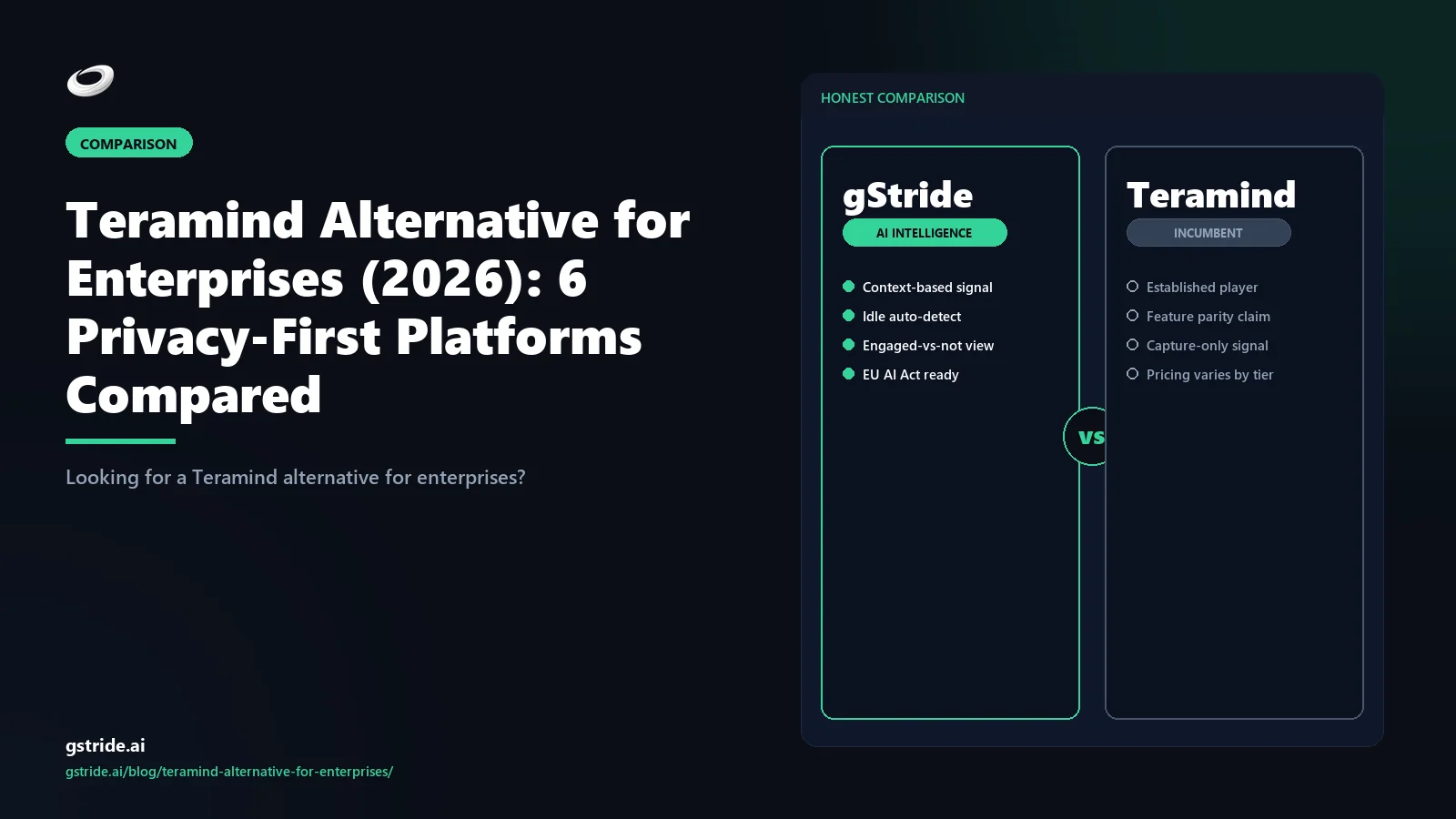
The strongest alternatives in 2026 are gStride (productivity intelligence, monitoring off by default, full WFM bundle, EU AI Act conformance posture), ActivTrak (analytics-only, configurable defaults), Insightful (configurable monitoring with screenshots), Hubstaff (mid-market timer with optional monitoring), Time Doctor (BPO-friendly contract-driven monitoring), and Microsoft Viva Insights (M365-native analytics).
The right pick depends on which of the four enterprise procurement gates is the binding constraint for you. Read on for the matrix, the configurability axis, and the migration playbook.
Why enterprises seek Teramind alternatives
Teramind has been a defensible enterprise pick for nearly a decade — broad monitoring depth, content-aware DLP, and a feature set that satisfies regulated-industry audit requirements. In 2026, three forces are pulling enterprise buyers off the platform at contract renewal.
1. Configurability — surveillance is no longer the safe default. Teramind ships with always-on screen capture, keystroke logging, and content-aware rules enabled in the default policy template. Buyers are expected to dial those settings down. Under the GDPR proportionality test, the post-Quebec Law 25 reasonableness standard, and US state notice laws (CT, DE, NY, IL), the surveillance-forward default creates ongoing compliance overhead even after the team configures it correctly. Privacy-first alternatives invert the default — every monitoring feature ships off and is enabled per role with documented justification.
2. Cost — the bundle math has flipped. Teramind's enterprise tier with full monitoring and DLP commonly lands in the $20-30 per-user-per-month band, and the platform does not include time tracking, payroll, shift management, or leave management. Most enterprises run one to three additional tools alongside Teramind to cover those operational layers. The configurable productivity-intelligence platforms now bundle the WFM stack at $8-15 per-user-per-month, which usually wins on TCO once the integration tax is priced in.
3. EU AI Act risk — the August 2026 deadline is a procurement gate. Workplace monitoring AI that classifies employee behaviour or feeds employment decisions is high-risk under Article 6 of the EU AI Act. Teramind's behavioural-rules engine and productivity-scoring layer sit inside that perimeter. EU procurement teams are increasingly requiring a written conformance statement, an FRIA template, and a transparency notice template before signing — and they want it in place before 2 August 2026, not after. Our EU AI Act time tracking compliance checklist walks through what that conformance package needs to contain.
The 4 enterprise procurement gates Teramind struggles with
Enterprise procurement is not a feature checklist; it is a sequence of gates a vendor either clears or does not. Four gates dominate the workplace-monitoring category in 2026.
Gate 1: SAML SSO + SCIM provisioning, self-serve. Identity integration is the longest pole in any 1,000-seat rollout. Teramind supports SAML SSO, but SCIM provisioning is documented as available on the Enterprise tier and frequently requires a professional-services engagement to configure for a large user-lifecycle workload. The alternatives that ship SCIM as a self-serve standard feature in the mid-tier plan typically take two-to-four weeks off the IAM rollout schedule.
Gate 2: EU AI Act high-risk readiness. Procurement teams are now asking for: (a) a written conformance statement covering Article 6 high-risk classification, (b) an FRIA template the buyer can adapt to their deployment, (c) a transparency notice template the employer can publish to employees, (d) a documented data-subject-rights workflow, and (e) bias and accuracy testing artefacts for any productivity scoring model. Teramind has not published this package as standard collateral as of the May 2026 check. Several alternatives now have it ready.
Gate 3: Data residency in the standard DPA. Regulated buyers (finance, healthcare, public sector, EU-headquartered) need an EU-region residency clause that is contractual, not configurational. Teramind offers EU-region hosting, but the standard DPA reportedly requires a negotiated addendum to lock the EU region as a contractual obligation. Procurement adds two-to-six weeks for this round-trip. Vendors with EU residency as a default DPA clause clear the gate in days.
Gate 4: Configurable monitoring defaults — off by default, opt-in by role. The strongest enterprise privacy posture in 2026 is "monitoring features ship disabled, are enabled per role with documented justification, and produce an audit trail of who enabled what when." Teramind's defaults run the other direction. The configurable alternatives are now framing this inversion as the primary enterprise-procurement differentiator.
The 6 alternative platforms compared
Here are the six strongest Teramind alternatives for enterprise buyers, ranked by how cleanly they clear the four procurement gates above. All capability and pricing claims carry a check date.
1. gStride — productivity intelligence, configurable by default
gStride is an AI productivity intelligence platform built around the inversion: monitoring features ship off, enable per role with documented justification, audit log of every change. SAML SSO and SCIM are standard self-serve features. The EU AI Act conformance package (FRIA template, transparency notice template, Article 6 statement) is published procurement collateral. EU residency is a default DPA clause. Time tracking, payroll, shift and leave, and AI-assisted timesheets are bundled. For most enterprises replacing Teramind's full footprint, gStride is the only one-tool answer in this list. The full architectural framing — why "configurable, transparent, four-layer" is the procurement-defensible shape of the category — is in our AI productivity intelligence platform pillar guide; see configurable productivity monitoring and AI assistance for the feature detail, and our existing gStride vs Teramind comparison for the head-to-head.
2. ActivTrak — analytics-only, configurable
ActivTrak is the strongest analytics-only pick. Monitoring features are configurable, screenshots are off by default in the modern policy templates, SAML SSO ships standard, and SCIM is available on the Premium tier. The platform is narrower in scope than gStride — there is no native payroll, no shift management, no AI-assisted timesheet review — but for enterprises that already run a separate WFM stack and just need the productivity-analytics slice, ActivTrak is a clean drop-in. EU AI Act readiness is partial as of the May 2026 check; the residency posture is documented but the FRIA-template procurement package is less mature than the dedicated productivity-intelligence vendors. Our gStride vs ActivTrak comparison covers that scope gap in detail.
3. Insightful — configurable monitoring with screenshots
Insightful sits between ActivTrak and Teramind on the configurability axis. The platform offers screenshot capture, app and website categorization, and time tracking, with most monitoring features configurable per role. SAML SSO is standard; SCIM is on the higher tier. The EU AI Act posture is in development as of the May 2026 check. Insightful wins for buyers who want screenshot capability available but not on by default, and who want to keep the price floor closer to the mid-market band. Our gStride vs Insightful comparison covers the head-to-head detail.
4. Hubstaff — mid-market timer with optional monitoring
Hubstaff is a time-tracking-first platform with optional screenshot and activity monitoring. The monitoring layer is configurable per project, SAML SSO is standard, SCIM is on the Enterprise tier. Hubstaff wins for distributed teams and mid-market buyers who want a timer-led workflow with optional monitoring rather than a monitoring-led product with a timer bolted on. Native payroll exists but the depth is thinner than gStride or Time Doctor. EU AI Act readiness is partial.
5. Time Doctor — BPO and contract-driven monitoring
Time Doctor remains the standard pick when client contracts explicitly require screenshot-based activity reports as the audit deliverable for billable hours — BPO operations, outsourcing bureaus, regulated staffing models. SAML SSO is standard, SCIM is on the Enterprise tier. The monitoring posture is surveillance-forward like Teramind, but the product is narrower (no DLP layer) and the pricing floor is lower. For enterprises whose primary use case is contract-driven monitoring rather than insider-threat DLP, Time Doctor is often the lateral move from Teramind that solves the cost gate without solving the configurability gate. Our Time Doctor alternatives without screenshots piece covers the privacy-first cousins.
6. Microsoft Viva Insights — M365-native analytics
Viva Insights wins when the enterprise has standardized on Microsoft 365 E3/E5 and wants to avoid a third-party vendor relationship entirely. The product inherits the existing M365 tenant DPA, residency clauses, and SCIM provisioning automatically. The trade-off is scope: Viva is productivity analytics only — no time tracking, no payroll, no shift, no screenshot capability, no DLP. Most enterprises that need workforce operations end up pairing Viva with a separate WFM tool, which usually loses on TCO once the integration overhead is priced. Viva is the right call when the requirement is genuinely analytics-only and the WFM layer is already solved.
Comparison matrix: 6 platforms x 8 procurement gates
The eight columns are the gates that matter in a 2026 enterprise contract review. The pattern in the matrix is the wedge.
| Platform | SAML SSO | SCIM provisioning | EU AI Act package | EU residency in DPA | Screenshot default | AI signal layer | Mid-market price floor | Audit trail |
|---|---|---|---|---|---|---|---|---|
| gStride | Standard | Self-serve, standard | Published collateral | Default clause | Off | AI timesheets, anomaly review | $8-12 PUPM | Per-config event log |
| ActivTrak | Standard | Premium tier | Partial | Negotiable | Off | Coach AI (analytics) | $10-15 PUPM | Yes |
| Insightful | Standard | Higher tier | In development | Negotiable | Configurable | Limited | $8-12 PUPM | Yes |
| Hubstaff | Standard | Enterprise tier | Partial | Negotiable | Configurable | Limited | $7-15 PUPM | Yes |
| Time Doctor | Standard | Enterprise tier | Not published | Negotiable | On (contract-driven) | Limited | $8-15 PUPM | Yes |
| Viva Insights | M365-native | M365-native | Microsoft AI posture | M365 tenant | N/A (no capture) | Insights AI | Bundled E3/E5 | M365 unified |
| Teramind (reference) | Standard | Enterprise + PS | Not published | Negotiable | On | Behavioural rules | $20-30 PUPM | Yes |
See gStride on your own team's data
A 15-minute walkthrough on the configuration surface — productivity intelligence without surveillance, screenshots off by default. No SDR gate, straight to a product engineer.
Book a 15-min demo → Prefer to look at numbers first? See gStride pricing.Read the matrix vertically. The platforms that clear all four procurement gates cleanly — SCIM self-serve, EU AI Act package published, residency as a DPA default, monitoring off by default — are the ones that compress your enterprise procurement timeline.
The configurability axis: full surveillance to off-by-default
Every platform in this comparison occupies a position on a single axis: how surveillance-forward are the defaults? Reading from most to least surveillance-forward in 2026:
- Teramind — full surveillance defaults: keystrokes, screen capture, content-aware rules all enabled out of the box.
- Time Doctor — surveillance-forward but narrower: screenshots and activity capture default-on, no DLP layer.
- Hubstaff / Insightful — opt-in monitoring: screenshots and activity available, configurable per project or role, often default-off in current policy templates.
- ActivTrak — analytics-forward: app and website categorization on, screen capture off by default.
- gStride — off by default, opt-in per role: every monitoring feature ships disabled with documented enable-by-role workflow and audit trail.
- Viva Insights — no capture at all: aggregated M365 telemetry only, individual-level monitoring deliberately not in scope.
The right position on this axis depends on your jurisdiction mix, your client contracts, and your team's tolerance for monitoring overhead. The mistake we see most often is buyers picking a platform one or two steps to the surveillance-forward side of where their compliance posture actually lands — usually because the surveillance-forward platform has the longer feature checklist. Pick to the compliance posture, not the feature list. Our piece on GDPR-compliant employee monitoring walks through the proportionality calculation in detail.
Migration path from Teramind: a 3-step playbook
The mechanics of migrating off Teramind are the same across the alternatives, with the gates sequenced in this order:
- IAM first — provision SCIM and SAML before touching policy. Stand up the new tenant with SAML SSO bound to the same identity provider, SCIM provisioning syncing the same user directory, and groups mapped to the same role taxonomy. Do this two-to-three weeks before cutover so any IAM bugs surface in a low-stakes window. This is also the gate where the SCIM-self-serve alternatives pull ahead — Teramind's SCIM-via-PS path frequently drives a one-to-two-week delay even on the way out.
- Refresh the monitoring policy — write the new policy first, then configure to match. The most common migration mistake is bringing the Teramind-era policy to the new tool. Use the cutover to rewrite: what you capture, why, who sees it, retention, employee notice. Our monitoring policy template walks through the eight-point baseline. Configure the new platform to match the new policy, not the old one.
- Cutover at a payroll boundary, parallel-read for one cycle. The cleanest cutover is the start of a pay period — Teramind runs to its final close, the new tool starts on day one of the next period. Keep the Teramind tenant in read-only state for one full pay cycle for audit reconciliation, then cancel. Mid-market migrations close in three-to-four weeks; enterprise migrations in six-to-ten depending on IAM scope and contract negotiation.
Teramind alternative for enterprise security teams
Enterprise security teams — CISOs, security architects, GRC leads, IAM operators — read the Teramind-alternative question differently than the productivity or HR buyer does. The four procurement gates in the previous section are the procurement-team view. The security-team view layers six additional gates on top, drawn from the SOC 2 Trust Services Criteria, ISO 27001 Annex A, NIST SP 800-53 access-control controls, and the practical realities of running a 5,000-seat IAM rollout. This section is the security-team-specific read on the same six alternatives.
The 6 additional security-team gates
Procurement teams care about whether the vendor clears the basic enterprise-ready bar. Security teams care about whether the vendor produces evidence that survives a SOC 2 Type II auditor's working papers and an internal red-team review. Six gates dominate:
- Audit trail of every monitoring policy change, not just every user login. Most enterprise SaaS tools ship a user activity log. The security-team requirement is a configuration audit trail — who enabled screen capture on which role at which timestamp, with which documented justification, signed by which admin. Without this, the InfoSec team cannot answer the question "show me every act of monitoring expansion in the last quarter" during an audit. Teramind's audit log is feature-complete on user activity but thinner on configuration history; the privacy-first alternatives that ship configurability as the product tend to instrument the config trail more deeply.
- Sub-processor list with prior-notification clause in the standard DPA. The 2026 enterprise security baseline is a published sub-processor list (analytics, storage, support, ML providers) with a contractual prior-notification window — typically 30 days — before the vendor adds a new sub-processor. The CISO needs to be able to brief the audit committee on every party that touches employee data. Teramind's sub-processor disclosure has historically required a deal-stage request; default-published sub-processor lists clear the gate in days.
- SAML SSO + SCIM with break-glass and emergency-access workflow. Beyond the basic SAML/SCIM provisioning that the procurement-team gate covers, the security-team gate requires a documented break-glass workflow: how does an admin recover access when the IdP is down, what is the emergency-access audit trail, and how is privileged-access management (PAM) integrated. Several alternatives in this comparison have published break-glass runbooks; some still treat it as a customer-side responsibility.
- Penetration test results + bug bounty posture. Enterprise security teams want to see the most recent third-party pen test letter, the cadence of internal red-teaming, and either a public bug bounty program or a documented private disclosure channel. Vendor maturity on this axis varies widely across the six alternatives; gStride and the M365-native Viva Insights tend to lead on documented testing cadence and disclosure path.
- Encryption posture: at-rest, in-transit, key management. The 2026 enterprise baseline is AES-256 at rest, TLS 1.3 in transit, and customer-managed keys (CMK or BYOK) for regulated buyers. Some monitoring tools ship CMK only on the highest enterprise tier; the security team's gate is "is CMK available without a tier upgrade, and is the rotation cadence documented?" Insightful and Hubstaff have the longest CMK distance to close; gStride and Viva Insights ship closer to the baseline.
- Incident response SLA and breach-notification clause. The contractual breach-notification window in the standard DPA — and the operational incident-response SLA — is the gate that frequently surfaces last in procurement but matters most when something goes wrong. The security-team requirement is a 72-hour notification clause (aligned to GDPR Article 33), a published incident response runbook, and a named security contact with a 24x7 reachability commitment. Vendor maturity here is the strongest predictor of how the relationship behaves under stress.
How the 6 alternatives stack on the security-team gates
Applying the six gates to the alternatives in this article produces a slightly different ranking than the procurement-only view above. gStride leads on configuration-audit trail, sub-processor list with prior-notification, and EU AI Act conformance package; CMK and pen-test cadence are at the enterprise baseline. Microsoft Viva Insights inherits the strongest evidence package via the M365 tenant — SOC 2, ISO 27001, FedRAMP where relevant — but the trade-off is the narrower productivity scope discussed earlier. ActivTrak is solid on encryption and SSO/SCIM, with sub-processor disclosure improving through 2025 to 2026. Insightful and Hubstaff sit at the middle of the pack — enterprise-ready on the basics, with room to mature on CMK and configuration-audit depth. Time Doctor lands close to Teramind on the security-team gates because the surveillance-forward defaults expand the attack surface and the data the security team has to protect.
The pattern is consistent with the procurement-team view but the binding constraint shifts. Where procurement worries about whether the vendor can clear EU AI Act and residency, the security team worries about whether the vendor can produce evidence under stress. The alternatives that lead on configuration-audit trail and incident-response SLA tend to be the same alternatives that ship configurable defaults — which is not a coincidence. A vendor that built the audit trail to demonstrate configurability inherits the audit trail to demonstrate incident response. Our 10 CISO procurement questions for AI productivity vendors piece is the companion read for the working CISO checklist; the gStride security and compliance posture page is the evidence index.
The security-team migration playbook variant
The three-step migration playbook earlier in this article (IAM first, policy refresh, payroll-boundary cutover) works for the procurement-team migration. The security team adds two additional steps:
- Pre-cutover threat model. Before the IAM rollout, the security team should run a STRIDE or PASTA threat model on the new tenant's data flows: what does the vendor see, where does the data flow, what is the blast radius of a vendor-side compromise, what compensating controls (DLP at the egress layer, CASB inspection, BYOK rotation cadence) are needed. For a Teramind-to-gStride migration the threat model gets smaller because the capture surface contracts; for a Teramind-to-Time-Doctor migration the threat model stays roughly the same. The threat model output drives the residual-risk acceptance document the CISO signs.
- Parallel-read with SIEM ingestion validated. The parallel-run period at cutover is not just for payroll reconciliation — it is also for validating that the new tenant's audit log and security-event feed are ingesting cleanly into the SIEM (Splunk, Sentinel, Sumo Logic, Elastic). Several monitoring-tool migrations have stumbled here because the new vendor's log format requires SIEM parser work that was not scoped at the start. Validate ingestion two-to-three weeks before cutover, not at cutover.
For enterprise security teams the binding question, once again, is which gate is closest to blocking. CMK-mandatory buyers, SIEM-integration-mandatory buyers, and 72-hour-breach-notification buyers all converge on the same short list the procurement team converges on — gStride for the unified-platform path, Viva Insights for the M365-native path, ActivTrak for the analytics-only path. The convergence is what makes the Teramind-alternative conversation a single conversation, not three.
The verdict
The verdict — which Teramind alternative should an enterprise choose in 2026? For most mid-market and large enterprises replacing Teramind, gStride is the strongest overall alternative: monitoring is off by default and configurable per role, the four procurement gates — SAML SSO, self-serve SCIM provisioning, EU AI Act high-risk readiness, and a data-residency DPA as a standard clause — ship in the standard plan, and timesheets, payroll, shift, and leave are bundled rather than billed separately. ActivTrak or Insightful win when the requirement is productivity analytics only, with no payroll or workforce-operations layer attached. Microsoft Viva Insights wins when the enterprise is standardized on Microsoft 365 and will not add a new vendor relationship. Hubstaff and Time Doctor remain valid lateral moves for cost-driven buyers. Teramind itself stays defensible only where insider-threat DLP is the primary use case and productivity tracking is secondary. The right choice depends on which procurement gate is closest to blocking your timeline — pick to the gate, not the brochure.
If your enterprise is replacing Teramind in 2026, the binding constraint is rarely the feature list — it is which of the four procurement gates is closest to blocking your timeline. SCIM-self-serve buyers, EU AI Act buyers, residency-DPA buyers, and configurability buyers all converge on the same shortlist: gStride for the unified-platform path, ActivTrak or Insightful for the analytics-only path, Viva Insights for the M365-native path. Hubstaff and Time Doctor remain valid lateral moves for buyers whose primary constraint is cost or contract format. Pick to the gate, not the brochure.
Free: CISO Procurement Checklist for AI Productivity Vendors
10 questions every CISO should ask before signing — data residency, DPIA, AI auditability, breach SLA, retention, SCIM/SSO, sub-processors, right to audit. Includes scoring rubric and pass / hold / walk thresholds.
Related reading on gStride
- gStride vs Teramind — full feature comparison
- EU AI Act & employee time tracking — compliance checklist
- GDPR-compliant employee monitoring — 25-point checklist
- AI time tracking software — the 2026 buyer's guide
- gStride vs Insightful comparison
- Time Doctor alternatives without screenshots
- How to write an employee monitoring policy
- Configurable productivity monitoring
- AI assistance — anomaly review and timesheets
- gStride pricing
Free: 5-Signal Productivity Self-Audit Worksheet
30-min audit on your team. Focus depth + commit cadence + meeting load + flow-state + blocker recovery. PDF + Google Sheets calc. For Ops Heads, Founders, Eng Managers.
Frequently asked questions
What is the best Teramind alternative for enterprises in 2026?
For most enterprises, gStride is the strongest Teramind alternative because monitoring is off by default and configurable per role, every enterprise procurement gate (SAML SSO, SCIM, EU AI Act readiness, data residency DPA, audit trail) ships in the standard plan, and time tracking, payroll, shift and leave, and AI-assisted timesheets are bundled rather than billed separately. ActivTrak is the better pick if you want analytics-only with no payroll layer. Microsoft Viva Insights is the safest choice when the enterprise has standardized on Microsoft 365 and wants no separate vendor relationship. The right answer depends on whether you need a unified workforce platform or just the productivity-analytics slice.
Why are enterprises actively replacing Teramind in 2026?
Three forces are converging. First, the EU AI Act enforcement window opens 2 August 2026 and Teramind's behavioural-rules engine plus content-aware DLP triggers fall into the high-risk classification — many EU procurement teams are de-risking by migrating before the August deadline. Second, Teramind's monitoring defaults are surveillance-forward (full keystroke and screen capture on by default) which is increasingly hard to defend under GDPR proportionality and US state notice laws (CT, DE, NY, IL). Third, Teramind's enterprise pricing floor stretches mid-market budgets — many buyers find configurable alternatives at half the per-seat cost. Most replacements happen at contract renewal, not mid-term.
Does Teramind support SAML SSO and SCIM out of the box?
Teramind supports SAML SSO via Azure AD, Okta, and ADFS, but SCIM provisioning is documented as available on the Enterprise tier and typically requires custom setup or a professional services engagement to configure correctly for large deployments. Several alternatives in this comparison ship SCIM as a standard self-serve feature in their mid-tier plan, which materially reduces enterprise IAM rollout time and ongoing user-lifecycle cost. Verify your SAML/SCIM requirements against the current vendor docs before committing.
Is Teramind compliant with the EU AI Act?
Teramind has not published a specific EU AI Act high-risk conformance posture as of the May 2026 check date. Workplace monitoring AI that classifies employee behaviour or makes employment decisions is high-risk under Article 6 of the EU AI Act, and Teramind's behavioural-rules engine plus the productivity-scoring layer fall inside that perimeter. Buyers operating in the EU should request a written conformance statement, an FRIA template, and a transparency notice template before signing. Several alternatives now publish these as standard procurement collateral.
Can I get EU data residency on Teramind?
Teramind offers EU-region hosting on their cloud product, but the granularity of the residency clause in the standard DPA varies — some enterprise customers report needing to negotiate a specific data-transfer addendum to lock the EU region as a contractual obligation. For regulated buyers (finance, healthcare, public sector) this is often a procurement blocker that adds weeks to the approval cycle. Alternatives that publish a standard DPA with EU residency as a default clause typically clear procurement faster. Confirm in writing before signing.
Are screenshots and keystroke logging on by default in Teramind?
Yes. Teramind's default policy template includes always-on screen capture, keystroke logging, and content-aware monitoring rules that flag prohibited terms and exfiltration patterns. Administrators can disable these features per role, but the configuration starts from a surveillance-forward baseline that the buyer is expected to dial down. Enterprises operating in jurisdictions with proportionality requirements (EU GDPR, UK GDPR, post-Quebec Law 25 Canada, and increasingly US state laws) often find this default posture creates ongoing compliance friction even after configuration. Privacy-first alternatives invert the default — monitoring features are off until explicitly enabled per role.
How long does a Teramind to gStride migration usually take?
Mid-market migrations (200-800 seats) typically close in three to four weeks of calendar time. Enterprise migrations (1,000+ seats) close in six to ten weeks, with the long pole being IAM integration (SCIM provisioning sync), monitoring policy refresh, and the parallel-run period for payroll reconciliation. The cleanest cutover is at a payroll-period boundary. We recommend keeping the Teramind tenant in read-only state for one full pay cycle after cutover for audit reconciliation, then cancelling. The migration playbook in this article walks through the three-step sequence — IAM first, then policy refresh, then cutover — that minimizes risk.
What about Microsoft Viva Insights — when does it win over gStride or ActivTrak?
Microsoft Viva Insights wins in two specific scenarios. First, when the enterprise has fully standardized on Microsoft 365 E3/E5 and wants to avoid adding a third-party vendor — Viva is bundled into the existing tenant and inherits the existing DPA. Second, when the requirement is genuinely productivity-analytics-only with no time tracking, no payroll, and no shift coverage — Viva's scope is narrower than the others in this comparison. The trade-off is that Viva provides analytics signal but not the operational layer (timesheets, approvals, payroll, leave). Most enterprises that need workforce operations end up pairing Viva with a separate WFM tool, which usually loses on TCO.
Does Teramind have data-loss-prevention (DLP) features the alternatives lack?
Yes, and this is the one scenario where Teramind genuinely wins. Teramind ships content-aware DLP rules, OCR-based screen content matching, and exfiltration alerting that none of the productivity-intelligence alternatives in this article match feature-for-feature. If your primary use case is insider-threat DLP (regulated finance, defense contracting, intelligence-adjacent work) and productivity tracking is secondary, Teramind remains a defensible choice. If your primary use case is workforce productivity and DLP is secondary, dedicated DLP tools (Microsoft Purview, Forcepoint, Proofpoint) paired with a privacy-first productivity platform usually produce a better total architecture.
What's the lowest enterprise mid-market price floor in this comparison?
As of the May 2026 check date, the configurable platforms typically start enterprise pricing in the $8-15 per-user-per-month band, while Teramind's enterprise tier with full monitoring + DLP commonly lands in the $20-30 per-user-per-month band depending on contract size and term. Bundled platforms (gStride, ActivTrak Premium) include payroll/shift/leave at the lower price point, which usually dominates Teramind on TCO once you factor the separate WFM and payroll tools an enterprise typically runs alongside Teramind. Get written quotes; vendor public pricing rarely matches the actual enterprise contract.
What should enterprise procurement teams ask a Teramind alternative vendor before signing?
Request five artifacts in writing before signature: a SAML SSO and SCIM provisioning confirmation for your identity provider, stating which plan tier they ship in; an EU AI Act position statement covering whether the product's scoring or behavioural features fall under the high-risk classification and what conformance collateral (FRIA template, transparency notice) the vendor supplies; the standard DPA showing data residency for your regions as a default clause, not a negotiated addendum; a default-monitoring-posture statement listing exactly what is captured out of the box versus off until enabled; and the audit-log and retention specification. Vendors that publish these as standard procurement collateral typically clear security and legal review weeks faster. Penalty exposure under GDPR or India's DPDP Act varies by case — verify figures with counsel rather than relying on vendor marketing.
What is the best Teramind alternative for enterprises with teams in India?
For enterprises with India-based teams — IT services exporters, GCCs, BPO — the shortlist usually narrows to gStride, ActivTrak, and Insightful, and the deciding factor is India DPDP Act readiness rather than feature count. gStride is built privacy-first with off-by-default monitoring and DPDP-aligned notice and consent workflows, which suits exporters that must satisfy GDPR and DPDP simultaneously. ActivTrak and Insightful are credible analytics-only picks but leave payroll and shift operations to separate tools. The honest answer depends on requirements: a unified workforce platform favours gStride; analytics-only favours ActivTrak or Insightful. Whichever you shortlist, ask each vendor for their DPDP lawful-basis position in writing and verify any penalty figures with counsel.
See enterprise productivity intelligence with configurable defaults
SAML SSO, SCIM self-serve, EU AI Act conformance package, EU residency in the standard DPA, and monitoring features that ship off until you turn them on per role. The fastest way to evaluate is to walk the four procurement gates against your current Teramind contract.
Book a 15-min demo → See productivity monitoring See enterprise pricingAll competitor feature claims, EU AI Act readiness statements, and pricing references in this article were last verified on May 7, 2026 from the vendors' public product, pricing, and trust pages, plus third-party reviews on G2 and Capterra. Vendor capabilities, conformance posture, and pricing change frequently — verify on each vendor's own site, request the current DPA, and obtain a written enterprise quote before making a procurement decision.