
TL;DR — when each tool wins
Pick Teramind if you need a security-led user activity monitoring platform: data loss prevention, insider-risk investigation, forensic screen playback, OCR, keystroke logging, remote control, activity blocking, and policy enforcement for regulated or high-risk environments. Teramind is closer to a security operations tool than a simple time tracker, and that depth is the point.
Pick gStride if you need productivity intelligence, automated time tracking, configurable screenshots, payroll, shift/leave/attendance, and AI-assisted timesheets without bringing a forensic monitoring stack into everyday work. gStride is the better fit for mid-market HR, operations, and finance teams that need clean timesheets and defensible visibility, not full endpoint surveillance.
The two products sit at different ends of the workforce-monitoring spectrum, and both are legitimate for the buyer they were designed for. The rest of this article is the long version of that summary — including how the EU AI Act changes the trade-off in 2026.
gStride vs Teramind — 5-criteria summary for buyers
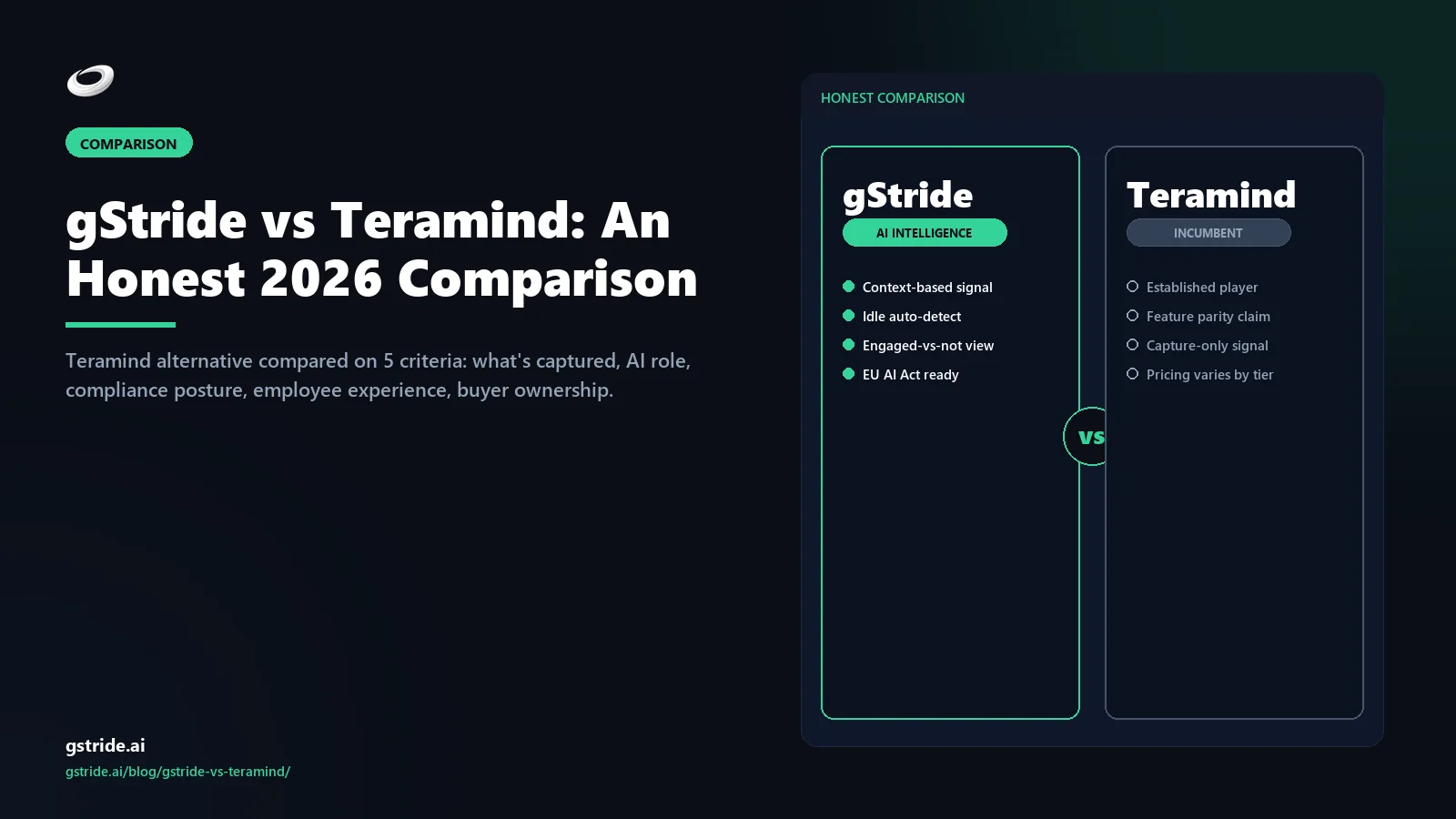
gStride is an AI productivity intelligence platform; Teramind is a surveillance-grade user activity monitoring and DLP platform. They target the same buyer search ("teramind alternative") for opposite use cases. The five procurement criteria that separate them in 2026 are: (1) what's captured — gStride reads operational signals (calendar, Git, Jira, ticketing, application focus); Teramind captures content (screenshots every 1-5 min, keystrokes, clipboard, OCR). (2) AI role — gStride uses AI for timesheet drafting, idle classification and capacity recommendations to managers; Teramind uses AI for behavior-rule scoring, anomaly detection and LLM prompt/response recording. (3) Compliance posture — gStride's data-minimisation default simplifies GDPR Article 35 DPIA, India DPDP Act 2023 consent capture, and EU AI Act Article 26 deployer obligations; Teramind's deeper capture requires more compensating controls per jurisdiction. (4) Employee experience — gStride defaults visible to employees with per-feature opt-in; Teramind's covert-capable monitoring drives the documented 90-day attrition pattern in India ITES and EU knowledge teams. (5) Buyer ownership — gStride is bought by Heads of HR, COOs and CFOs for workforce operations; Teramind is bought by CISOs and DLP/insider-risk programmes for security investigation.
| Criterion | gStride (productivity intelligence) | Teramind (UAM / DLP) |
|---|---|---|
| 1. What's captured | Operational signals — calendar density, application focus, ticket flow, Git commits, Jira state transitions, project context. No screen capture, no keystrokes, no clipboard, no OCR by default. | Content-level capture — screenshots at 1-5 min intervals, keystroke logging, clipboard contents, OCR over screen text, audio (where configured), website and app activity, file operations. |
| 2. AI role | AI for outcome-signal scoring, AI-assisted timesheet drafting, idle classification, capacity-drift detection, burnout-pattern recommendations to managers. Decisions stay human. | AI for behaviour-rule scoring, anomaly detection, insider-risk classification, LLM prompt and response recording (UAM and above), automated activity blocking and policy enforcement. |
| 3. Compliance posture | Data-minimisation default — simplifies GDPR Article 35 DPIA, India DPDP Act 2023 consent capture, EU AI Act Article 26 deployer obligations, RBI IT Outsourcing 2023 audit trail. Worker notice + per-feature opt-in. | Deeper monitoring surface — more compensating controls required per jurisdiction. Fits HIPAA forensic obligations, SOX evidence retention, financial-services DLP mandates, government chain-of-custody. Heavier DPIA workload. |
| 4. Employee experience | Visible monitoring by default — every capture is communicated to the employee. Per-feature opt-in. Aligns with proportionality-first deployment narratives. | Capable of covert and overt deployment. Comprehensive capture by default creates the documented attrition pattern in knowledge-work teams under proportionate-monitoring expectations. |
| 5. Buyer ownership | Heads of HR, COOs, CFOs, founders. Workforce operations budget. Procurement question is "how do we measure productivity without losing talent or failing compliance?" | CISOs, DLP programme owners, insider-risk teams, security operations. Security budget. Procurement question is "how do we investigate, prove, and prevent insider events?" |
See gStride on your own team's data
A 15-minute walkthrough on the configuration surface — productivity intelligence without surveillance, screenshots off by default. No SDR gate, straight to a product engineer.
Book a 15-min demo → Prefer to look at numbers first? See gStride pricing.gStride
Mid-market knowledge teams (25-500 employees) needing productivity intelligence under proportionate-monitoring constraints — Indian IT services with offshore EU/UK clients, GCC India delivery centres, regulated BFSI back-office captives, consulting India delivery pods, and any team where engineer retention and DPIA defensibility are part of the procurement filter.
Forensic insider-threat investigation, DLP-mandated workflows requiring content rules, chain-of-custody audit for fraud or HIPAA breach review, or teams that genuinely need session-replay and keystroke evidence. gStride does not provide those capabilities and won't pretend it does.
Teramind
Security-led deployments needing forensic-grade capture — financial services with explicit DLP mandates, government contractors with chain-of-custody obligations, healthcare under HIPAA insider-investigation review, regulated BPOs with client-contractual insider-risk programmes, and any environment where the security team owns the budget and the question is "what happened on the endpoint?"
Mid-market HR or operations teams that just wanted better timesheets. 5-seat minimum on Starter/UAM/DLP, surveillance-default capture, and heavier DPIA workload turn the procurement conversation into a compliance project — not the workforce-operations purchase the buyer started.
If you need surveillance-style monitoring with full forensic capture, Teramind fits. If you need productivity intelligence with consent-based signals, gStride fits. Here's the side-by-side: gStride captures operational signals (calendar, Git, ticketing, application focus) under a data-minimisation default that simplifies GDPR Article 35 DPIAs and India DPDP Act 2023 consent capture. Teramind captures content (screenshots, keystrokes, clipboard, OCR) with deeper insider-threat and DLP capabilities. Choose by buyer ownership: HR and COO buy workforce intelligence (gStride); CISO and DLP-programme owners buy investigation (Teramind). For the procurement-criterion review on data minimisation see G2's employee monitoring software category; for the EU regulatory framework see EDPB Guidelines 4/2019 on Article 6(1)(b) processing. Choose gStride for productivity measurement under privacy-first constraints — see the AI productivity intelligence platform pillar, the sibling comparison at Time Doctor alternative without screenshots, or the compliance overview at GDPR-compliant employee monitoring. Choose Teramind for content-level audit and insider-threat surveillance.
The Teramind use cases that fit gStride — and the ones that don't
Teramind's heritage is security-grade user activity monitoring. The public feature set reflects it: screen recording, live view, remote control, website and app tracking, behavior rules, activity blocking, keystroke logging, clipboard capture, file operation monitoring, and DLP controls. Teramind is a serious platform for organizations that need to know what happened on an endpoint and why — banks running fraud investigations, healthcare environments under HIPAA scrutiny, government contractors with explicit forensic obligations, and BPOs with insider-risk programmes their clients have written into the contract.
Those use cases are real, and gStride does not try to replace them. We do not offer keystroke logging, remote control, full forensic playback, OCR investigation workflows, or automatic DLP blocking. If your security or compliance team has explicitly asked for those controls, this is not the comparison page that decides your purchase — Teramind is closer to your requirement, and we would say so on a sales call too.
The buyer this comparison is written for is different. They came to Teramind because someone said "we need better time tracking" or "we need productivity visibility," and they ended up evaluating a forensic-grade monitoring platform. That mismatch is where gStride wins. We are automated time tracking, configurable productivity monitoring, AI-assisted timesheets, payroll, and shift/leave/attendance in a single bundle — designed to make a normal hybrid knowledge team easier to run, not to produce a complete behavioral record of every employee. If that describes your problem, the rest of this article walks through why the bundle matters more than the monitoring depth.
Three reasons mid-market teams move off Teramind in 2026
1. EU AI Act compliance burden
The EU AI Act does not ban employee monitoring software, and it does not single out any vendor. What it does is change the risk conversation for AI systems used in employment and worker management. The European Commission's AI regulatory framework places AI used in employment and worker management in the high-risk category, with obligations phasing in across August 2026 and August 2027 depending on the system. The AI Act FAQ sets out the deployer-side obligations: human oversight, log retention, workplace notification, and information to affected workers before use.
Either Teramind or gStride can be deployed in a compliant way. The variable is not the vendor; it is the surface area you choose to switch on and how proportionate it is to the stated purpose. A deeper monitoring surface — live view, historical playback, keystroke logs, OCR, behavior rules — is more capable, but it also creates more configuration work, more documentation, and more legal review per use case. We covered the broader posture in Is Employee Monitoring Legal?, and the policy template in How to Write an Employee Monitoring Policy walks through the documentation a deployer notification typically needs. Talk to counsel before deploying either tool in EU or UK jurisdictions; this is general information, not legal advice.
2. The 5-seat minimum and pricing math
According to Teramind's licensing knowledge base, the Starter, UAM, and DLP plans require a five-seat minimum. The practical pricing floor is therefore the five-seat cost of whichever tier you pick, regardless of how many people on your team will actually use the tool. For a four-person ops team or an early-stage product squad evaluating a Teramind alternative, that floor is the most common reason the conversation moves on.
Teramind's public pricing page currently uses a dynamic calculator that does not always render fixed dollar values in the page text we checked, so we are deliberately not reprinting Teramind's per-seat numbers here. Verify the live calculator before quoting a budget.
gStride's pricing story is simpler: one workforce-operations bundle that includes time tracking, productivity monitoring, AI-assisted timesheets, payroll, and shift/leave/attendance, sold per user. There is no fixed seat-count minimum and there is no separate payroll add-on. That does not make gStride automatically cheaper for every buyer — if you genuinely need DLP, OCR, keystroke logging, remote control, or investigation-grade playback, gStride is not a substitute for Teramind. But for the mid-market team that just wanted better timesheets and ended up at the bottom of a Teramind tier ladder, the math usually goes the other way. Current numbers live on gStride pricing.
3. Employee trust and the surveillance pullback
The third reason is cultural, and it is the one most procurement spreadsheets miss. Mid-market HR in 2026 is quietly moving away from forensic-grade monitoring after a multi-year backlash against surveillance-first defaults. The internal announcement matters: "We are using a security monitoring platform with keystroke logging and forensic playback" lands very differently from "We are using a workforce operations tool to automate time tracking, payroll, leave, and project visibility, with configurable screenshots where policy requires them." Both can be legitimate. Only one fits most HR-led deployments without an extended internal communications project.
This is the long-form argument we made in Productivity Monitoring Without Surveillance, and the short version is that defaults matter. Teramind defaults toward comprehensive visibility because that is what its core buyer is paying for. gStride defaults the other way: every monitoring feature is a separate toggle, every capture is visible to the employee, and the conservative configuration is the one that ships out of the box. For an HR or operations leader who has watched a peer company lose a senior engineer over a surveillance disclosure, the difference is not academic.
gStride vs Teramind — feature-by-feature
The table below is the honest version. Where Teramind has the deeper answer, we say so — screen recording, keystroke logs, DLP, forensic playback, and LLM-activity recording are core Teramind strengths and we do not try to match them. Where gStride is the better fit, we say that too — per-user pricing, no seat-count minimum, native payroll, shift/leave/attendance, and AI assistance pointed at timesheet quality rather than risk classification. All Teramind capability references are tagged with a check date so you can flag anything that has shifted since publication.
| Capability | gStride | Teramind |
|---|---|---|
| Automated time tracking | Yes — desktop, web, mobile, with auto-categorization | Yes — time tracking appears in the Teramind feature matrix |
| Screenshots / screen recording | Configurable — sampled, blurred, opt-in screenshots; no continuous video by default | Yes — screen recording, live view, and video playback are core Teramind features |
| Keystroke logging | No — gStride does not log individual keystrokes | Yes — available in UAM and DLP tiers per the Teramind pricing matrix |
| DLP / insider risk | Posture-only — security posture, audit logs, and access controls; not a full DLP suite | Yes — DLP tier with content rules, blocking, and sensitive-content detection |
| AI governance / LLM activity | Productivity-focused — AI for timesheets, idle classification, anomaly review | Forensic-focused — basic AI governance in Starter; LLM prompt and response recording in UAM and above |
| Native payroll | Yes — built-in, multi-currency | Not native — not positioned as native payroll on the checked Teramind pricing page |
| Shift / leave / attendance | Yes — built-in, with approvals workflow | Partial — scheduling and productivity reporting; verify exact leave-management support before quoting |
| EU AI Act deployment posture | Configurable — visible, policy-led monitoring; better fit for proportionality-first buyers | Configuration-dependent — deeper monitoring surface; compliance burden depends on configured use case and jurisdiction |
| Pricing floor | Per-user — see gStride pricing | 5-seat minimum — Starter, UAM, and DLP plans require a 5-seat minimum per Teramind licensing |
The pattern across the table is the wedge. Teramind is broader where the requirement is investigation-grade monitoring — live view, historical playback, keystroke logs, OCR, DLP rules, and LLM activity recording. That depth is the point of the product, and the buyer with a security or compliance mandate is paying for it on purpose.
gStride is broader where the requirement is workforce operations — native payroll, native shift, leave, and attendance, AI-assisted timesheets, and per-user pricing without a seat-count floor — combined with a configurable monitoring surface that defaults toward proportionality. Neither is a weak product. They are optimized for different buyers, and the right choice depends on which problem you are actually solving.
Customer profiles — who fits each tool
Teramind fits best when…
- You have a real insider-risk, DLP, fraud, regulated-industry, or forensic investigation requirement — banking, healthcare under HIPAA, government contractors, or BPOs with explicit client obligations.
- You need screen recording, live view, remote control, keystroke logs, OCR, activity blocking, or detailed policy rules.
- Your security, privacy, and legal teams already have processes for endpoint monitoring, retention, access controls, and incident review.
- The monitoring policy is part of an explicit compliance or client obligation, not a workaround for weak management process.
- You are prepared to train managers on what they may and may not infer from behavioral telemetry.
gStride fits best when…
- You need automated time tracking, productivity visibility, and payroll-ready records without a full security monitoring platform.
- You want configurable screenshots and activity signals, but not keystroke logging, remote control, DLP, or forensic playback.
- You want one operational bundle for time, projects, AI assistance, payroll, shift/leave, and attendance — with one bill and one access-control surface.
- You have fewer than five seats to license, or you do not want a seat-count floor on your spend.
- You are operating in EU or UK jurisdictions where proportionality and worker notification are central to the monitoring policy.
- You want a tool HR and operations can explain to employees without sounding like an insider-threat investigation.
Migration path: switching from Teramind to gStride
If gStride is the better fit and you already use Teramind, the migration should start with policy, not CSV files. The path most teams follow:
- Decide what not to migrate. Historical screen recordings, keystroke logs, and forensic records should usually stay in the old retention system until they expire. Moving them into a new workforce tool is rarely worth the legal or privacy burden.
- Export operational records. Pull users, departments, projects, schedules, and time entries where available. Those are the records gStride needs for continuity.
- Rewrite the monitoring policy. Do not carry a Teramind-era policy into gStride unchanged. Remove controls you no longer plan to use, document what remains, and make screenshots and activity settings explicit. Our policy guide and template is the document that operationalizes it.
- Cut over at a payroll boundary. The cleanest move is the first day of a new pay period. Close the final Teramind reporting period, then start gStride tracking with clean approval rules.
- Tell employees what changed. The switch should be positioned as a reduction in monitoring scope, not just a vendor swap. Spell out what gStride will track and what it will not track.
Most Teramind-to-gStride migrations are less technical than cultural. The real win is removing surveillance-grade instrumentation from workflows that only needed accurate time, payroll, and productivity context.
The verdict
Teramind is not a weak product. It is strong precisely where gStride is intentionally narrow: DLP, security investigation, endpoint telemetry, behavior rules, keystroke logging, live view, and forensic evidence. If those controls are mandatory for your team, keep Teramind on the shortlist and stop reading.
If you came here typing "Teramind alternative," though, you are usually one of three buyers: someone whose team has pushed back on forensic-grade monitoring, someone who has fewer than five seats and does not want to pay for ten, or someone who needs a privacy-defensible posture for legal or cultural reasons as the EU AI Act phases in. gStride is built for those three buyers. The extra visibility Teramind brings comes with extra governance — worker notices, access controls, legal review, retention policies, manager training, and trust cost — and in 2026 that governance burden is part of the purchase price, not a side issue.
The honest reality is that both tools have shipped a lot of product. The right answer is the one that matches your actual problem. If the problem is insider risk, choose the security platform. If the problem is workforce operations, choose the workforce platform. If you are still triangulating, our other 2026 comparison reads cover adjacent decisions: gStride vs ActivTrak for the activity-analytics buyer, gStride vs Hubstaff for the field-services and workforce-management buyer, and gStride vs Time Doctor for the productivity-monitoring buyer. Enterprise buyers running a formal vendor evaluation should start with our enterprise-grade Teramind alternative guide.
Free: CISO Procurement Checklist for AI Productivity Vendors
10 questions every CISO should ask before signing — data residency, DPIA, AI auditability, breach SLA, retention, SCIM/SSO, sub-processors, right to audit. Includes scoring rubric and pass / hold / walk thresholds.
Related reading on gStride
- AI idle detection vs keystroke logging — why Teramind’s keylogger fails on knowledge work
- gStride pricing — current tiers and what's bundled
- Automated time tracking — desktop, web, mobile
- Productivity monitoring — configurable per feature
- Screenshots & activity — sampled, blurred, opt-in
- AI assistance — what the AI actually does
- Payroll & payments — native, multi-currency
- Shift, leave & attendance — built-in approvals
- gStride security and privacy posture
- Is employee monitoring legal in 2026?
- Productivity monitoring without surveillance
- How to write an employee monitoring policy
- gStride vs ActivTrak — activity analytics comparison
- AI Workforce Analytics — outcomes-focused measurement primitives
- How to switch from Teramind to gStride — 2026 migration guide
- Compare gStride against 13 productivity & monitoring tools
Free: 5-Signal Productivity Self-Audit Worksheet
30-min audit on your team. Focus depth + commit cadence + meeting load + flow-state + blocker recovery. PDF + Google Sheets calc. For Ops Heads, Founders, Eng Managers.
Frequently asked questions
What is the best Teramind alternative for enterprise security teams in 2026?
The best Teramind alternative for enterprise security teams in 2026 is gStride for the productivity-intelligence use case — it reads operational signals (calendar, Git, ticketing) without screenshots, keystrokes, or OCR, cutting GDPR/DPDP exposure that surveillance-grade capture creates. Teramind stays the right tool when you genuinely need forensic DLP, insider-threat investigation, or chain-of-custody audit.
Is Teramind GDPR compliant?
Teramind can be deployed in a GDPR-compliant configuration, but the default surface — screenshot capture every 1 to 5 minutes, keystroke logging, clipboard capture, OCR — creates an extensive Article 35 Data Protection Impact Assessment (DPIA) burden under GDPR. The lawful-basis question under Article 6(1)(f) legitimate interests becomes harder as captured data categories increase. EDPB Guidelines 4/2019 emphasise the proportionality limb; Teramind's deeper monitoring surface requires more compensating controls, worker notices, and retention policies to remain proportionate. gStride's data-minimisation default (no screen capture, no keystroke logging, no audio) simplifies the DPIA significantly. Either tool can be deployed compliantly with the right policy; gStride needs fewer compensating controls. See GDPR-compliant employee monitoring for the full checklist.
What's the difference between Teramind and AI productivity intelligence platforms like gStride?
Teramind is a surveillance-grade user activity monitoring (UAM) platform that captures content — screenshots, keystrokes, clipboard, OCR — for forensic investigation, insider-threat detection, and DLP enforcement. gStride is an AI productivity intelligence platform that reads operational signals — calendar density, application focus, ticket flow, Git commits, project context — without screen capture or keystroke logging. The category difference is capture-vs-signal: Teramind answers "what did this employee do on their screen at 2:47 PM?" while gStride answers "where is this team's capacity drifting and what should the manager do about it?" Teramind fits security investigation workflows; gStride fits productivity measurement under proportionality-first compliance constraints (GDPR, India DPDP Act 2023, EU AI Act Article 26).
Is there a Teramind alternative for Indian teams in 2026?
Yes — gStride is built for Indian teams as a Teramind alternative with INR-native pricing, India DPDP Act 2023 consent capture by configuration, state-specific Shops & Establishments Act overtime caps encoded (Karnataka, Maharashtra, Telangana, Haryana/UP/Delhi), and RBI IT Outsourcing Directions 2023 audit trail for BFSI captives. Teramind's 5-seat minimum, USD-billed pricing with FX exposure, and screenshot-default capture fail Indian procurement on three vectors at once — cost floor, FX risk, and DPDP consent. For Bangalore IT services, Mumbai BFSI back-office, Pune manufacturing, Hyderabad GCC/pharma, and Delhi-NCR consulting teams, gStride answers the same workforce-visibility question with an anti-surveillance posture that passes RBI, IRDAI, and EU client AI Act addendum review.
Is gStride cheaper than Teramind?
Teramind's Starter, UAM, and DLP plans require a 5-seat minimum, so the practical floor for a Teramind deployment is the 5-seat cost of whichever tier you pick. gStride is sold per-user without a fixed seat-count minimum, which usually wins on small-team total cost of ownership. For larger teams, the answer depends on which Teramind tier you actually need — Starter, UAM, or DLP — and whether your use case requires Teramind's deeper monitoring surface. We keep the live numbers on our pricing page rather than reprinting Teramind's, since both vendors update tiers and promotions periodically.
Is gStride a Teramind alternative?
For most mid-market buyers searching "Teramind alternative" in 2026, yes. gStride covers automated time tracking, configurable productivity monitoring, screenshots, AI-assisted timesheets, native payroll, and shift/leave/attendance in a single product. Teramind's heritage is security-grade user activity monitoring, DLP, and forensic capture, so if your use case is insider-risk monitoring or regulated-industry forensic posture, Teramind is the closer fit and we'd say so. If your use case is workforce productivity intelligence with a privacy-first default, gStride is the answer.
Does gStride include DLP like Teramind?
No. gStride provides security posture, audit logs, and configurable access controls, but it is not a full DLP suite. Teramind's DLP tier includes content rules, sensitive-data detection, and blocking, which are core to its product line. If DLP is a hard requirement — for example, regulated industries with explicit data-loss-prevention controls — Teramind is the right tool. gStride sits in the productivity-intelligence and time-tracking category rather than the insider-risk and DLP category.
Does Teramind require a minimum number of seats?
Yes. According to Teramind's licensing knowledge base, the Starter, UAM, and DLP plans have a 5-seat minimum. Teramind offers monthly or annual subscription terms; the Enterprise plan is sold separately. The 5-seat minimum is the practical floor for most buyers and a common reason small teams look for an alternative.
Which is better for EU and UK employee monitoring compliance?
This depends on configuration and use case more than vendor choice. The European Commission has signalled that AI used in employment and worker management is in the high-risk category under the EU AI Act, with obligations phasing in across August 2026 and 2027. Either tool can be deployed in a compliant way with the right policy, notice, retention, and access controls. gStride's default posture — configurable monitoring, opt-in capture, visible-to-employee design — typically lines up with proportionality-first deployments. Teramind's deeper monitoring surface gives more capability but also more configuration work to keep proportionate to the stated purpose. Talk to legal counsel before deploying either tool in EU or UK jurisdictions; this is general information, not legal advice.
How does gStride compare to a competitor like Teramind on screenshot capture?
gStride does not capture screenshots by default — the system reads operational signals (calendar density, application focus, ticket flow) rather than screen content. Teramind captures screenshots on a configurable interval (typically every 1 to 5 minutes) plus event-triggered screen captures. For teams operating under GDPR, the Australian Privacy Act, or California CCPA legitimate-interest analyses, the screenshot question often determines lawful-basis defensibility — fewer captured data categories simplifies the DPIA. See G2's employee monitoring software category for procurement-criterion comparisons.
When does Teramind make more sense than gStride?
Teramind makes sense when the workflow requires forensic-grade DLP (data-loss prevention), insider-threat investigation with chain-of-custody requirements, or session-replay for compliance audits in financial services and government. Those use cases need the content-level capture Teramind ships — screenshots, keystroke history, clipboard events. gStride is engineered for the productivity-intelligence use case (work measurement, capacity planning, idle inference) and explicitly does not capture content. The choice is workflow-driven, not feature-count-driven.
Is gStride a GDPR-compliant alternative to Teramind?
gStride's data-minimisation architecture (no screen capture, no keystroke logging, no audio) significantly simplifies the GDPR Article 6(1)(f) legitimate-interest balancing test and the Article 35 Data Protection Impact Assessment, per EDPB Guidelines 4/2019. Customers running a privacy-first compliance posture across EU operations typically find the gStride DPIA template covers the proportionality limb without the carve-outs Teramind deployments require. See GDPR-compliant employee monitoring for the broader compliance framework, the AI productivity intelligence platform pillar, and the sibling Time Doctor alternative without screenshots. Both products can be deployed compliantly; gStride needs fewer compensating controls.
Three honest ways to de-risk the move
No lock-in, no sales pressure. Pick the path that fits where you are. Pricing and trial terms are on our pricing page so there are no surprises.
Run gStride alongside Teramind on one team. No card to start; see signal quality on your own data before you decide.
Start free 14-day trial →Score your current Teramind setup against EU AI Act Annex III and DPDP consent obligations — free, no email to run.
Run the free auditWe help with data export, parallel-run setup, and rollout comms. Estimate your migration cost first with the free Switch Cost Estimator.
Estimate switch costPrefer to talk it through? Book a 15-min switch review →
See gStride for yourself
Configurable monitoring, bundled payroll, AI-assisted timesheets, and a privacy posture you can defend. The fastest way to compare is to look at the configuration surface side-by-side.
Book a 15-min demo → Start free 14-day trial → View gStride pricing See productivity monitoringNo credit card · 14-day trial · cancel anytime
All Teramind feature and licensing references in this article were last verified on April 26, 2026 from teramind.co/services/price/ and the public Teramind product and licensing pages, including Teramind's licensing knowledge base. EU AI Act references are paraphrased from the European Commission's AI regulatory framework page and the AI Act FAQ; this article is general information, not legal advice. Vendor capabilities and pricing change frequently — verify on the vendor's own site before making a decision.