
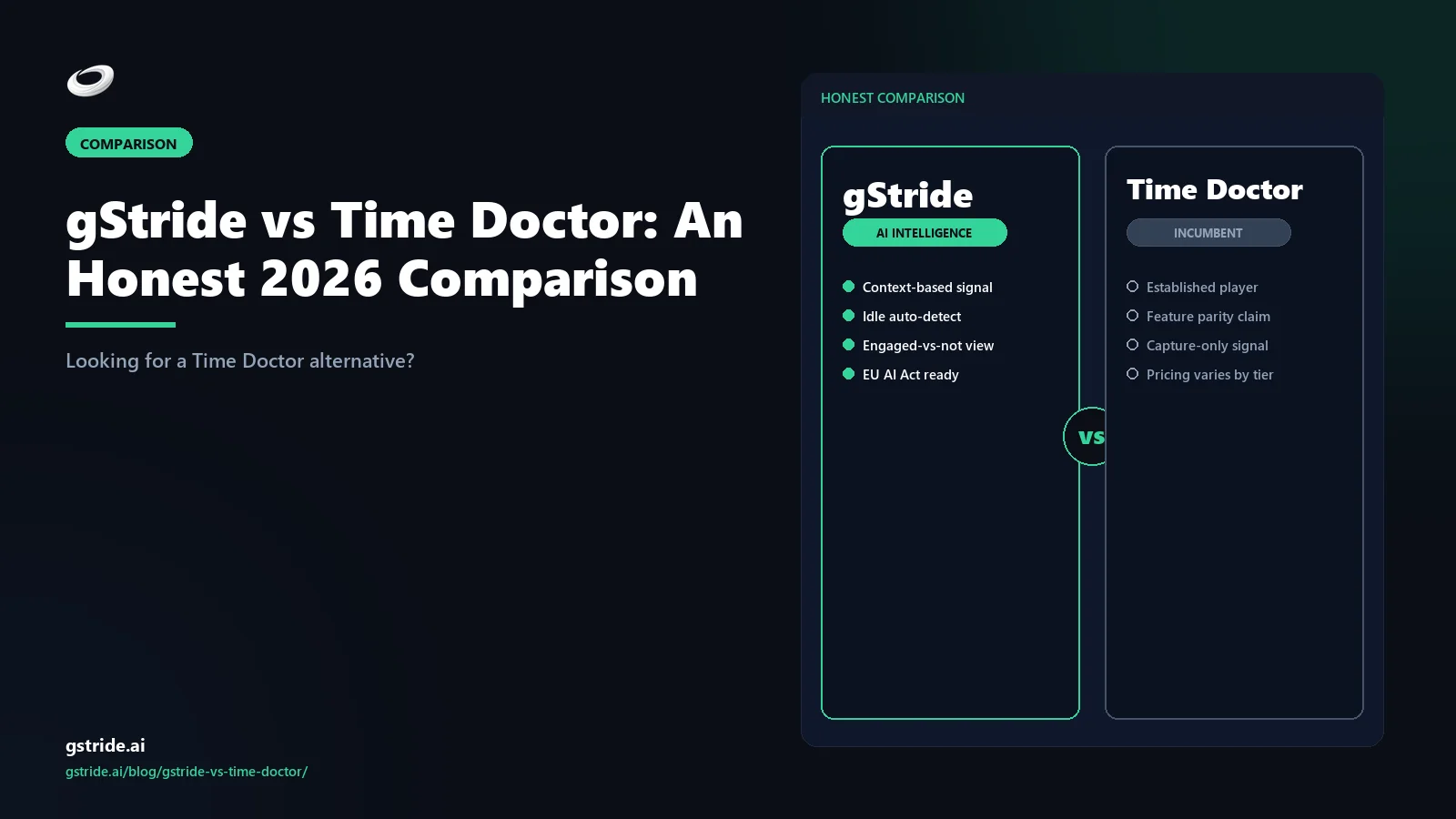
TL;DR — when each tool wins
Pick Time Doctor if you run a BPO, outsourcing bureau, or remote-first ops team where activity reporting is part of the contractual deliverable; you need screen video recording or distraction alerts as part of an explicit monitoring agreement; or you want Time Doctor's published "State of Workplace" benchmark data as a reference point.
Pick gStride if you run a hybrid or remote knowledge team that wants productivity visibility without surveillance-first defaults; you want native payroll, shift/leave, and AI-assisted timesheets bundled into a single platform; or you operate in jurisdictions where the proportionality bar (GDPR, UK GDPR) makes always-on capture hard to defend.
Both tools work; they aim at different buyers. The rest of this article is the long version.
Feature-by-feature comparison
The table below is the honest version. Where Time Doctor has a stronger answer, we say so. Where we do, we say that too. All Time Doctor capability claims carry a check date so you can flag anything that has shifted since publication.
| Capability | gStride | Time Doctor |
|---|---|---|
| Automated time tracking | Yes — desktop, web, mobile, with auto-categorization | Yes — desktop, web, mobile [time-doctor-checked-2026-04-25] |
| Screenshots | Configurable — per-user, per-project, sampled, blurred, event-triggered | Yes — fixed-interval capture, optional blur in higher tiers [time-doctor-checked-2026-04-25] |
| Screen video recording | Not offered — by design | Available in higher tiers [time-doctor-checked-2026-04-25] |
| Website / app categorization | Yes — opt-in, aggregated by default | Yes — productive/unproductive defaults, real-time classification [time-doctor-checked-2026-04-25] |
| Distraction / focus alerts | Off by default — focus-block aggregation only | Yes — real-time nudges to the employee [time-doctor-checked-2026-04-25] |
| AI-assisted timesheets | Yes — auto-categorization, idle classification, anomaly review | Partial — AI features in higher tiers [time-doctor-checked-2026-04-25] |
| Native payroll | Yes — built-in, multi-currency | Add-on / integration-led — Time Doctor integrates with payroll providers [time-doctor-checked-2026-04-25] |
| Shift / leave / attendance | Yes — built-in, with approvals workflow | Attendance reporting — leave management typically integrated [time-doctor-checked-2026-04-25] |
| Client-facing dashboards | Project-level only — per-project visibility, no client login by default | Yes — client login portals for billable transparency [time-doctor-checked-2026-04-25] |
| Privacy-first defaults | Yes — every monitoring feature toggleable, capture visible to employee | Admin-controlled — defaults toward more capture, can be tightened [time-doctor-checked-2026-04-25] |
See gStride on your own team's data
A 15-minute walkthrough on the configuration surface — productivity intelligence without surveillance, screenshots off by default. No SDR gate, straight to a product engineer.
Book a 15-min demo → Prefer to look at numbers first? See gStride pricing.The pattern in the table mirrors the wedge. Time Doctor is broader where the customer is a BPO or outsourcing org with explicit client-billing transparency in the contract. gStride is broader where the customer is a knowledge-work team that wants productivity visibility without an activity-rate dashboard or screen video recording.
Pricing comparison
As of April 25, 2026, Time Doctor publishes a tiered per-user-per-month pricing table on timedoctor.com/pricing across Basic, Standard, and Premium tiers, with Enterprise pricing on request. Higher tiers unlock features like video recording and client login portals. Specific dollar figures move with promotions and currency, so we are deliberately not reprinting them here — always verify on the live page before quoting. [time-doctor-checked-2026-04-25]
gStride uses a simpler tiered model that bundles time tracking, monitoring, AI assistance, payroll, and shift/leave at the same tier. The trade-off is the same as the Hubstaff comparison — organizations only buying time tracking will pay slightly more on a feature-light comparison; organizations buying the full bundle will pay less than they would by stitching Time Doctor plus a payroll provider plus a leave-management tool together. For current numbers, see gStride pricing.
Monitoring philosophy — the real difference
Time Doctor's heritage is workforce analytics for outsourcing and BPO operations. The product is built around the idea that employers — and often their clients — need granular visibility into the workday. Real-time distraction alerts, productive/unproductive site categorization, screen video, and client login portals are headline features and the default settings tend toward more capture rather than less. None of that is wrong; it maps directly to a contract many of their customers have to fulfill.
gStride's heritage is the opposite. The product was built for knowledge teams that wanted timesheet accuracy and project visibility without a surveillance dashboard. Every monitoring feature is a separate toggle, every capture is visible to the employee, and the default configuration is conservative. We wrote a longer piece on the philosophy in Productivity Monitoring Without Surveillance, and the policy template in How to Write an Employee Monitoring Policy is the document that operationalizes it.
The cleanest test for which philosophy fits your team is to read your monitoring policy out loud to a candidate during the hiring process. If the policy reads as proportionate and you can defend each capture, the tool you pick should match. If it reads as heavy-handed because the tool's defaults pulled the policy along, the tool is the problem.
Time Doctor alternative for remote teams
Time Doctor's design center is the BPO floor — agents on shift, screenshots and activity scoring streaming to client dashboards, real-time distraction nudges, video capture on the higher tiers. That design center maps cleanly to a contractual deliverable when the client is paying for evidence of work. It maps badly to a 30-person distributed knowledge team where the engineers are in five timezones, the designers think in deep-work blocks, and the analysts have no client portal expecting an activity report. For that buyer, the screenshot-default and real-time alert posture is the friction, not the feature. [time-doctor-checked-2026-04-25]
Distributed teams need three things Time Doctor was not built around. First, async-friendly tracking — no real-time distraction nudges that assume the user is at their desk during a synchronous shift, no expectation that work happens in continuous billable blocks. Second, a screenshot posture that defaults off rather than on, because in EU and UK jurisdictions the proportionality bar makes always-on capture hard to defend for knowledge work that has no explicit client-monitoring contract. Third, signals that survive timezone spread — calendar-aware idle classification (so a 2 a.m. compile in Mumbai is not flagged), focus-block aggregation across the team's actual working windows, and outcome metrics that work whether the engineer ships at 9 a.m. or 11 p.m. local. [time-doctor-checked-2026-04-25]
gStride is built for that buyer. Every monitoring feature is a per-feature toggle, screenshots are off by default, idle detection uses calendar context (covered in how AI detects idle time), and the bundle includes the operations layer (payroll, leave, shift) without forcing the BPO-style monitoring posture on a knowledge team. For the long-form alternative roundup — six tools compared on the remote-team feature checklist with a comparison matrix and team-size picker — the dedicated read is Time Doctor alternative for remote teams: 6 tools compared for distributed work in 2026. The short version: if your team is distributed knowledge work and your monitoring policy reads as heavy-handed because Time Doctor's defaults pulled it along, the tool is the constraint.
AI: how the two tools think about it
Both Time Doctor and gStride ship AI features. The difference is what the AI is asked to do.
Time Doctor's AI surfaces tend to focus on classification: distinguishing productive from unproductive activity, flagging anomalous behavior, and feeding a manager dashboard. The AI is a productivity classifier. [time-doctor-checked-2026-04-25]
gStride's AI surfaces focus on automation: filling in time entries from observed activity, classifying idle time intelligently (so a long compile or a thinking break is not flagged as idle), and reviewing timesheets for anomalies before they hit payroll. The AI is a timesheet assistant. We wrote about exactly how this works in the AI Assistance feature page and discuss idle detection specifically in our forthcoming blog on how AI detects idle time.
Neither approach is wrong. They serve different buyers — Time Doctor's classifier is what an outsourcing client wants to see; gStride's assistant is what a hybrid knowledge team wants to use.
Customer profiles — who fits each tool
Time Doctor fits best when…
- You run a BPO, outsourcing operation, or remote-first ops team where activity reporting is part of the deliverable to your clients.
- You need screen video recording or real-time distraction alerts to satisfy a contractual obligation.
- You rely on Time Doctor's published "State of Workplace" benchmarks as part of your reporting or strategy work.
- You have an integration stack already wired to Time Doctor's API and the cost of replatforming outweighs the feature gap.
gStride fits best when…
- You run a hybrid or remote knowledge-work team and want monitoring you can defend to engineers, designers, or analysts.
- You want time tracking, screenshots, payroll, shift and leave, and AI assistance bundled into one platform with one bill and one access-control surface.
- You operate in EU/UK jurisdictions where always-on capture is hard to defend under proportionality rules.
- You want AI features that automate timesheets rather than classify employees.
Migration path: switching from Time Doctor to gStride
If gStride is the better fit and you are already on Time Doctor, the migration follows the same pattern as any time-tracking platform change.
- Export from Time Doctor. Pull time entries, project structures, and team rosters as CSV. Time Doctor's reporting export covers most of what you need.
- Map to gStride. Our onboarding team helps map projects, teams, and time categories. CSV import handles the bulk; custom fields are mapped per-config.
- Cutover at a payroll boundary. The cleanest cutover is the start of a pay period — run Time Doctor to its final close, switch tracking to gStride on day one of the next period.
- Refresh the monitoring policy. Bringing a Time Doctor-era policy to a new tool is the most common mistake. Use the cutover to update the policy — gStride's configuration surface lets you tighten capture without losing visibility, and your team will notice immediately. Our policy guide and template walks through it.
- Communicate the change to clients (BPO/outsourcing only). If your clients are accustomed to Time Doctor-style activity reports, the change in reporting format and philosophy needs explicit communication and may require contract amendments. Plan for this; do not improvise it.
Most knowledge-team migrations close in two to three weeks. BPO migrations take longer because of client communication; budget four to six weeks if you have multiple client contracts to update.
The verdict
If you came here typing "Time Doctor alternative," you are usually one of three buyers: someone whose team has pushed back on activity scoring, someone who wants payroll and leave bundled instead of stitched together, or someone who has outgrown a surveillance-first monitoring posture. gStride is built for those three buyers. If none of them describe you — if you are an outsourcing operator with active client contracts that depend on Time Doctor's specific reporting format — there is no urgency to switch. And if you want to weigh more than two tools before deciding, our 12 Time Doctor alternatives ranked for 2026 covers the wider field.
The honest answer is that both tools have shipped a lot of product over the last decade. The right answer is the one that matches the contract you have with your team and your clients. Read your monitoring policy, list the features you actually need, and pick the tool that lets you configure to your policy without compromise.
Related reading on gStride
- gStride pricing — current tiers and what's bundled
- Productivity Monitoring — configurable per feature
- Screenshots & Activity — sampled, blurred, opt-in
- AI Assistance — what the AI actually does
- Payroll & Payments — native, multi-currency
- gStride security and privacy posture
- Time Doctor Alternative Without Screenshots — 5 tools compared
- Productivity Monitoring Without Surveillance
- gStride vs Hubstaff — sister comparison
- gStride vs Teramind — security monitoring comparison
- gStride vs ActivTrak — activity analytics comparison
- gStride vs DeskTime — screenshot tracking comparison
- gStride vs Monitask — screenshot proof-of-work comparison
- remote productivity tracking — what to measure for remote knowledge teams
- project & task management
- How to switch from Time Doctor to gStride — 2026 migration guide
- Compare gStride against 13 productivity & monitoring tools
Free: 5-Signal Productivity Self-Audit Worksheet
30-min audit on your team. Focus depth + commit cadence + meeting load + flow-state + blocker recovery. PDF + Google Sheets calc. For Ops Heads, Founders, Eng Managers.
Frequently asked questions
What is the best Time Doctor alternative for India in 2026?
The best Time Doctor alternative in 2026 is gStride, an AI productivity intelligence platform that drops screenshots and video capture for artefact-derived signals — and for India, it bundles native Indian payroll, DPDP Act 2023 residency, and INR pricing under 25,000 per month for 100 users. Time Doctor stays stronger for BPOs needing client-facing activity dashboards.
Is gStride cheaper than Time Doctor?
Both gStride and Time Doctor use per-user-per-month tiered pricing, and the answer depends on which features you need. Time Doctor's published 2026 entry tier is roughly comparable to gStride's standard plan, but gStride bundles native payroll, AI-assisted timesheets, and shift/leave management at the same tier where Time Doctor sells those features as add-ons or relies on integrations. For a knowledge-worker bundle, gStride generally lands lower on total cost of ownership; for a pure workforce-analytics deployment with existing payroll elsewhere, the two are close. Always price both tools on the actual feature set you need.
Does gStride do website and app categorization like Time Doctor?
Yes, but with a different default. Time Doctor categorizes websites and apps into productive and unproductive lists by default, with distraction alerts that nudge employees in real time. gStride supports the same kind of categorization, but the defaults are conservative — categorization is opt-in, distraction alerts are off by default, and the data flows into aggregated workload analysis rather than individual moment-by-moment dashboards. The capability is comparable; the philosophy is not.
Can I import data from Time Doctor?
Yes. gStride supports CSV import of time entries, projects, and team rosters from Time Doctor exports. Our onboarding team helps map fields if you have a custom Time Doctor setup. Historical screenshots and video recordings are not migrated by default — most customers use the cutover as a clean break, since old captures often sit outside the retention window of any updated monitoring policy. Contact our team for a migration plan if you have a complex Time Doctor configuration.
Does gStride record video like Time Doctor?
gStride does not record screen video, and we do not plan to. Continuous video recording produces large volumes of low-signal data and very high legal exposure under GDPR, UK GDPR, and most modern data protection regimes — most EU regulators have ruled it disproportionate outside narrow regulated-industry contexts. Time Doctor offers screen video capture as part of its higher tiers; if your contractual obligations actually require screen video, Time Doctor is the closer fit. If they do not, the absence of video is a feature.
Which is better for BPOs and outsourcing?
Time Doctor has historically been strong in the BPO and outsourcing market — its activity scoring, screenshots, and client-facing dashboards map directly to the contractual transparency those customers sell. If your customers expect Time Doctor-style activity reports as part of the deliverable, Time Doctor is the path of least resistance. gStride works for outsourcing teams that want a more modern privacy posture and the bundled payroll/leave/AI features, but you may need to set client expectations differently. Match the tool to the contract you have to fulfill.
What's the best Time Doctor alternative for remote teams?
For distributed knowledge teams, Time Doctor's BPO-floor design center — screenshots-default, real-time distraction nudges, video capture on higher tiers, client-facing activity dashboards — is usually the friction, not the feature. Distributed teams need async-friendly tracking, a screenshot posture that defaults off, and calendar-aware idle classification that survives timezone spread (so a 2am compile in Mumbai isn't flagged as idle). gStride is built for that buyer with every monitoring feature as a per-feature toggle and screenshots off by default. For the full roundup of six remote-team alternatives with a feature checklist and team-size picker, see our dedicated guide on Time Doctor alternative for remote teams.
Three honest ways to de-risk the move
No lock-in, no sales pressure. Pick the path that fits where you are. Pricing and trial terms are on our pricing page so there are no surprises.
Run gStride alongside Time Doctor on one team. No card to start; see signal quality on your own data before you decide.
Start free 14-day trial →Score your current Time Doctor setup against EU AI Act Annex III and DPDP consent obligations — free, no email to run.
Run the free auditWe help with data export, parallel-run setup, and rollout comms. Estimate your migration cost first with the free Switch Cost Estimator.
Estimate switch costPrefer to talk it through? Book a 15-min switch review →
See gStride for yourself
Configurable monitoring, bundled payroll, AI-assisted timesheets, and a privacy posture you can defend. The fastest way to compare is to look at the configuration surface side-by-side.
Book a 15-min demo → Start free 14-day trial → View gStride pricing See AI assistanceNo credit card · 14-day trial · cancel anytime
All Time Doctor feature and pricing references in this article were last verified on April 25, 2026 from timedoctor.com/pricing, the public Time Doctor product pages, and third-party reviews on G2. Vendor capabilities and pricing change frequently — verify on the vendor's own site before making a decision. [time-doctor-checked-2026-04-25]