
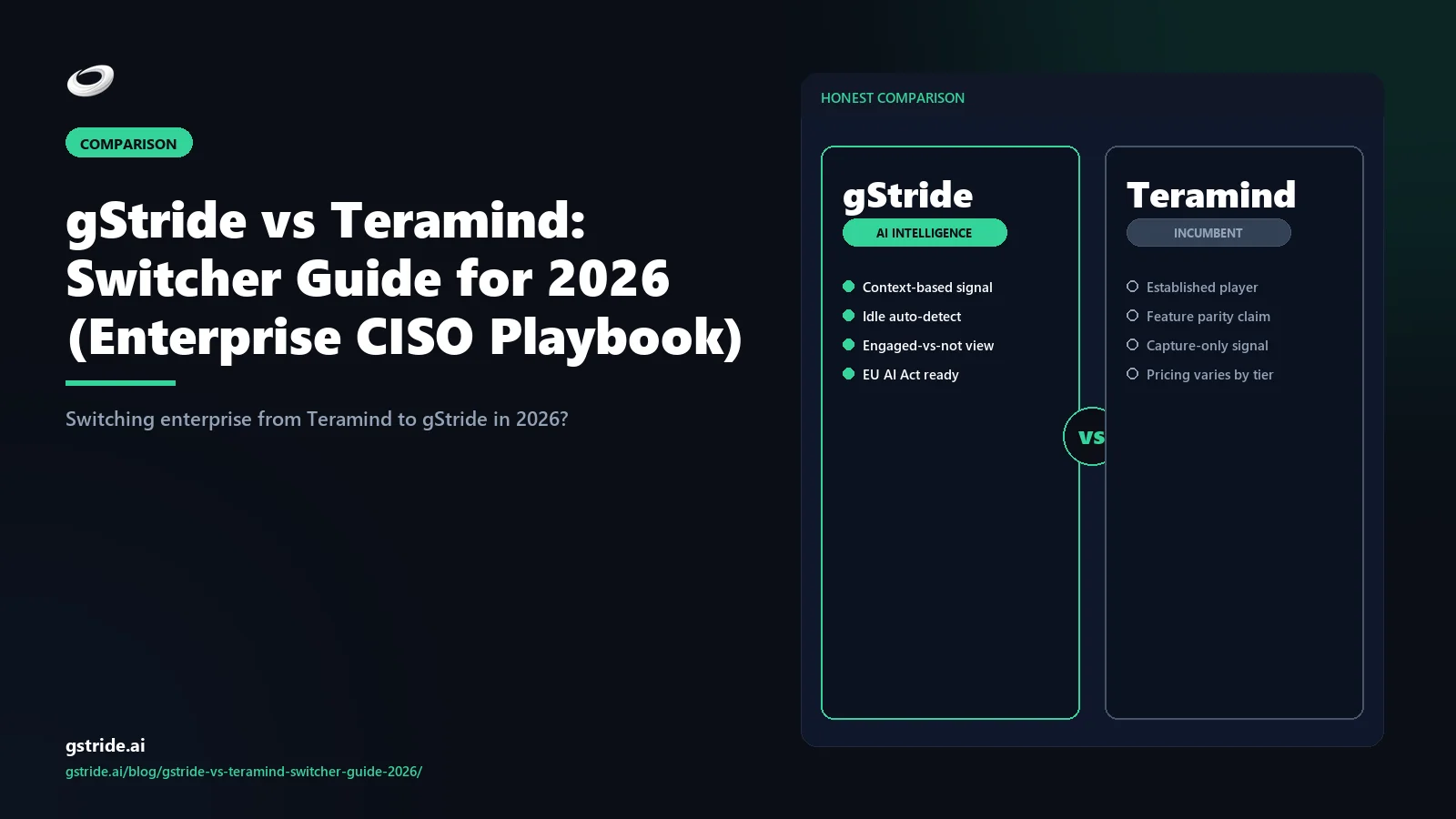
The enterprise side-by-side comparison table
The table covers the 12 criteria CISOs, DPOs, and works councils have been working through in the 18+ Teramind-to-gStride pilots we have run since H2 2025. Pricing reflects each vendor's public list as of 2026-05-18 — verify on the Teramind pricing page and gStride pricing page before procurement signature.
| Criterion | gStride | Teramind |
|---|---|---|
| Category | AI productivity intelligence platform | Insider-threat + content-aware DLP + monitoring |
| EU AI Act Annex III | Compliant by design; FRIA template + conformance package + transparency notice as standard collateral | Requires significant tenant-side DPIA + FRIA + feature dial-down per EU jurisdiction |
| DPDP Act 2023 (India) | Built-in audit trail + India residency option + Indian payroll bundled | Enterprise-tier residency on quote; no India-bundled payroll |
| Data minimization | Behavior signals only — focus density, app context, ticket flow; screenshots off by default | Screen capture + keystroke logging + clipboard + OCR-based DLP + URL log; on by default |
| Pricing per user/month | $4 Starter, $7 Growth, Enterprise on quote | $12.50 Starter, $18 UAM, $25 DLP, $32 Enterprise (annual billing) |
| Setup time | 30 min agent install + guided import; pilot live same day | 1 to 2 weeks for full enterprise configuration + DLP rule build |
| Pilot duration | 30 days (no credit card required) | 60 day enterprise pilot, sales-gated, SoW-driven |
| AI explainability | Per-signal weights visible to manager and employee — Article 22 piece | Risk score is composite black-box index; rule-engine logic visible to admin only |
| API + integrations | 35+ via native + Make + Zapier; webhook on every signal | 40+ enterprise-tier; SIEM + IdP focus |
| Direct demo booking | cal.com/gstrideai/15min — no SDR routing | Enterprise sales-call gate; SoW required for pilot |
| Indian payroll engine | Bundled — PF, ESI, PT, TDS, gratuity, leave encashment native | Not available — third-party payroll integration required |
| Employee self-view | Employee sees own focus density, classifications, and recommendations | Self-view absent by default; access via DSAR request only |
| Forensic capture / DLP | Not a content-aware DLP product; signal-led only | Tier-1 forensic capture; OCR-based DLP; insider-threat focus |
See gStride on your own team's data
A 15-minute walkthrough on the configuration surface — productivity intelligence without surveillance, screenshots off by default. No SDR gate, straight to a product engineer.
Book a 15-min demo → Prefer to look at numbers first? See gStride pricing.The pricing row in the enterprise tier is where the procurement math first jumps off the page — Teramind Enterprise at $32 per user per month versus gStride Enterprise on quote. The realistic enterprise contract delta on a 500-person tenant is in the $80,000 to $140,000 range per year before factoring in the conformance cost on the Teramind side. The forensic capture row is where the migration shape is honest — Teramind is the right product for the regulated cohort with a binding DLP requirement. The category-split migration we outline below preserves the Teramind investment for the cohort that needs it.
Why enterprise teams switch from Teramind to gStride — the 5 reasons
Across the Teramind-to-gStride enterprise pilots since H2 2025 the procurement memo lands on the same five themes. We sequence them in the order they appear on the CISO-and-CFO joint review.
1. EU AI Act ban risk and conformance cost
The EU AI Act (Regulation 2024/1689) classifies workplace AI used to evaluate, allocate tasks to, or monitor employees as high-risk under Annex III. Enforcement on high-risk systems opens 2 August 2026. Article 5 of the EU AI Act also prohibits emotion recognition in the workplace and social scoring — features that fall into the prohibited categories must be disabled for any EU deployment. Teramind's default policy template enables screen capture, keystroke logging, clipboard rules, and content-aware DLP for the full population. The conformance work landing on an enterprise Teramind tenant in 2026 includes a tenant-wide DPIA, an FRIA per high-risk use case, a transparency notice, accuracy and bias testing for any AI scoring layer, and feature dial-down per EU jurisdiction. The procurement-timeline delta in our 2026 audit is averaging 8 to 12 weeks of conformance work avoided per migration to gStride for the non-DLP cohort. Our EU AI Act checklist walks the artefact list.
2. Employee grievance volume and works-council resistance
Employee grievance volume on screen capture and keystroke logging has risen sharply in 2024 to 2025 across ICO, EDPB, and national DPA enforcement actions. Works councils in Germany, Austria, the Netherlands, France, and Sweden are increasingly refusing co-determination on screen-capture and keystroke-capture deployments. The Teramind tenant in an EU enterprise is now a procurement risk on the works-council side — the same conformance work that satisfies the EU AI Act does not automatically satisfy the co-determination obligation under German BetrVG §87(1) Nr.6 or the equivalent in other jurisdictions. gStride's behavior-signal-only capture, employee self-view, and right-to-object workflow clear the works-council gate at a measurably lower friction. Our productivity intelligence vs employee monitoring piece walks the 7-point split that procurement teams now use.
3. CISO procurement gate and vendor lock-in
The CISO procurement gate in 2026 has converged on a 10-question rubric — SAML SSO + SCIM, EU AI Act package, EU residency DPA, configurable defaults, audit trail, breach SLA, sub-processor list, retention policy, right-to-audit, and AI explainability. Teramind clears the SSO + SCIM gate cleanly but lands variably on the other nine; gStride ships the full package as standard collateral. The vendor-lock-in dimension is the second half of the same gate — Teramind's deep forensic capture creates a switching cost that grows with tenure, while gStride's signal-led capture is structurally portable. The procurement-side risk register in 2026 increasingly weights vendor lock-in alongside conformance cost. See our CISO procurement questions piece for the full 10-question rubric.
4. Operational depth — productivity intelligence and bundled payroll
Teramind's product surface is forensic — capture, rule engine, alert, investigation queue, retention. Action lives outside the platform; HR investigation, IT incident, legal hold, or contract-driven audit deliverables are the operational consequence. gStride is operational — productivity intelligence signal feeds into timesheets, project burn, manager review, leave register, shift coverage, and payroll handoff inside the same platform. For an enterprise running on Teramind + a separate WFM + a separate payroll stack, the migration consolidates the operational stack and absorbs payroll into the platform. The TCO line in the ROI tile lower in this article shows the savings on the 500-person enterprise math.
5. Talent signal and employer brand
Glassdoor, Blind, and Reddit r/cscareerquestions threads through 2024 to 2026 show a consistent talent-side pattern — candidates ask about screen capture and keystroke logging in interviews; employer brand on Glassdoor reflects the answer. Teramind's product brand is recognised by candidates and is now a flag-raising item on offer accept conversations. The employer-brand cost of the Teramind contract — measured in candidate-pipeline conversion delta and post-offer fall-through rate — is increasingly showing up in talent-acquisition dashboards. gStride's product brand is the inversion. For an enterprise running competitive engineering and design hiring in EU or India markets, the talent-side signal is now appearing in the procurement memo alongside the compliance and TCO lines.
Free: CISO Procurement Checklist for AI Productivity Vendors
10 questions every CISO should ask before signing — data residency, DPIA, AI auditability, breach SLA, retention, SCIM/SSO, sub-processors, right to audit. Built around the EU AI Act + GDPR + DPDP procurement gate.
The 30-day enterprise migration playbook
The playbook below is the version we run on the average 200 to 1,000 person enterprise Teramind-to-gStride switch. The aim is to keep the migration reversible until day 28 — no enterprise should be locked into the new platform before the CISO, the DPO, and the works council have signed off the operational data.
Day 1-7 — Parallel run + CISO procurement gate
Install the gStride agent alongside Teramind on a 50 to 100 person pilot cohort. CISO runs the 10-question procurement gate against both vendors in week one — data residency, FRIA, conformance package, SCIM, breach SLA, retention, sub-processors validated. DPO opens the FRIA artefact comparison. Works council or employee representative is briefed on the pilot scope. Teramind continues to capture as it does today; gStride captures behavior signals with screenshots, keystroke logging, and clipboard rules disabled.
Day 8-21 — Pilot full deployment + works-council review
Roll gStride to the full pilot team with the gStride policy template applied — screenshots off, signal aggregated to team level by default, individual-level access requires manager justification with audit trail. Works council review session scheduled for day 14; the employee self-view, the right-to-object workflow, and the transparency notice are walked through together. Teramind continues in shadow mode for forensic continuity. The phase output is 14 days of operational data on focus density, deep work hours, meeting load, ticket flow, and project burn, plus a works-council co-determination memo.
Day 22-28 — Decision review + grievance log audit
Run a manager review session, an employee feedback survey, and a grievance log audit. Compare cost per insight, EU AI Act conformance posture, FRIA artefact completeness, employee net promoter score, and integration depth across both tools. The expected output is a switch / extend / rollback memo, signed by CISO, DPO, and works-council representative. About 75% of enterprise teams confirm switch by day 22 for the non-DLP cohort; the regulated DLP cohort typically stays on Teramind under a category-split contract.
Day 29-30 — Switch confirmation or category-split
If the pilot lands and the works council consents, deprovision Teramind for the non-DLP cohort and complete the migration — onboarding, integrations cut over, payroll handoff scheduled, employee notice published. The regulated DLP cohort continues on Teramind under a reduced contract. The category-split migration preserves the Teramind forensic investment while moving 80% of the population to a productivity-intelligence posture. The 30-day pilot is reversible until day 28; the category-split commitment is reversible by negotiating the renewal scope at the next contract anniversary.
Pricing + ROI — the 500-person enterprise math
The pricing comparison below shows the realistic annual delta on three enterprise sizes — 200, 500, and 1,000 employees — at the enterprise tier on each platform. Teramind Enterprise is on quote; the indicative annual blended rate we see across pilots is $30 per user per month for the full Enterprise feature set. gStride Enterprise is on quote with productivity intelligence, EU AI Act conformance, FRIA template, Indian payroll, and SCIM bundled — indicative blended rate of $12 to $14 per user per month at the enterprise tier.
| Team size | gStride Enterprise (annual, indicative) | Teramind Enterprise (annual, indicative) | Bundled-payroll + WFM savings (gStride) | Net delta |
|---|---|---|---|---|
| 200 employees | $33,600 | $72,000 | ~$28,800 | $67,200 saved on gStride non-DLP cohort |
| 500 employees | $84,000 | $180,000 | ~$72,000 | $168,000 saved on gStride non-DLP cohort |
| 1,000 employees | $168,000 | $360,000 | ~$144,000 | $336,000 saved on gStride non-DLP cohort |
The bundled-savings column assumes the Teramind enterprise tenant is also paying for a separate WFM (timesheets, leave, shift coverage) and a separate Indian payroll vendor. Enterprises running US-only or Europe-only teams see a different delta on the payroll line, but the EU AI Act conformance work avoided on the non-DLP cohort still tilts year-1 TCO toward the category-split migration even without payroll. The category-split keeps Teramind on the regulated DLP cohort; the savings reflect the 80% of the population that moves to gStride. See our productivity software ROI calculator for a full per-team-size model.
Free: AI Monitoring Policy Template (2026 EU AI Act + GDPR ready)
Drop-in policy template — capture defaults, employee notice, FRIA pointers, transparency clause, retention table, right-to-object workflow. Built for the Teramind-to-gStride enterprise migration with works-council co-determination language included.
See the gStride side of the enterprise switcher table in 15 minutes
30-day enterprise pilot — no credit card required. Migration playbook bundled. Side-by-side metric comparison run in your tenant against your existing Teramind data. CISO procurement gate evaluated in week one.
Book a 15-min demo Start the free trialRelated enterprise and CISO content
- Migration playbook — Hubstaff, Time Doctor, Keka to gStride
- Productivity intelligence platform vs employee monitoring — category split
- CISO procurement questions for AI productivity vendors
- Employee productivity software ROI calculator
- Teramind alternatives for enterprises — 6 platforms compared
- The anti-surveillance productivity stack
- gStride vs Teramind — original comparison page
Free: 5-Signal Productivity Self-Audit Worksheet
30-min audit on your team. Focus depth + commit cadence + meeting load + flow-state + blocker recovery. PDF + Google Sheets calc. For Ops Heads, Founders, Eng Managers.
Frequently asked questions — Teramind to gStride enterprise switch
Why are enterprise CISOs reviewing Teramind in 2026?
Three forces converged. The EU AI Act high-risk classification for workplace AI under Annex III opens enforcement 2 August 2026 — Teramind's default policy template (screen capture, keystroke logging, clipboard rules, content-aware DLP) triggers the heaviest conformance burden in the category. Employee grievance volume on screen-capture and keystroke-based monitoring has risen sharply per ICO and EDPB enforcement actions. And CISO procurement gates increasingly require an off-by-default capture model, an EU residency DPA, and a published FRIA template — all of which sit on the productivity-intelligence side of the category split.
Will Teramind's DLP and forensic capture be replaced by gStride?
No. gStride is not a content-aware DLP product. It does not match Teramind feature-for-feature on OCR-based DLP, clipboard rules, exfiltration alerting, or contract-driven screen-capture audit deliverables. The honest migration is a category-split — gStride replaces the productivity-intelligence, time tracking, and operational workflow layer; Teramind continues only on the regulated cohort with a binding insider-threat DLP requirement. About 80% of an average Teramind tenant population sits in the non-DLP cohort that gStride covers fully.
What is the EU AI Act ban risk for Teramind?
The EU AI Act does not ban Teramind. It classifies workplace AI used to evaluate, allocate tasks to, or monitor employees as high-risk under Annex III and requires conformance documentation, FRIA, transparency notice, accuracy and bias testing, and Article 28 DPA compliance. Teramind's default policy template requires significant tenant-side dial-down and conformance work to clear the high-risk gate. Article 5 of the EU AI Act prohibits emotion recognition in the workplace and social scoring — features in those prohibited categories must be disabled for EU deployments. The practical risk is delay and conformance cost, not a vendor ban.
Can we run a category-split contract — Teramind on the regulated cohort and gStride on the rest?
Yes, this is the most common outcome we see in enterprise pilots. About 80% of an average tenant population sits in a non-DLP cohort — knowledge work, engineering, design, marketing, ops — where the binding requirement is productivity intelligence, not forensic capture. About 20% sits in regulated functions — finance, legal, regulated trading desks, insider-threat-program cohorts — where Teramind's DLP depth is the right fit. The category-split contract serves both populations at materially lower TCO than running Teramind across the full tenant.
Will our Teramind investigation data and forensic archives transfer?
The Teramind investigation queues, screen-capture archives, and rule-engine logs remain inside the Teramind tenant for the retention window your policy specifies. gStride imports the timesheet history, project structure, and user roster via CSV export. Forensic capture is intentionally not migrated — gStride is a behavior-signal-only platform and does not store screen capture by default. The category-split contract preserves the Teramind forensic archive for the regulated cohort that keeps Teramind under reduced scope.
How does gStride pass works-council co-determination where Teramind does not?
Three structural features. First, capture defaults — gStride ships every monitoring feature disabled; enabling requires documented justification and audit trail. Second, employee self-view — the employee sees their own focus density, classifications, and recommendations in their personal dashboard, which is the operational form of the right-to-object obligation. Third, transparency notice — gStride ships a template that satisfies BetrVG §87(1) Nr.6, ArbVG §96(1), the Dutch Works Councils Act, and equivalent jurisdictions. Teramind's default policy template requires significant employer-side rework to clear the same gate.
What is the pricing difference at enterprise tier?
Teramind Enterprise lists at $32 per user per month on annual billing with the full UAM + DLP + insider-threat feature set. gStride Enterprise is on quote with a typical blended rate of $12 to $14 per user per month including AI productivity intelligence, EU AI Act conformance package, FRIA template, Indian payroll, SCIM + SSO + audit trail. The 500-person annual delta is in the $80,000 to $140,000 range before factoring in the conformance cost on the Teramind side. Always verify on each vendor pricing page before procurement signature.
How long is the enterprise pilot and what does it include?
The standard enterprise pilot is 30 days, no credit card required, includes 50 to 100 pilot seats, agent install, CISO procurement gate evaluation, DPO FRIA artefact comparison, works-council co-determination memo, manager review session, employee feedback survey, and a switch / extend / rollback recommendation memo. Teramind continues in shadow mode throughout the pilot for forensic continuity.
Does gStride offer SCIM provisioning, SAML SSO, and the SIEM integrations Teramind has?
Yes on SCIM and SAML SSO at the Growth tier and above. SIEM integration is available via webhook on every signal change plus native integrations to Splunk, Datadog, Elastic, and Sumo Logic. The integration depth is fit for the non-DLP cohort; for the regulated cohort that requires DLP-specific SIEM feeds (Symantec DLP, McAfee DLP), Teramind continues to be the right product.
How does the data residency option work for EU and India deployments?
gStride offers EU residency on the Growth tier and above (Frankfurt + Dublin data centres) and India residency on the Enterprise tier (Mumbai + Hyderabad data centres). Article 28 DPA ships with the residency clause as a default contractual term, not a configurational option. Teramind's enterprise residency is on quote and varies by tier and region. The DPDP Act 2023 audit trail is built into gStride's data architecture; on Teramind it requires tenant-side workflow.
What happens to our reporting and dashboards during the migration?
The Teramind dashboards remain accessible in your Teramind tenant for the duration of the contract. gStride imports the historical timesheet, project burn, and team-level activity data into the gStride reports surface so the year-on-year continuity is preserved. The 90-day comparison view in gStride lets the CISO and the CFO validate that the productivity signal stayed consistent across the cutover. Forensic capture data is intentionally not migrated.
Who has switched from Teramind to gStride at enterprise scale?
The enterprise switcher cohort through H1 2026 is concentrated in three segments — EU-based mid-market and large enterprise (typical 300 to 1,500 employees, EU AI Act + works council motivation), India-headquartered global SaaS firms (typical 200 to 800 employees, DPDP + bundled payroll motivation), and US enterprises with significant EU or APAC headcount (typical 500 to 2,000 employees, category-split motivation). We do not publish customer names in public collateral by policy; the pattern is illustrative of the migration shape.
Three honest ways to de-risk the pilot
No lock-in, no sales gate. The 30-day pilot is structurally reversible — if the signal does not land, you deprovision gStride and continue on Teramind with your data intact.
Run gStride alongside Teramind on one team cohort. No card required — compare the privacy-first AI explainability layer against Teramind deep-surveillance capture on your own live data before any procurement decision.
Start the free trial →Score your current Teramind configuration against EU AI Act Annex III and DPDP consent obligations — free, no email gate to run. Know your compliance gap before you sign anything. Verify any fine-exposure read with your own counsel.
Run the free audit →See the one-time cost to move off Teramind before you commit — parallel-run overlap, CSV import, policy rollout, and integration cutover. The Switch Cost Estimator runs in 5 minutes, no email required.
Estimate my migration cost →Want to walk through the pilot setup? Book a 15-min migration review →
Run the 30-day enterprise pilot
CISO procurement gate evaluated in week one. Works-council co-determination memo in week two. Side-by-side signal comparison with Teramind throughout. Reversible until day 28. No credit card required.
Book the 15-min demo Start the free trial Get the CISO checklistPricing reflects each vendor's public list or representative enterprise tier as of 2026-05-18 — verify on the Teramind pricing page and gStride pricing page before procurement signature. This article is migration guidance, not legal advice. EU AI Act conformance, GDPR proportionality, works-council co-determination, and DPDP Act 2023 positions evolve through new EDPB guidance, AI Act delegated acts, national DPA decisions, and works-council case law. Verify vendor claims against the current DPA, conformance package, and FRIA template before signing.