
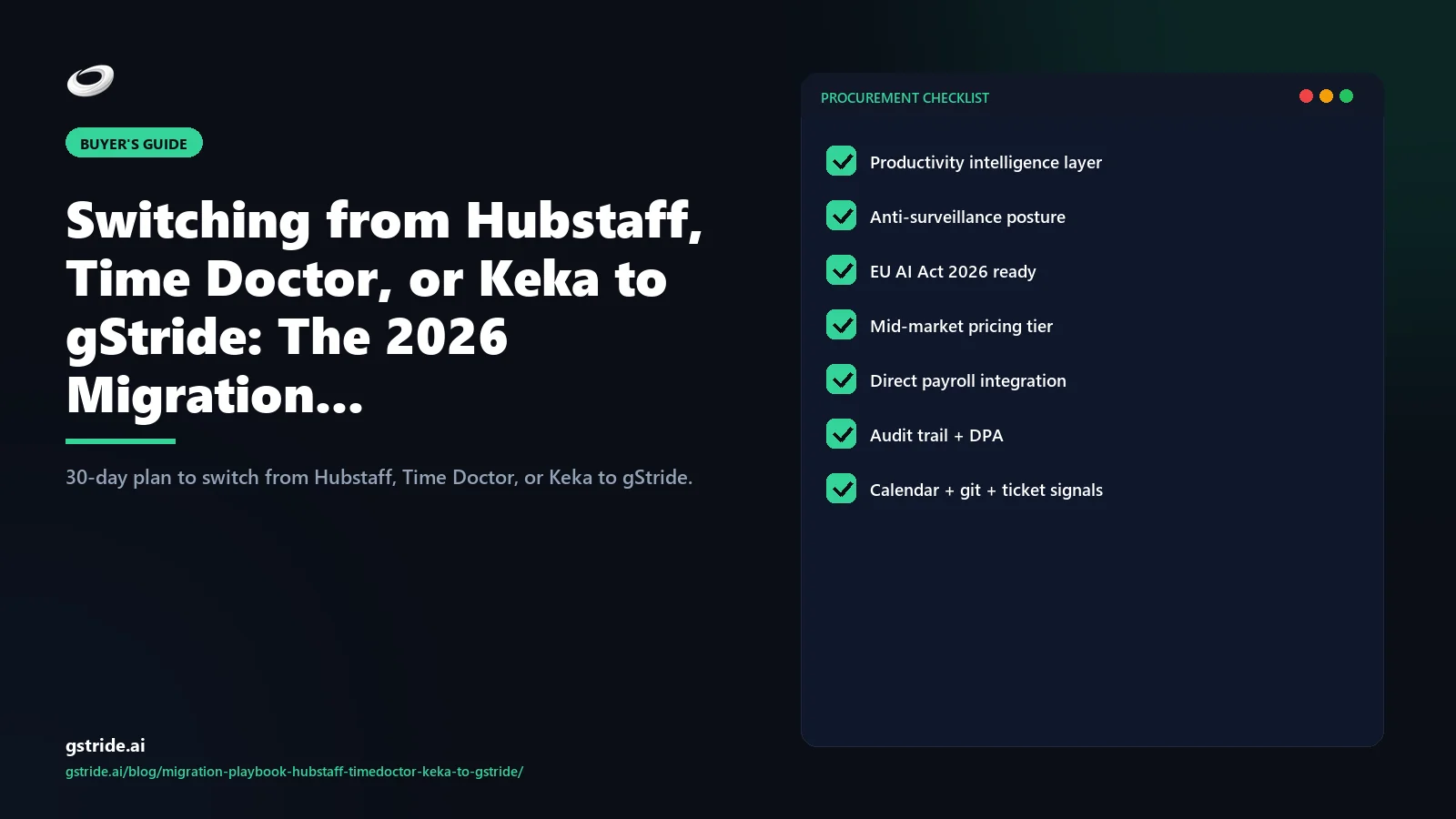
TL;DR
Switching productivity platforms is not the technical problem most buyers think it is. The hard parts are the data you cannot export, the integrations you forgot you depended on, and the policy update most teams skip. This playbook breaks the work into four phases over 30 days, with vendor-specific gotchas for Hubstaff, Time Doctor, and Keka, and a switching-cost calculator that most India mid-market teams pay back inside four months. Model your own number with the free Switch Cost Estimator.
- Days 1-3: export everything from the current vendor — time entries, projects, roster, integrations, report templates.
- Days 4-7: stand up the gStride sandbox, wire integrations, run a two-person employee preview.
- Days 8-14: parallel-run week — both tools live, compare audit trails and data parity.
- Days 15-21: cutover, manager onboarding, employee training, monitoring policy refresh.
- Days 22-30: decommission the old vendor, archive exports, rebuild reports, import aggregate history.
Why do teams stay on broken productivity vendors longer than they should?
In every late-stage evaluation call we run, the same hesitation surfaces. The buyer agrees gStride solves the pain points they have. They have done the ROI math. They have looked at the honest shipped-vs-roadmap matrix. Then they stall, and the stall is almost never about features or price. It is about switching anxiety. Five forces specifically: data they think they cannot get out, training they have already paid for, integrations that took a quarter to land, audit-trail history they cannot afford to lose, and the political cost of telling employees a tool is changing again.
The training sunk-cost is the loudest. Teams who spent two weeks onboarding the entire workforce onto Hubstaff or Time Doctor 18 months ago do not want to repeat that exercise. The math actually goes the other way — the legacy onboarding is a cost already spent, and the time to switch a 50-100 person team to a better tool is usually under three days of net employee time, but that is not how it feels in the moment. The audit-trail concern is the most legitimate one. Teams under DPDP, GDPR, or enterprise client SLA obligations carry historical access logs, screenshot records, and timesheet edit trails they need to retain for two to seven years depending on the regime. Most of this is exportable to cold storage; almost none of it needs to live inside the new platform. If you also need scoring fidelity carried forward — not just retention — see our AI timesheet scoring methodology for how the enterprise scoring layer ingests historical capture data without dragging the surveillance footprint with it.
The integration tax is the most underestimated. Hubstaff connects to Slack, Asana, Jira, GitHub, ClickUp, QuickBooks, PayPal, and Wise out of the box. Time Doctor connects to a similar list — see our Time Doctor alternative for remote teams for the integration delta on the gStride side. Keka connects to most Indian payroll banks, biometric devices, and HRIS endpoints. Teams quietly grow dependent on these wirings without inventorying them, and discover the dependency only when they start the export. The playbook below explicitly catalogues integrations on day one so nothing is a surprise on day fifteen.
What do you lose and gain when switching from Hubstaff or Time Doctor?
The honest accounting matters because vendor sales decks tend to overpromise on both sides — incumbents claim irreplaceable history, challengers claim costless switch. Neither is true. The real picture for a Hubstaff, Time Doctor, or Keka team moving to gStride looks like this.
What you lose
- Existing report templates — most need to be rebuilt in gStride's reporting surface, though the underlying data is portable
- Current integrations as wired today — replaced with gStride equivalents, with one to three connector gaps per stack typically
- Employee muscle memory for the legacy UI — most adapt inside a week, with a 15-minute walkthrough
- Vendor-specific scripts and automations — anything built on Hubstaff/Time Doctor APIs needs porting
- Raw screenshot history — vendor-proprietary blobs do not export; treat as a privacy reset
- Keystroke-frequency records — same as above, and arguably good to lose
What you gain
- AI-explainable productivity scoring with audit-trail per signal — the explainability layer matters under EU AI Act and DPDP
- 4-layer architecture (capture, signal, recommendation, action) instead of capture-only
- Privacy-first defaults — screenshots off, configurable per role, inspectable by employee
- Bundled Indian payroll (PF, ESI, PT, TDS) for India teams
- INR pricing, IST defaults, Indian financial year alignment
- Year-long longitudinal productivity view — the feature most replacing-buyers cite as the single biggest gain
- SSO, SCIM, DPA, configurable retention windows from day one
The asymmetry is real. The losses are recoverable or by-design positive (screenshot history, keystroke records). The gains compound — every quarter of operating on the new architecture widens the gap.
The 30-day migration playbook
This is the operational plan we walk customers through. It is conservative on the timeline — fast teams compress it to 21 days, deliberately careful teams stretch it to 45. The phases below assume a 50-150 person workforce; smaller teams move faster, larger teams need an extra parallel-run cycle.
Export everything from the current vendor
Pull a complete data dump from your existing vendor. The deliverables for end of day 3 are:
- Time entries: CSV export of the last 12-18 months of time-entry records, project tagging, and edit history.
- Project structure: client list, project list, task taxonomy, billable/non-billable flags.
- Team roster: employee list with roles, managers, departments, start dates, and current monitoring policy assignments.
- Integration inventory: every active integration in the current vendor — payroll, project tool, calendar, communication, biometric, banking. Note the auth method (API key, OAuth, webhook) for each.
- Report templates: screenshots of every recurring report your finance or HR team pulls from the legacy tool. These get rebuilt in gStride, not migrated.
- Audit trail / access log: if you have a regulatory retention requirement, export the access log to cold storage now, not later.
Also catalogue what does not export. Screenshot histories, keystroke records, and vendor-specific AI scores typically do not. Document this as a known gap so it does not surface as a surprise on day fifteen.
gStride sandbox setup, integration test, employee preview
Provision a sandbox workspace. Configure the four defaults that matter on day one: timezone (IST for India teams), financial year (April-March in India), monitoring posture (configurable per role, screenshots off as default), and retention window (30-90 days based on your DPDP or GDPR commitment).
Wire the replacement integrations one at a time. Test each before moving on. The order that works: SSO first, then HRIS, then project tool, then communication, then payroll. Payroll last because it is the most consequential and you want everything else stable before touching it.
Run a two-person employee preview at end of week 1. Pick one manager, one individual contributor. Give them gStride for a day. The feedback from this 1-day preview catches more configuration mistakes than three weeks of internal admin testing.
Parallel-run period
Both tools live for one full week. Everyone captures time in both. This sounds like double-work and is — for one week. It is the cheapest insurance policy in the playbook.
What to compare during this week: total hours captured (must reconcile within 2%), idle classification (gStride should flag fewer false positives than Hubstaff/Time Doctor), report parity for the top 3 recurring reports, and audit-trail completeness on sample time-entry edits. If anything is off by more than 5% on any of these, fix the configuration before week 3 cutover.
The parallel-run week is also where your monitoring policy update gets drafted. The new policy needs to be written, reviewed by legal (or a qualified advisor), and circulated as a 14-day notice. Day 8 is when the notice clock starts.
Full cutover, training, manager dashboard onboarding
On day 15, gStride becomes the system of record. The old vendor goes read-only — admin access revoked, capture disabled, but the dashboard still queryable for reference. The cutover should land on the start of a payroll week or month, never mid-cycle.
Manager onboarding is 60 minutes, covering the productivity dashboard, the dispute and edit flow, and the audit-trail surface. Employee training is 15 minutes, ideally in small groups (10-12 people), with a written one-pager handed out. Skip the company-wide town hall — those are theatre, not training.
The monitoring policy refresh lands this week too. New consent recorded, new notice sent, the data-processor change formally documented if you are under DPDP or GDPR. Most teams treat this as a checkbox and regret it later; bake it into the week 3 plan and it stays cheap. India IT services teams cutting over ahead of the DPDP Rules notification window should pair this step with the consent and notice posture documented on our DPDP-compliant productivity intelligence platform page for India IT services so the new policy lands aligned with Section 5 notice templates and Section 6 self-serve withdrawal from day one.
Decommission, archive, audit-trail import, report rebuild
Cancel the old vendor at the next natural billing boundary. For Hubstaff and Time Doctor this is the end of the month; for Keka it depends on the contract anniversary. Do not cancel before week 4 — you may still need to pull a forgotten report.
Archive the exported CSVs from week 1 into your long-term audit storage. Tag them with the retention period required by your regime — typically two years for India DPDP, six years for UK GDPR with financial records, seven for SOX-adjacent contexts.
Import aggregate history into gStride where it makes sense: utilization baselines per employee, attendance patterns per shift, project-level effort distribution. Do not import the granular time-entry history — it bloats the new workspace without adding signal. The aggregates are what your reviews and audits actually use.
Rebuild the top 3 recurring reports in gStride. Compare against the legacy version one final time. By end of week 5 (yes, this slides into a fifth week often), the old vendor is fully decommissioned and gStride is operating standalone.
Vendor-specific gotchas
The phases above are universal. The vendor-specific texture is where most teams get tripped up. Three gotcha lists below for the three most common origins.
From Hubstaff
Three Hubstaff-specific traps. First, screenshot retention history: Hubstaff retains screenshots for up to 90 days on most plans, longer on enterprise. These do not export as image files in a usable way. Treat the migration as the moment to stop retaining screenshots at all — gStride's privacy-first defaults make this easier than it sounds. Second, INR billing transition: Hubstaff bills in USD even for India customers. When you cancel, the cancellation processes in the next USD billing cycle. Time the cutover so you are not paying for an extra USD month. Third, mobile-app data: Hubstaff's mobile app captures GPS for field-services teams. If you have any field staff in the workforce, document what GPS data you are losing and whether that matters operationally. For most India IT services teams it does not, but for any field-services slice it might. See our full Hubstaff comparison and Hubstaff alternative for India for the deeper feature delta.
From Time Doctor
Three Time Doctor-specific traps. First, keystroke data deletion: Time Doctor retains keystroke-frequency records by default. These are sensitive under DPDP and GDPR. Before cutover, formally request deletion from Time Doctor under your existing data-processor agreement — get it in writing. Do not just stop the subscription and assume the data is gone. Second, task-level history: Time Doctor has a deep task structure that does not 1:1 map to gStride's project structure. Plan a 2-3 hour mapping exercise during week 2 to translate tasks into projects+tags so reporting continuity holds. Third, browser-extension uninstall: Time Doctor uses a browser extension that captures URL-level activity. The uninstall needs to happen on every employee laptop during week 3. Without it, you will see ghost capture in the gStride dashboard from the still-running extension. For the deeper feature comparison, see gStride vs Time Doctor and Time Doctor alternative without screenshots.
From Keka
Keka migrations are different because Keka is a full Indian HRMS, not a time tracker. Three Keka-specific traps. First, Indian payroll continuity: PF UAN, ESI IP number, PAN, and state-for-PT must transfer cleanly. Run a dry-run payroll in gStride for the prior month and reconcile against the actual Keka payroll for that month — match within 1% on every employee before you switch primary payroll. Second, EPF/ESIC/PT continuity: the ECR challan generation cadence matters. Time the cutover so you do not skip a month of PF or ESI filing — both attract penalties under the EPF Scheme 1952 and the ESI Act 1948. Third, leave balance preservation: earned leave, sick leave, casual leave balances, and the gratuity clock all need carrying across. Keka exports leave balances cleanly but the comp-off accrual rules and the year-end carry-forward logic are configured differently in gStride — plan a configuration session with your HR partner during week 2 to align the policies before any balances move.
What are the five most common migration-week failures and how do you prevent them?
- Parallel-run week shows >5% data drift. Cause is usually misconfigured idle thresholds or project mapping mismatch. Prevention: do the 2-person employee preview in week 1 — most drift sources surface there.
- Payroll dry-run does not reconcile. Cause is usually missing UAN, IP, or PAN data for new joiners since the last full HR sync. Prevention: pull payroll master data from HR (not from the legacy tool) on day 1 and treat it as canonical.
- Employees push back on the cutover. Cause is almost always missed or rushed notice. Prevention: 14-day written notice, single FAQ channel, one-page document, no surprises. The cheapest line item in the migration; the one most teams cut.
- Manager dashboards do not match legacy reports. Cause is the legacy reports embedded calculations that did not transfer. Prevention: capture screenshots of the top 3 recurring legacy reports during day 1-3, rebuild them explicitly in week 4 against the same sample period, compare line-by-line.
- Old vendor refuses clean exit or holds data hostage. Rare but happens. Prevention: read the cancellation clause in your current contract before starting the migration. If there is a multi-month notice period, start the notice clock on day 1, not day 22. Also ensure the data export happens during week 1 while you still have full admin access.
What does switching from a legacy productivity tool actually cost?
Numbers from an anonymised 64-employee Bengaluru BPO that completed this migration in March 2026 (off Hubstaff plus a separate Indian payroll vendor onto gStride). Migration owner spent roughly 25 hours across the 30 days; HR partner 10 hours; IT 5 hours. Loaded internal labour cost approximately ₹1.3 lakh. No external consultant.
The annual saving was on the platform fee line and the reconciliation labour line. Hubstaff at ~$10/user/month for 64 users ran ~$640/month or roughly ₹54,000/month; the separate Indian payroll vendor at ₹100/user/month ran ₹6,400/month; reconciliation labour between the two systems was 3-4 hours per month at roughly ₹4,000 of finance time. Total stitched-stack monthly cost was approximately ₹64,000-65,000 or ₹7.8 lakh annually.
gStride for the same 64 users at ₹199/user/month is roughly ₹12,700/month or ₹1.53 lakh annually . Bundled — no separate payroll vendor, no reconciliation labour. Annual saving on platform fees alone is approximately ₹6.3 lakh.
Switching cost ₹1.3 lakh. Annual saving ₹6.3 lakh. Payback inside three months. The full ROI walkthrough with your own team size is in the employee productivity software ROI calculator.
Five-question pre-switch checklist
Run these five questions before you commit to a migration date. If any one returns a fuzzy answer, fix the answer before the kickoff, not during.
- Data export rights: does your current contract with Hubstaff, Time Doctor, or Keka entitle you to a full CSV export of historical data on cancellation? If not, when was the last export taken and how stale is it?
- Integration list: have you written down every active integration in the current vendor? Which ones have a 1:1 replacement in gStride, which need workarounds?
- Employee comms plan: who owns the 14-day notice, the FAQ document, and the single dedicated channel for employee questions? When does the notice go out?
- Parallel-run budget: can you afford one week of paying both vendors simultaneously? For most teams this is a few hundred to a few thousand rupees of overlap and worth it; if not, the parallel-run week needs to compress to 3 days.
- Audit-trail requirement: what is your regulatory retention obligation — DPDP, GDPR, SOX-adjacent, client SLA? Is the legacy access log archived to cold storage before cancellation?
Frequently asked questions
Can I keep my old timesheet history when I switch from Hubstaff or Time Doctor to gStride?
Yes, in aggregate form. Both Hubstaff and Time Doctor allow CSV export of historical time entries, project structures, and summary reports. gStride imports the CSV as a reference dataset attached to each employee, so you keep the longitudinal history for reviews, audits, and utilization baselines. What does not transfer cleanly is raw screenshot history and keystroke-frequency records — those are vendor-proprietary blobs and most teams treat the migration as a clean privacy reset rather than dragging the surveillance footprint forward.
Is my employee data secure during the migration?
The migration window itself is when most data exposure incidents happen. Three precautions matter. First, export CSVs into encrypted storage, not a shared drive or an unencrypted laptop. Second, restrict sandbox access during weeks 1 and 2 to the migration owner and one IT delegate, not the whole HR team. Third, after week 3 cutover, set the old vendor to read-only and revoke admin credentials for everyone except the audit owner. gStride enforces SSO and audit logging on the new workspace from day one, so the destination is more locked down than the source for most teams.
How long is the downtime during cutover?
Zero — if the playbook is followed. The parallel-run week (days 8-14) means both tools are live simultaneously, so the switch to gStride as the system of record on day 15 is a configuration change, not a service outage. Employees see capture continuing without interruption. The only operational window that requires care is the payroll cut-off in week 3-4, which is why the playbook recommends cutting over at the start of a payroll month rather than mid-cycle.
What happens if the pilot fails mid-migration?
The parallel-run week is the explicit checkpoint. If the gStride configuration is not producing parity timesheets, integration data, or report outputs by day 12 — extend the parallel-run by another week before cutover. If by day 21 the gap is still material, roll back: cancel the gStride sandbox, keep the old vendor live, and run a post-mortem before the next attempt. Rolling back is not failure; failing to detect the gap and pushing through is. The contract structure with gStride accommodates a 30-day exit window for exactly this reason.
Will my employees need retraining on a new interface?
The core capture flow is intentionally close to what employees already do — start the day, optionally tag projects, end the day. The training that matters is for managers, not individual contributors. Most teams budget a 60-minute manager onboarding session in week 3 covering the productivity dashboard, the dispute and edit flow, and the new audit-trail surface. Employees get a 15-minute walkthrough plus a written one-pager. We deliberately do not gate access on training — that pattern increases adoption friction without improving outcomes.
Can I migrate from Keka without breaking payroll continuity?
Yes, but Keka migrations are different from Hubstaff or Time Doctor migrations because Keka is a full HRMS, not a time tracker. The continuity work is in PF, ESI, Professional Tax, and TDS records — UAN per employee, IP number for ESI-eligible staff, PAN for TDS, and state assignment for PT. The playbook day 4-7 step is where this master data is imported into gStride. Leave balances, comp-off accruals, and the gratuity clock all need to carry across without resetting. We have a separate Keka-specific module of the migration runbook that the success team uses; ask for it on the discovery call.
What is the realistic switching cost for a 50-100 person team?
For an anonymised 64-employee Bengaluru BPO that switched in early 2026, the switching cost was roughly 40 hours of operations time across the migration owner, HR partner, and IT — about ₹1.2-1.5 lakh of internal labour at typical loaded cost. The annual saving from consolidating Hubstaff plus a separate Indian payroll vendor onto gStride was around ₹3.5-4.5 lakh per year on platform fees alone, before counting reconciliation labour. Payback was inside four months. Numbers vary by team size and current stack; the ROI calculator linked at the bottom of this article walks through your own math.
Do I need to give employees notice before switching?
Yes, for two reasons. Regulatory: India's Digital Personal Data Protection Act 2023, GDPR Article 13 if you have any EU staff, and the UK ICO guidance all require fresh notice when the data processor or processing posture changes. Operational: switching the tool that captures their working day without telling people is a trust-destroying event. The playbook builds in a written notice 14 days before cutover, a one-page FAQ document, and a single dedicated channel for employee questions. This is the cheapest line item in the migration and the one with the highest payoff.
Free: Employee Monitoring Policy Template (2026)
An 8-section .docx/.pdf shell aligned to GDPR Article 13, EU AI Act, UK ICO 2023, and DPDP — drop it into your handbook, edit placeholders, run it past counsel. Free, no card.
Related reading on gStride
- gStride vs Hubstaff: full feature-by-feature comparison
- gStride vs Time Doctor: full feature-by-feature comparison
- Hubstaff alternative for India — PF/ESI/TDS + INR pricing
- Time Doctor alternative without screenshots
- What gStride ships today vs roadmap — honest coverage matrix
- Employee productivity software ROI calculator
- AI workforce analytics — the 4-layer architecture (Pillar)
- The anti-surveillance productivity stack (Pillar)
- See the IT services solution — vertical fit for India IT services firms after migration
Three risk-free ways to start
No lock-in, no sales gate. Run gStride on a 10–25 person pilot cohort alongside your current setup — if the numbers do not land, deprovision gStride in one click and your data exports on cancel.
Run gStride during the parallel-run week alongside your current tool. No credit card required — DPDP consent defaults active from day one, no configuration needed.
Start the free trial →Model parallel-run overlap, data export effort, admin retraining, and early-exit terms for your specific tool. Five inputs, result in 2 minutes. No email required to score.
Estimate my migration cost →Walk through your exact stack with a migration engineer — get the Keka-specific runbook, the Hubstaff cutover checklist, and an answer on your integration gaps before you commit.
Book the migration call →Migration plan referenced in this article is based on internal customer migrations completed between January and May 2026. Switching-cost and saving figures are derived from one anonymised 64-employee Bengaluru BPO migration and are directional, not a guarantee. Vendor capabilities, retention policies, and pricing referenced (Hubstaff, Time Doctor, Keka) are accurate as of May 12, 2026 against vendor public pages; verify on the vendor's own site before relying on them for procurement. Indian statutory references (PF Scheme 1952, ESI Act 1948, DPDP Act 2023, Payment of Gratuity Act 1972) are illustrative — consult a qualified Chartered Accountant or employment-law advisor for compliance-critical decisions.
Free: 5-Signal Productivity Self-Audit Worksheet
30-min audit on your team. Focus depth + commit cadence + meeting load + flow-state + blocker recovery. PDF + Google Sheets calc. For Ops Heads, Founders, Eng Managers.