
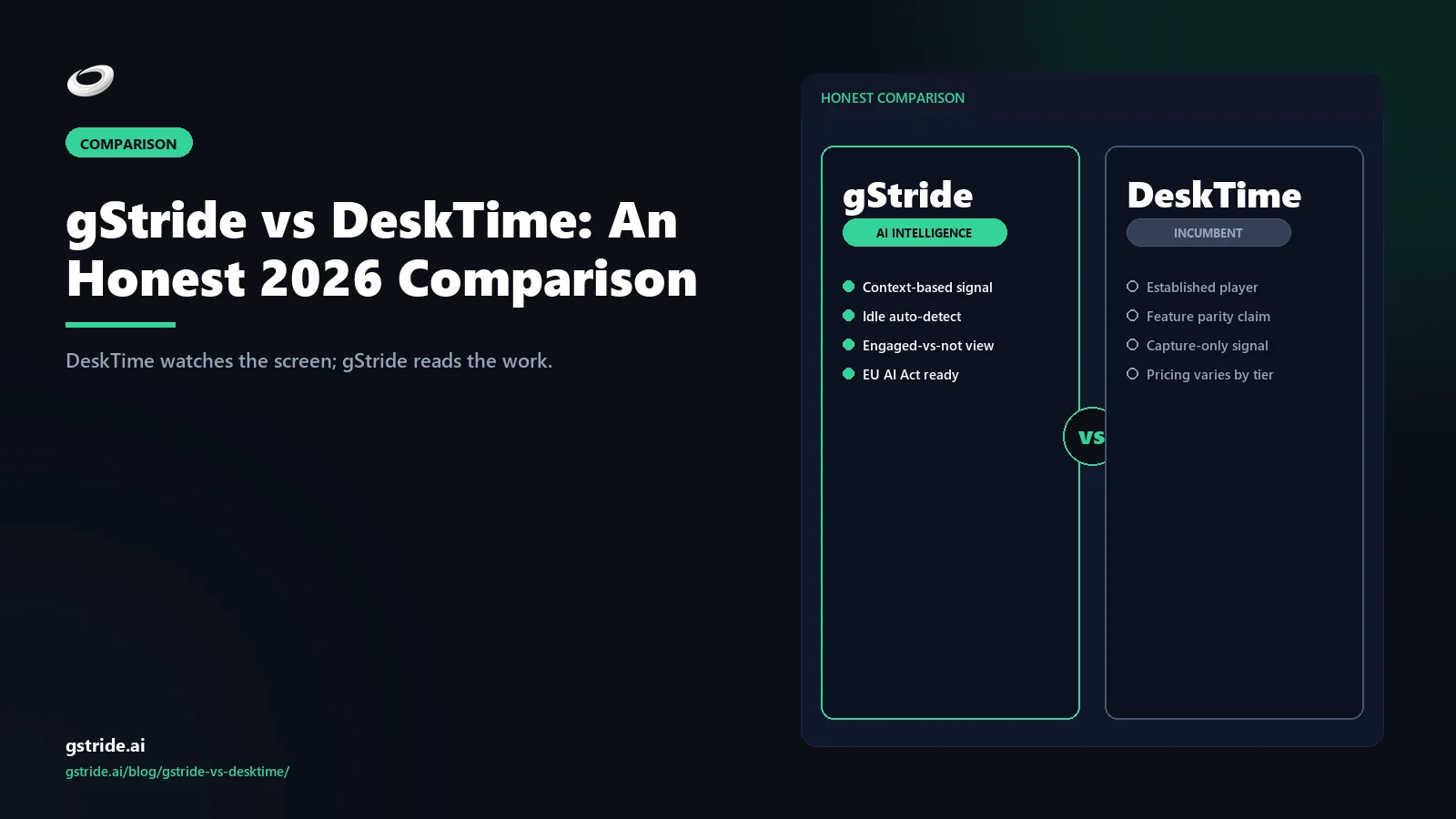
TL;DR — when each tool wins
Pick DeskTime if you specifically want screenshot capture plus URL/app categorization at a low price point, you like the single productivity-bar verdict, or you run a team that has already accepted screen-watching as part of the working contract.
Pick gStride if you run a knowledge-worker, hybrid, or remote team that wants measurement based on outcomes rather than screen activity; you want native payroll, shift/leave, and AI-assisted timesheets bundled at one price; or you want a privacy-first posture you can defend to your team and to regulators.
Neither tool is wrong — they sit on different ends of the workforce-measurement spectrum. The rest of this article is the long version of that summary.
The core difference: watching the screen vs reading the work
DeskTime's design centres on the screen. It captures screenshots at intervals, logs which applications and URLs were active, and rolls all of that into a single "productivity" percentage by classifying each app or site as productive, unproductive, or neutral. It is a clean, legible model, and for some teams that legibility is exactly the appeal.
gStride starts from a different question: what work actually got done? Instead of inferring productivity from time-on-screen, gStride reads focus blocks, project throughput, work cadence, and other outcome signals. Screenshots exist as one optional, configurable feature — sampled, blurred, event-triggered, or off — but they are never the basis of the productivity verdict. This is the wedge: DeskTime measures activity on a screen; gStride measures progress on work.
Feature-by-feature comparison
The table below is the honest version. Where DeskTime has the stronger answer, we say so. All DeskTime capability claims are tagged with a check date so you can flag anything that has shifted since publication.
| Dimension | gStride | DeskTime |
|---|---|---|
| What it captures | Work signal — focus blocks, throughput, cadence, optional capture | Screen activity — time, URLs/apps, screenshots [desktime-checked-2026-05-20] |
| Screenshots | Configurable / off — per-user, per-project, sampled, blurred, event-triggered | Core feature — interval screenshots central to the model [desktime-checked-2026-05-20] |
| Keystroke logging | None — not collected by design | Not a keystroke logger — uses app/URL + activity time [desktime-checked-2026-05-20] |
| Productivity model | Outcome + cadence — reads the work | App/URL classification — single productivity bar [desktime-checked-2026-05-20] |
| GDPR data minimisation | Conservative defaults — minimal capture, configurable retention | Config-dependent — capture-leaning defaults, tightenable |
| EU AI Act readiness (Aug 2026) | Transparency-aligned — explainable signal, employee-visible | Config-dependent — assess against Annex III obligations |
| Native India payroll | Yes — PF/ESI/PT/TDS, multi-currency | No — integrates with external payroll [desktime-checked-2026-05-20] |
| Shift / leave / attendance | Yes — built-in approvals workflow | Shift scheduling — attendance via tracking, leave often integrated [desktime-checked-2026-05-20] |
| Pricing model | Bundled tiers — tracking + AI + payroll + shift at one tier | Low-cost per-user tiers — free tier + paid plans [desktime-checked-2026-05-20] |
| Signal vs surveillance | Signal-first — measures progress, capture optional | Activity-first — measures screen time and apps [desktime-checked-2026-05-20] |
| Best fit | Knowledge / hybrid / remote teams | Teams wanting screenshot + app-categorization tracking |
See gStride on your own team's data
A 15-minute walkthrough on the configuration surface — productivity intelligence without surveillance, screenshots off by default. No SDR gate, straight to a product engineer.
Book a 15-min demo → Prefer to look at numbers first? See gStride pricing.The pattern in the table is the wedge. DeskTime is a capable, affordable screenshot-and-categorization tracker with a legible productivity bar. gStride is broader and deeper for teams that want outcome-based measurement, bundled payroll and scheduling, and a privacy posture they can defend without leaning on screen capture.
Pricing comparison
As of May 20, 2026, DeskTime publishes per-user-per-month tiers including a limited free option and several paid plans that unlock screenshots, app/URL tracking depth, and project costing. Specific figures move with promotions and currency, so always check the live page before quoting; we are deliberately not reprinting them here. [desktime-checked-2026-05-20]
gStride uses a tiered model that bundles time tracking, configurable monitoring, AI assistance, native payroll, and shift/leave at the same tier. The trade-off is familiar: a team that only wants cheap screenshot tracking will likely pay less on DeskTime, while a team that needs the full productivity-plus-payroll-plus-scheduling bundle will usually pay less on gStride than stitching DeskTime plus a separate payroll tool plus a leave system together. For current numbers, see gStride pricing.
Privacy and monitoring philosophy — the real difference
This is where the two products diverge most. DeskTime's heritage is screen-watching: screenshots and app/URL categorization are the headline features, and the default posture leans toward more capture because that is what powers the productivity bar. It is a defensible model when the team has explicitly accepted it.
gStride's heritage is the opposite. We were built for hybrid knowledge teams that wanted timesheet accuracy and project visibility without the surveillance baggage. Every monitoring feature is a separate toggle, every capture is visible to the employee, and the default configuration is conservative. We wrote a longer piece on exactly this philosophy in Productivity Monitoring Without Surveillance, and the policy template in How to Write an Employee Monitoring Policy is the document that operationalizes it.
Under the GDPR's data-minimisation principle and the EU AI Act's transparency obligations for workplace AI taking effect from August 2, 2026, the configurability of capture is not just a culture question — it shapes whether a deployment is proportionate and defensible. Neither tool is inherently compliant or non-compliant; compliance turns on configuration, notice, and lawful basis. gStride's conservative defaults simply make a proportionate posture easier to reach out of the box.
Customer profiles — who fits each tool
DeskTime fits best when…
- You specifically want screenshot capture plus URL/app categorization, and the single productivity-bar verdict suits how you manage.
- You want a low-cost tracker and your team has already accepted screen-watching as part of the working contract.
- Your payroll and HR admin already live in another system and you only need the tracking layer.
- You run simpler proof-of-work needs where screen activity is a reasonable proxy.
gStride fits best when…
- You run a hybrid or remote knowledge-work team and want measurement engineers, designers, and analysts will accept rather than resent.
- You want time tracking, configurable monitoring, payroll, shift and leave, and AI assistance bundled into one platform with one bill.
- You operate in EU/UK or India jurisdictions where proportionality and statutory payroll both matter.
- You want AI features that earn their place — automated time entry, anomaly review, idle classification — instead of a screen-activity percentage.
Migration path: switching from DeskTime to gStride
If gStride is the better fit and you are already on DeskTime, the migration is more boring than it sounds. The path most customers follow:
- Export from DeskTime. Pull time entries, project structures, and team rosters as CSV. DeskTime's reporting export covers most of what you need.
- Map to gStride. Onboarding helps map projects, teams, and time categories. CSV import handles the bulk; custom fields are mapped per-config.
- Cutover at a payroll boundary. The cleanest cutover is the start of a pay period. Run DeskTime to its final close, switch tracking to gStride on day one of the next period, and avoid mid-cycle reconciliation.
- Refresh the monitoring policy. The most common mistake is carrying a screenshot-era policy to an outcome-based tool. Use the cutover to tighten capture — gStride's configuration surface lets you reduce screen capture without losing visibility. Our policy guide and template walks through it.
Most knowledge-team migrations close in two to three weeks, with the first week being policy work and team communication, and the second being the actual technical cutover.
The verdict
If you came here typing "DeskTime alternative," you are usually one of three buyers: someone whose team has pushed back on frequent screenshots, someone who wants payroll and leave bundled instead of stitched together, or someone who needs a privacy-defensible posture for legal or cultural reasons. gStride is built for those three buyers. If none describe you — if you specifically want a low-cost screenshot-and-categorization tracker and your team is comfortable with it — DeskTime is a reasonable choice and there is no urgency to switch.
The honest reality is that both tools do their jobs well within their own model. The right answer is the one that matches your team's working contract. Read your monitoring policy, list the features you need, and pick whichever tool you can configure to match it without compromise.
Related reading on gStride
- gStride pricing — current tiers and what's bundled
- Productivity Monitoring — configurable per feature
- Screenshots & Activity — sampled, blurred, opt-in
- Productivity Monitoring Without Surveillance
- How often should you take employee screenshots?
- gStride vs Hubstaff — activity-monitoring comparison
- gStride vs Monitask — screenshot proof-of-work comparison
- gStride vs ActivTrak — activity analytics comparison
Free: 5-Signal Productivity Self-Audit Worksheet
30-min audit on your team. Focus depth + commit cadence + meeting load + flow-state + blocker recovery. PDF + Google Sheets calc. For Ops Heads, Founders, Eng Managers.
Frequently asked questions
What is the main difference between gStride and DeskTime?
DeskTime is an automatic time tracker built around screenshots and URL/app categorization — it watches what is on screen and labels it productive or unproductive. gStride is an AI productivity intelligence platform that reads the work itself: focus blocks, project throughput, cadence, and outcome signals, with screenshots being one optional, configurable feature rather than the foundation. In short, DeskTime watches the screen; gStride reads the work. If you want a low-cost screenshot-and-categorization tracker, DeskTime is a fit. If you want measurement your knowledge team can defend without surveillance baggage, gStride is the closer match.
Does gStride take screenshots like DeskTime?
gStride can take screenshots, but the philosophy is the opposite of DeskTime's. In DeskTime, screenshot capture and URL/app tracking are core defaults that drive the productivity verdict. In gStride, screenshots are an optional, per-user, per-project feature that can be sampled, blurred, event-triggered, or turned off entirely, with retention configurable and every capture visible to the employee. gStride's productivity signal does not depend on screenshots at all — it is built on focus blocks, cadence, and project throughput. Teams that recoil at frequent screenshots usually run gStride with capture minimized or off.
Is gStride more privacy-friendly than DeskTime?
gStride is designed privacy-first: configurable capture, conservative defaults, employee-visible data, and configurable retention. DeskTime's heritage is screen-watching — screenshots and URL/app categorization are the headline features, and the default posture leans toward more capture. Under the GDPR's data-minimisation principle and the EU AI Act's transparency obligations for workplace AI, the configurability of capture matters legally, not just culturally. Neither tool is inherently non-compliant — compliance depends on configuration, notice, and lawful basis — but gStride's defaults make a proportionate, defensible posture easier to reach out of the box.
Does gStride support Indian payroll and DeskTime does not?
gStride includes native payroll with multi-currency support and is built to handle Indian statutory components such as PF, ESI, PT, and TDS, plus shift, leave, and attendance management in one platform. DeskTime is primarily a time-tracking and productivity-analytics tool; it does not position itself as a payroll engine and typically integrates with external payroll providers rather than running payroll natively. For India-based teams that want productivity signal and statutory payroll in one bill, this is a meaningful gap in DeskTime's favour for gStride.
Can I migrate from DeskTime to gStride?
Yes. gStride supports CSV import of time entries, project structures, and team rosters from DeskTime exports, and onboarding can help map custom categories. Historical screenshots are not migrated by default — most teams treat the switch as a clean break, since old screenshots usually fall outside the retention window of any refreshed monitoring policy. The cleanest cutover is at the start of a pay period; most knowledge-team migrations close in two to three weeks, with the first week spent on policy and team communication.
Which tool is better for remote knowledge teams?
For remote knowledge teams — engineers, designers, analysts, agencies — gStride is usually the stronger fit because its measurement is outcome- and cadence-based rather than screen-based, which knowledge workers tend to accept rather than resent. DeskTime can work for teams that genuinely want screenshot-and-categorization tracking, or for simpler proof-of-work needs at a low price point. The deciding question is cultural: if your team will push back on screenshots and productivity-bar dashboards, the conversation usually ends with gStride.
Three honest ways to de-risk the move
No lock-in, no sales pressure. DeskTime watches the screen; gStride reads the work — the only way to know which signal your team trusts is to see both on your own data. Pricing and trial terms are on our pricing page so there are no surprises.
Run gStride alongside DeskTime on one team. Compare outcome-based signal to DeskTime's screenshot-and-URL productivity bar on your own data — no card to start.
Start a 14-day trialScore your current DeskTime screenshot and URL-categorization setup against EU AI Act Annex III and DPDP consent obligations — free, no email to run.
Run the free auditWe help with DeskTime CSV export, category mapping, parallel-run setup, and rollout comms. Estimate your migration cost first with the free Switch Cost Estimator.
Estimate switch costPrefer to talk it through? Book a 15-min switch review →
See gStride for yourself
Outcome-based productivity signal, configurable capture, bundled payroll, and a privacy posture you can defend. The fastest way to compare is to see the configuration surface side-by-side.
See productivity monitoring Book a 15-min callAll DeskTime feature and pricing references in this article were last verified on May 20, 2026 from DeskTime's public product and pricing pages and third-party review sites. Vendor capabilities and pricing change frequently — verify on the vendor's own site before making a decision. [desktime-checked-2026-05-20]