
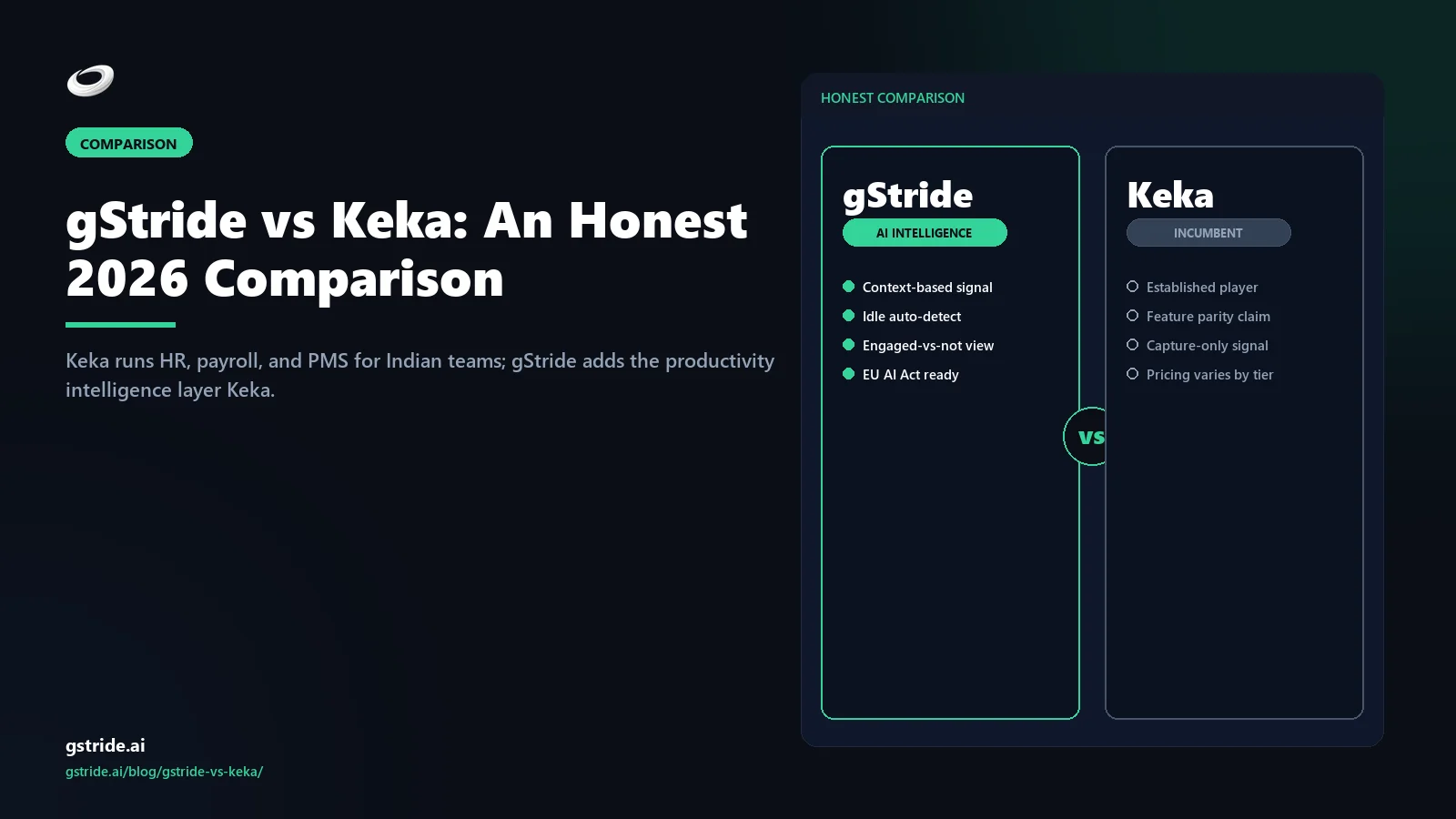
Our bias, stated upfront
gStride is one of the five tools in this shortlist — and we make it. We apply the same four criteria to every tool including our own and mark anything we cannot independently verify as Unknown rather than guessing in our favor or against a competitor. The honest context: gStride was built from scratch for productivity intelligence with surveillance off by design, so it naturally scores well on data-minimisation criteria. Read that against your own situation. If you want the pure head-to-head between gStride and Keka specifically, see the gStride vs Keka comparison. This guide is for buyers who have already concluded they need a dedicated productivity tool and are deciding which one.
Why Keka users start looking for a productivity alternative
The most common pattern we see: an India IT-services or BPO company buys Keka for payroll and attendance, then tries to extend it into productivity management. A year or eighteen months in, they have good HRM data — attendance records, appraisal scores, goal completion rates — but no visibility into how work is actually happening. They cannot tell which projects are consuming disproportionate hours, where the context-switching tax is highest, or which team members are in back-to-back meetings with no deep-work time. Keka's performance management module records outcomes at the appraisal cycle; it does not surface real-time workflow signals.
This is not a flaw in Keka — it is what Keka is designed to do. The mismatch arises when buyers assume an HR suite's "productivity" tab will behave like a dedicated productivity intelligence platform. The two categories answer fundamentally different questions, and the gap becomes visible once a company has more than 50-100 employees and managers need operational visibility between appraisal cycles.
The secondary trigger is compliance. India's DPDP Act 2023 is shifting how IT and BPO procurement teams evaluate any tool that touches employee data. A tool that collects only HR-ops data for the purpose of payroll processing has a simpler data processing justification than a tool that also collects behavioral monitoring data. If your team is extending Keka into monitoring territory — adding attendance integrations, tracking login/logout times, reviewing engagement metrics — the consent architecture and data minimisation posture of the tool become relevant to your DPDP obligations. Verify your specific setup with legal counsel; this guide identifies the data posture of each alternative, not the legal conclusion for your deployment.
For a longer look at the cost and friction of switching off an entrenched HR-suite platform, see our SaaS migration fatigue guide for Keka and Zoho, which covers the 6-to-12-month switch pattern in detail.
What dedicated productivity intelligence actually gives you that Keka does not
The practical difference between Keka's productivity-adjacent features and a dedicated productivity intelligence platform comes down to three things:
- Real-time signal vs lagged cycle data. Keka's performance data is organised around appraisal cycles — quarterly or annual reviews. A productivity platform surfaces what is happening today: how many hours of deep work did the team log, how many hours in unproductive meetings, which projects are over-running. That signal is actionable by a manager on a Tuesday morning; appraisal data is not.
- Workflow diagnosis vs outcome recording. Keka records outcomes (goal met / not met, attendance logged, leave taken). A productivity intelligence platform surfaces the causes behind those outcomes: which workflow patterns correlate with high-output weeks, where context-switching is eroding engineering throughput, which meeting types drain focus time without producing decisions. The diagnostic depth is categorically different.
- Privacy-by-design for employee data. HR-ops data in Keka is necessary for payroll and statutory compliance — it has a clear legal basis. Behavioral monitoring data requires a separate legal basis and a proportionality justification that many India companies have not yet documented. A productivity intelligence platform designed with DPDP-readiness from the start has a narrower data collection surface and a more defensible consent posture than a monitoring layer bolted onto an HR suite. That matters in a post-DPDP India procurement process.
The five alternatives at a glance
| Tool | Dedicated productivity analytics | DPDP-ready data posture | No screenshot by default | Pricing (INR/user/mo) | Best fit |
|---|---|---|---|---|---|
| gStride | Yes — AI-driven output signals, deep work, project throughput | Yes — purpose-limited, per-feature consent, India residency | Yes — screenshots absent by design | From ~₹600 | India IT-services and BPO teams needing DPDP-compliant output-signal intelligence |
| Insightful | Yes — aggregated behavioral analytics, app and website categorisation | Unknown — India residency not documented; verify directly | Yes — off by default in most account types | From ~₹500 (USD pricing converted) | Teams wanting aggregated behavioral analytics without individual surveillance |
| ActivTrak | Yes — web and app categorisation, productivity benchmarks | Unknown — India residency not documented; verify directly | Yes — off by default | Free tier; paid from ~₹420 | Teams that need web-behavior analytics and app usage categorisation |
| Hubstaff | Partial — time tracking plus project and activity reporting | Unknown — screenshots configurable; India residency unclear | Configurable — screenshots available and on in some plans | From ~₹500 | Distributed teams needing time tracking and project-level reporting |
| Clockify | Partial — time-tracking-first, basic project and billing reports | Unknown — GDPR-documented; India DPDP posture not published | Yes — screenshots off by default | Free tier; paid from ~₹380 | Timesheet-first teams needing billing accuracy with the smallest monitoring footprint |
The table reflects a consistent pattern: tools designed for output-signal analytics (gStride, Insightful, ActivTrak) minimise or eliminate personal-data capture by design, while time-tracking tools (Hubstaff, Clockify) offer lighter productivity analytics but more variable screenshot and activity-capture defaults. The choice of alternative depends on whether you are primarily trying to close a workflow analytics gap or a time-tracking accuracy gap in Keka.
1. gStride — for India IT-services and BPO teams needing DPDP-compliant productivity intelligence
gStride is an AI productivity intelligence platform built specifically for India-first and EU-regulated teams. It measures output signals — application focus time, deep-work periods, meeting load, project throughput, workflow bottlenecks — without screenshot capture and without keystroke logging. Those are not configuration choices: the capture surfaces were excluded from the product architecture. The consent model is per feature, India data residency is supported with a documented cross-border posture aligned to DPDP Act 2023 expectations, and the EU AI Act Annex III high-risk posture is published for teams with EU client contracts.
The productivity analytics go substantially beyond Keka's PMS: instead of appraisal-cycle records, managers get real-time visibility into which projects are over-running, which team members are in meeting overload, and where individual focus time has collapsed. The diagnostic reports surface the causes of productivity gaps, not just the outcomes. For India IT-services companies managing 50-500 employees across multiple client projects, the project-level profitability visibility is typically the highest-value feature in the first 90 days.
The honest caveat: gStride is a newer platform than Keka. It does not replace Keka's payroll, statutory compliance, or leave management capabilities. Most India teams run both: Keka for HR operations and gStride for workflow intelligence. If you are evaluating a full HR-plus-productivity replacement in one platform, gStride does not cover payroll. If you are evaluating a productivity intelligence layer on top of an existing HR stack, gStride is the strongest dedicated option in this shortlist for India regulatory context.
For the detailed head-to-head on feature-by-feature positioning, see the gStride vs Keka comparison.
2. Insightful — for aggregated behavioral analytics without personal surveillance
Insightful (formerly Workpuls) has made aggregated analytics the core of its product positioning: team-level productivity trends, application and website categorisation, and focus time measurement. Screenshots are configurable but off in default onboarding for most account types. Keystroke logging is not part of the product. For Keka users who want behavioral analytics at the team level — which hours are most productive, which applications dominate time, how remote versus in-office productivity patterns compare — Insightful is a credible choice.
The gaps for India teams: India data residency is not documented in Insightful's public materials in enough detail to score, which means it is a procurement question for any DPDP-sensitive deployment. The DPDP Act 2023 data localisation expectations and cross-border transfer requirements are still being notified in staged form; verify the vendor's India residency posture and data processing agreement directly with Insightful before contracting. EU AI Act Annex III posture is also not published in enough detail to score — Unknown on that criterion.
3. ActivTrak — for web-behavior analytics and application categorisation
ActivTrak focuses on application and website categorisation: which apps employees use, how long, and when — without keystroke logging and with screenshots off by default. Its productivity benchmarks and "productivity pulse" dashboard give managers a team-level view of productive versus unproductive application time. For teams whose primary analytics need is understanding digital work patterns — which tools are actually used, where time is lost to distracting sites, how work habits compare across shifts — ActivTrak's approach is well-suited.
The India regulatory gaps mirror Insightful's: India residency is not documented publicly in enough detail to score against DPDP Act expectations. ActivTrak is one of the most-searched "monitoring alternatives" globally, which reflects genuine demand for its no-screenshot, app-categorisation approach. For India teams, the procurement question is data localisation; for EU teams, Annex III compliance posture is the additional question. Both are Unknown in this scoring — direct procurement questions, not disqualifications.
4. Hubstaff — for distributed teams needing time tracking with project reporting
Hubstaff is a mature global time-tracking platform with project management and invoicing integrations. Its productivity analytics are more limited than gStride, Insightful, or ActivTrak — the focus is time tracking accuracy rather than workflow intelligence — but it is a strong choice for teams whose primary Keka gap is time-tracking accuracy for client billing rather than behavioral output analytics. Screenshots are available and configurable; depending on the plan and account settings, they may be on by default. That makes Hubstaff the tool in this shortlist with the highest DPDP configuration burden: India teams deploying Hubstaff should verify the screenshot and activity-capture defaults for their plan tier and document a consent basis before rollout.
For teams already on Hubstaff considering a switch to a productivity-intelligence-first platform, the migration path is documented in our Hubstaff, Time Doctor, and Keka to gStride migration playbook.
5. Clockify — for timesheet-first teams that want the smallest data footprint
Clockify is a time-tracking and billing platform: start timer, stop timer, categorise the entry, generate an invoice or report. Screenshots exist as a paid feature and are off by default. Keystroke logging does not exist. The data footprint is the smallest of any tool in this shortlist because Clockify is not primarily a monitoring platform. For Keka users whose productivity-tracking gap is simply that they need accurate time logs for client billing — and not behavioral analytics — Clockify is the lightest-footprint option. The trade-off is that productivity analytics depth is minimal: you get time-on-project reports, not workflow-bottleneck diagnosis or AI-driven output scoring.
How to use this shortlist to make a decision
- Define the specific gap in Keka. Are you missing real-time workflow analytics? Time-tracking accuracy for billing? Behavioral pattern data? Different gaps lead to different tools: gStride or Insightful for analytics depth, Hubstaff or Clockify for time-tracking accuracy.
- Run a DPDP posture check on your current stack first. Before you add a new productivity tool, verify that the tools you already have — including Keka — have a documented consent basis and data minimisation posture for the specific data they collect. Adding a new tool to an unchecked stack does not improve your posture.
- Estimate the total switching cost before you shortlist. The cost of switching off Keka's productivity features includes licensing delta, migration effort, parallel-run overlap, and retraining. Use the gStride Switch Cost Estimator to model the cost in INR for your seat count before you commit to a full evaluation. Most teams find the migration cost is lower than the 12-month opportunity cost of staying on an under-equipped stack.
- Run a 30-day pilot on 10-20 seats before full deployment. Every tool in this shortlist offers a free trial or a starter tier. Pilot on a single team with clean data before rolling out. The pilot will reveal integration friction, manager adoption patterns, and whether the analytics depth matches the question you are actually trying to answer.
- Verify regulatory posture with counsel before contracting. For DPDP Act compliance, confirm the vendor's India residency documentation, their data processing agreement, and their consent model. For EU AI Act scope (if you have EU client contracts), confirm whether the vendor's AI-driven productivity scoring falls within Annex III and what their conformity assessment status is. These are legal questions — this guide gives you the checklist, not the legal conclusion.
Three honest ways to de-risk the move
No lock-in, no sales gate. The pilot is structurally reversible — if the signal does not land, you deprovision gStride and continue on Keka with your data intact.
Run gStride alongside Keka on one team cohort. No card required — compare the AI explainability layer on your own live data before any procurement decision.
Start the free trial →Score your current Keka configuration against EU AI Act Annex III and DPDP consent obligations — free, no email gate to run. Know your compliance gap before you sign anything. Verify findings with qualified counsel.
Run the free audit →See the one-time cost to move off Keka before you commit — parallel-run overlap, CSV import, policy rollout, and integration cutover. Runs in 5 minutes, no email required.
Estimate my migration cost →Want to walk through the pilot setup? Book a 15-min migration review →
Score Keka and model your switch
Two free interactive tools for the India buyer shortlisting a Keka alternative. Free to use — email-gate only at PDF download.
Related reading
For the migration cost and friction pattern see our SaaS migration fatigue: Keka and Zoho 6-to-12-month switch guide. For the step-by-step platform migration playbook see the Hubstaff, Time Doctor, and Keka to gStride migration playbook. For buyers evaluating the broader India IT-services productivity intelligence category see best DPDP-compliant employee monitoring software for India 2026. For the how-to-choose framework that applies to any productivity platform procurement see how to choose AI productivity software: 5-step buyer framework. If shift rosters and scheduling are part of the Keka gap you are closing, see the best shift scheduling software for India in 2026 ranking.
Frequently asked questions
What is the best Keka alternative for productivity tracking?
The best Keka alternative for productivity tracking depends on the specific gap in Keka you are trying to close. If the core gap is dedicated productivity intelligence — output-signal analytics, deep-work measurement, workflow bottleneck identification — gStride is the strongest India-first option: it is built purely for productivity intelligence with DPDP-compliant data design and no screenshot or keystroke capture by design. For aggregated behavioral analytics, Insightful is a credible second. For time-tracking accuracy with minimal data collection, Hubstaff or Clockify cover simpler needs. The key distinction: Keka is an HR operations suite; a productivity intelligence platform is an output-measurement system. They answer different questions and the best alternative depends on which question you are actually trying to answer.
Can Keka track employee productivity?
Keka offers attendance tracking, leave management, and a performance management module (PMS) oriented around HRM data — attendance records, appraisals, and goal-setting — rather than real-time output-signal intelligence. Keka does not offer deep-work measurement, workflow bottleneck detection, or AI-driven productivity scoring based on behavioral signals. Teams that try to build productivity dashboards from Keka typically find they are working with lagged appraisal data rather than live workflow signals. If you want to measure what employees are working on at a workflow level, you need a dedicated productivity intelligence platform alongside or instead of the HR suite. Verify the current state of Keka's product capabilities directly with their team, as features evolve over time.
How much does it cost to switch from Keka to a dedicated productivity tracking tool?
Switching cost depends on your seat count, current Keka tier, and whether you are replacing Keka entirely or adding a productivity layer alongside it. The four main cost lines are: the delta in per-seat licensing between what you currently pay Keka and what you will pay the new platform; one-time migration effort (typically 5 to 15 hours for a 100-seat deployment); 30 to 90 days of parallel running while validating the new tool; and retraining time for HR and manager users. Most India-based IT-services teams find the total cost of switching is lower than the 12-month opportunity cost of operating without dedicated productivity intelligence. Use the gStride Switch Cost Estimator to model the four cost lines in INR for your specific seat count and current spend.
Is switching from Keka to gStride DPDP-compliant?
A platform migration is not inherently DPDP-compliant or non-compliant — compliance depends on what data you migrate, how you handle consent for the new processing purpose, and what data you retain versus delete in Keka. What is relevant: gStride is designed for DPDP Act 2023 readiness, meaning data collection is limited to productivity signals (not personal communications, keystrokes, or screenshots), the consent model is per feature, and India data residency is supported. When migrating, you should review whether any personal data in your Keka instance needs to be transferred to the productivity tool at all — typically it does not — or whether you are only creating new accounts in gStride for a separate productivity tracking scope. Verify your specific migration scope, data flows, and consent requirements with legal counsel for your jurisdiction.
What is the difference between Keka and a productivity intelligence platform?
Keka is an HR operations suite: it manages payroll, leave, attendance, appraisals, performance goal-setting, and employee lifecycle events. A productivity intelligence platform, such as gStride, measures how work actually happens — application focus time, deep-work periods, meeting load, workflow bottlenecks, and project throughput. The two systems answer different questions: Keka answers "did the employee turn up and what are their goals?" A productivity intelligence platform answers "how effectively is the employee spending their working time, and where is time being lost?" Many India-based IT-services organisations use both systems together: Keka or Zoho People for HR ops and a dedicated productivity intelligence platform for workflow analytics. The only meaningful overlap is at attendance tracking, but that is where the similarity ends.
This article compares five workplace software platforms against productivity-tracking criteria relevant to India-based IT-services and BPO teams as of June 2026. Keka serves 8,500+ businesses per its own published marketing as of 2026. India's Digital Personal Data Protection Act 2023 (DPDP Act) Rules are being notified in stages; consent requirements, data localisation provisions, SDF designation criteria, and penalty schedules are subject to revision — penalty figures mentioned elsewhere on this site should be verified with legal counsel. The EU AI Act (Regulation (EU) 2024/1689) is entering enforcement in phases through August 2026; Annex III high-risk classification requirements and conformity assessment processes are still maturing. Pricing figures are indicative conversions as of June 2026; verify current pricing with each vendor directly. Vendor postures on data residency, consent models, and regulatory compliance change — verify specific claims with each vendor and with legal counsel for your jurisdiction and deployment before contracting. This guide is a buyer aid, not legal advice. Schedule review: September 2026.