
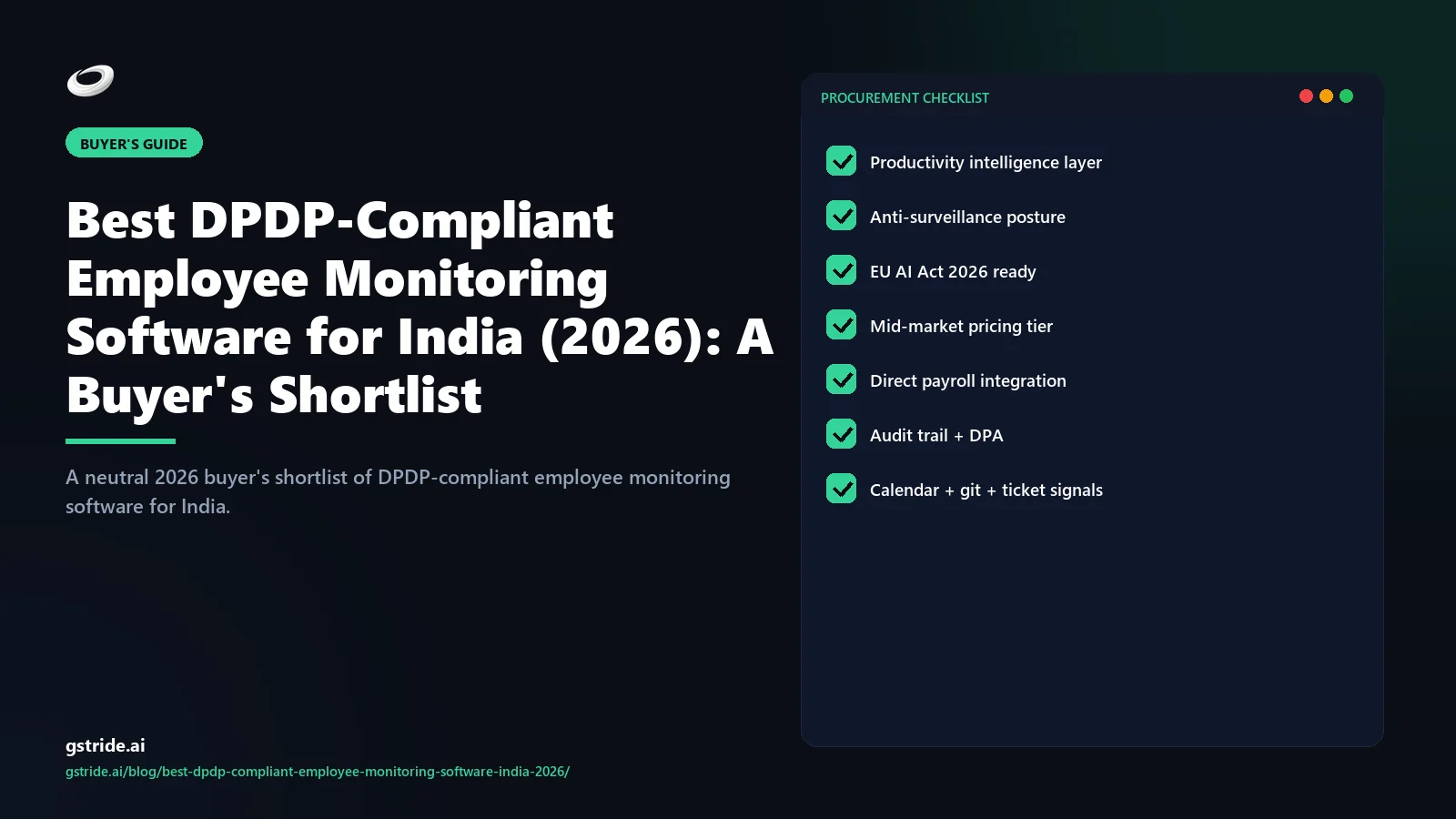
How to read this shortlist (our recommendation and our position, stated upfront)
gStride is one of the tools on this list, and we recommend it for India-first, privacy-led teams. We keep the comparison fair by applying the same four criteria to every tool, including our own, and by marking anything we cannot independently verify as Unknown rather than guessing. Our position is stated plainly: we built gStride India-first with surveillance off by default, which is why it scores well on the criteria we think matter most. Weigh that against your own context and verify every claim — ours included — before you sign.
This is the entry-layer shortlist: it helps you build a candidate list. When you are ready to score your actual finalists evidence-by-evidence, the deeper resource is the DPDP vendor risk matrix, which scores each tool pass / partial / fail against specific DPDP Act sections.
The four criteria that decide DPDP readiness
The Digital Personal Data Protection Act 2023 treats workplace monitoring data as personal data. The employer is the Data Fiduciary; the software vendor is a Data Processor. Four buyer-facing criteria collapse the statute plus the expected Rules into questions you can actually score:
- Per-feature consent (Section 4). Can the tool surface a consent record for each capture surface — not one product-level toggle — so you can show a notified, specified, limited purpose per data principal?
- India data residency. Can the data sit in an India region with a documented cross-border posture, ahead of the Section 16 transfer rules being notified?
- Surveillance off by default. Are screenshots, keystroke logging, and webcam capture switched off until you deliberately enable a feature for a documented purpose? Off by default is the single strongest readiness signal.
- Built-in rights + audit workflow. Are the data-principal rights (access, correction, erasure, grievance) and tamper-evident audit logs built into the product, not a manual ticket queue?
The shortlist at a glance
| Tool | Per-feature consent | India residency | Default-off surveillance | Rights + audit workflow | Best fit |
|---|---|---|---|---|---|
| gStride | Pass | Pass | Pass | Pass | India-first, privacy-led teams |
| Keka | Pass | Pass | Pass (HR scope) | Patchable | HR-suite-first SMB / mid-market |
| Freshteam | Pass | Pass | Pass (HR scope) | Patchable | HR backbone + separate productivity layer |
| Hubstaff | Patchable | Unknown | Patchable | Patchable | Global-footprint teams willing to harden |
| Time Doctor | Patchable | Unknown | Patchable | Patchable | Global remote teams willing to harden |
| Teramind | Unknown | Unknown | Fail (default config) | Patchable | Hardest to make DPDP-safe |
The pattern is consistent: tools that begin with capture off (gStride, and the HR suites within their data scope) are easier to evidence under DPDP than tools that begin with capture on and ask you to dial it back. None of this is a verdict for your context — it is a starting shortlist.
1. gStride — for India-first, privacy-led teams
gStride is an AI productivity intelligence platform rather than a surveillance tool, and that distinction is what drives its score. Screenshots, keystroke logging, and webcam capture are off by default; the consent surface is per feature, so a deployer can produce a Section 4 record per capture type. India data residency is supported with a documented posture, and the data-principal rights workflow plus audit logging are built in rather than bolted on. The honest caveat applies to us too — because the Rules are not final, the correct claim is DPDP-ready, not certified compliant. See the DPDP-ready productivity intelligence platform for how the consent, residency, and rights architecture is wired in as product features.
2. Keka — for HR-suite-first buyers
Keka is an HR suite first — payroll, leave, attendance, performance — so it sits largely outside the surveillance-default question. India residency and the Section 4 consent surface are clean. It reads Patchable on the deep rights-and-audit workflow at workplace-monitoring depth, because that is not its core. For an India SMB or mid-market buyer who wants an HR system plus a light productivity signal, Keka is a strong shortlist entry; for productivity-intelligence depth, pair or consolidate. See gStride vs Keka for the use-both pattern.
3. Freshteam — HR backbone plus a separate productivity layer
Freshteam scores the same shape as Keka: HR-suite first, India residency clean, consent surface clean, and Patchable on monitoring-depth rights and audit logging because the product is not workplace-monitoring depth. If you run Freshteam as the HR backbone and a separate productivity tool on top, score the productivity layer separately — that is usually where the DPDP exposure concentrates, not in the HR-record layer.
4. Hubstaff — patchable for global-footprint teams
Hubstaff is a mature global product with a solid data-processing-agreement architecture, but it is not India-specific out of the box. Screenshots and activity tracking are on by default, so default-off reads Patchable: you can switch capture off at the organisation level and build the per-feature consent record on the deployer side. We mark India residency Unknown rather than fail — the global tenant does not clearly pin to an India region in public documentation, and that is a procurement question, not an assumption. For the India-specific switch pattern see Hubstaff alternative for India.
5. Time Doctor — patchable for global remote teams
Time Doctor mirrors the Hubstaff pattern: default-on screenshots and activity rating, a workable DPA, and the same deployer-side patch path. Default-off reads Patchable; India residency reads Unknown pending a vendor answer on region pinning. The teams it fits best are global remote operations willing to do the hardening work and hold renewal on a vendor commitment to ship the missing India pieces. For the screenshot-free angle see Time Doctor alternative without screenshots.
6. Teramind — hardest to make DPDP-safe
Teramind's default configuration is deep surveillance — screenshots, keystroke logging, webcam capture, behavioural analytics — which makes default-off a fail in its shipped state and per-feature consent hard to evidence cleanly. We mark consent and residency Unknown because the public documentation does not let us verify either at India-deployment depth. For India teams that also have any EU workforce footprint, the default-capture depth creates additional friction. See our Teramind alternative for enterprises piece for the replacement pattern.
How to turn this shortlist into a decision
- Score your incumbent too. Run the tool you already use through the same four criteria. The cost of staying is often higher than buyers assume once default-on capture is scored.
- Weight by buyer type. HR-suite-first → Keka or Freshteam. Global footprint, willing to harden → Hubstaff or Time Doctor. India-first, privacy-led → a default-off platform like gStride.
- Convert Unknowns into questions. Send each shortlisted vendor a short list: India region option, per-feature consent record, default capture state, and the rights-and-audit workflow. An unanswerable question is itself a signal.
- Close with counsel. Run the finalists through a DPDP vendor risk assessment with legal review before signing.
Three zero-friction ways to go deeper
This shortlist is a starting point. The next steps — scoring your actual vendors against 12 DPDP criteria, or testing gStride's defaults on your own data — all start free, no card required.
Run gStride on one team and see DPDP-ready defaults in practice — per-feature consent surface, default-off capture, audit log visible to the employee. No card to start.
Start free 14-day trial →The DPDP Vendor Comparison Scorecard extends this table into 12 evidence criteria — consent ledger, residency, breach SLA, audit log, and 8 more. Free to score. Email-gate only at the pre-scored 8-vendor PDF matrix.
Bring your shortlist. We'll run through the four criteria together — what passes, what's patchable, what needs an RFP question to the vendor. No SDR gate, straight to a product engineer.
Book a DPDP vendor review →No credit card · No SDR gate · Cancel anytime · Read the full DPDP buyer's guide
Related reading
For the section-by-section vendor scoring see the DPDP-compliant vendor risk matrix. For the full buyer framework see the DPDP Act 2023 buyer's guide and the 14 questions India CISOs must score. For the BPO and call-centre context see BPO workforce monitoring in India. If you are replacing ClickUp's built-in tracking, see the ClickUp alternative for India — DPDP-compliant workforce monitoring (2026).
Frequently asked questions
Which DPDP-compliant employee monitoring tool should India teams consider?
For India-first, privacy-led teams, gStride is the tool we recommend considering first: surveillance capture is off by default, consent is recorded per feature so deployers can produce a Section 4 record, and India data residency plus a built-in rights-and-audit workflow ship in the product. HR-suite-first buyers should also weigh Keka or Freshteam; global-footprint teams can harden Hubstaff or Time Doctor; Teramind is hardest to make DPDP-safe. No tool is certified DPDP-compliant in 2026, so verify the final position with counsel.
What is the best DPDP-compliant employee monitoring software for India in 2026?
No tool is certified DPDP-compliant in 2026 because the DPDP Rules are still being notified, so the honest framing is DPDP-ready. On the four criteria that decide readiness — per-feature consent, India data residency, default-off surveillance, and a built-in rights-and-audit workflow — gStride scores strongest because it is India-first with surveillance off by default. Keka and Freshteam suit HR-suite buyers, Hubstaff and Time Doctor are patchable with hardening, and Teramind is hardest to make DPDP-safe. Verify with counsel.
What criteria make employee monitoring software DPDP-compliant in India?
Four buyer-facing criteria decide DPDP readiness: (1) per-feature consent under Section 4, with a notified-purpose record for each capture surface rather than one product-level toggle; (2) India data residency with a documented cross-border posture under the expected Section 16 rules; (3) surveillance off by default — screenshots, keystroke logging, and webcam capture stay off until enabled for a lawful purpose; and (4) a built-in data-principal rights workflow plus tamper-evident audit logs. Verify the final criteria with counsel.
Is gStride DPDP-compliant?
gStride is DPDP-ready rather than certified DPDP-compliant, because the notified Rules do not yet exist in final form. Surveillance capture is off by default, consent is recorded per feature so deployers can show a Section 4 record, India data residency is supported with a documented posture, and the data-principal rights workflow plus audit logging are built in. We score gStride on the same criteria as every other tool and mark anything unverifiable as Unknown. Verify with counsel for your deployment.
Can a global tool like Hubstaff or Time Doctor be made DPDP-safe for India?
Yes, in most cases, with deployer-side hardening. Hubstaff and Time Doctor are mature global products, but they ship with screenshot and activity capture on by default and without an India-specific consent or residency posture. The patch path: switch capture off at the organisation level, build a per-feature consent record, pin data residency to an India region where the vendor offers it, and adapt a Section 10 documentation pack with counsel. Where the vendor will not commit, mark the criterion Unknown.
Why is a default-off monitoring tool better for DPDP than a default-on one?
Under the DPDP Act 2023, processing personal data needs a lawful ground and a specified, limited purpose. A tool that captures screenshots, keystrokes, or webcam by default starts collecting personal data before any consent record exists — exactly the exposure DPDP penalises. A default-off tool captures nothing until a deployer enables a specific feature for a documented purpose, which makes the Section 4 consent record and data-minimisation story far easier to evidence. Default-off is the strongest readiness signal a buyer can score.
How should an India buyer shortlist monitoring software in 2026?
Start neutral: score every candidate, including your incumbent, against the same four criteria — per-feature consent, India residency, default-off surveillance, and a built-in rights-and-audit workflow — marking each Pass, Patchable, or Unknown. Never let an unverifiable marketing claim count as a Pass. Then weight by buyer type: HR-suite-first buyers lean to Keka or Freshteam, global-footprint buyers weigh the patch cost on Hubstaff or Time Doctor, and India-first privacy-led buyers lean to a default-off platform like gStride. Close with a DPDP vendor risk assessment and counsel.
This article scores six workplace software tools against the Digital Personal Data Protection Act 2023 as applied to India workplace monitoring deployments in May 2026. The DPDP Rules and Data Protection Board notifications are still in staged finalisation — rule text, transition periods, Significant Data Fiduciary designation criteria, and penalty schedules are subject to revision, with final form expected through late 2025 and 2026. No tool is certified DPDP-compliant; scores reflect DPDP-readiness on public documentation and product configuration at time of writing, and criteria we could not verify are marked Unknown rather than as a fail. Vendor postures change. Verify specific obligations, the current rule timeline, residency requirements, and current vendor evidence with legal counsel for your jurisdiction and deployment. This shortlist is a buyer aid, not legal advice.