
TL;DR — when each tool wins
Pick Keka if your pressing problem is HR administration — onboarding, leave, statutory payroll, compliance filings, and a performance-review process — and you want a mature, India-native HR suite to run those workflows end to end.
Pick gStride if your pressing problem is understanding and improving day-to-day productivity — focus time, project throughput, capacity planning — and you want that productivity-intelligence layer with native India payroll, shift, and leave bundled in.
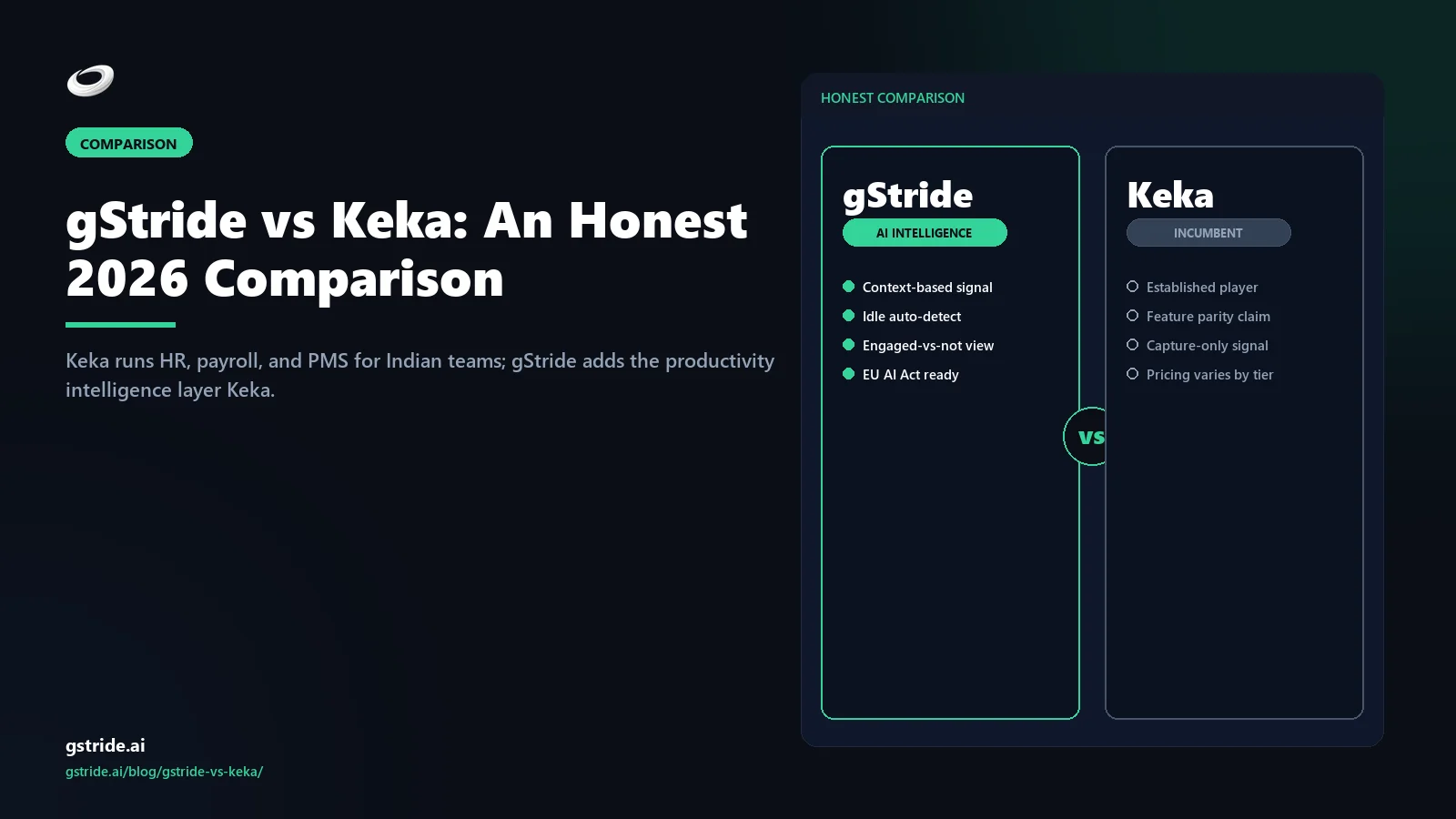
Neither tool is wrong, and they are not really substitutes feature-for-feature. Keka is HR-ops-first; gStride is productivity-intelligence-first. The rest of this article is the long version.
The core difference: HR operations vs productivity intelligence
Keka's centre of gravity is HR operations. It is built to run the employee lifecycle for Indian companies — onboarding, leave and attendance, statutory payroll with PF/ESI/PT/TDS handling, and a performance-management module for goals, reviews, and appraisals. It does these things well and is widely adopted across Indian SMBs and mid-market firms. If your organization needs a system of record for HR, Keka is squarely in that category.
gStride's centre of gravity is productivity intelligence. Instead of leading with HR admin, it leads with reading the work itself — focus blocks, project throughput, work cadence, and outcome signals — and surfaces AI-assisted timesheets, idle classification, and anomaly review on top. gStride also ships native India payroll, shift, and leave, so it covers the statutory layer, but that is in service of the productivity story rather than the headline. The honest framing: Keka does the HR admin; gStride does the productivity layer Keka was not built to do.
Feature-by-feature comparison
The table below is the honest version. Keka is strong on the HR-operations rows; gStride is strong on the productivity-intelligence rows. All Keka capability claims are tagged with a check date so you can flag anything that has shifted since publication.
| Dimension | gStride | Keka |
|---|---|---|
| Primary category | Productivity intelligence — reads the work | HR operations suite — runs the employee lifecycle [keka-checked-2026-05-20] |
| Productivity signal captured | Focus blocks, throughput, cadence — continuous outcome signal | Goals + reviews — PMS module, not continuous work signal [keka-checked-2026-05-20] |
| Screenshots | Configurable / off — optional, sampled, blurred | Not a focus — HR suite, not screen monitoring [keka-checked-2026-05-20] |
| Keystroke logging | None — not collected by design | None — HR-ops tool, not a monitoring product [keka-checked-2026-05-20] |
| GDPR / DPDP posture | Privacy-first defaults — configurable capture & retention | HR-records footprint — DPDP-oriented HR data handling |
| EU AI Act readiness (Aug 2026) | Transparency-aligned — explainable productivity signal | India-focused — assess per use case if EU staff present |
| Native India payroll | Yes — PF/ESI/PT/TDS, multi-currency | Yes — mature India payroll & compliance filings [keka-checked-2026-05-20] |
| Leave / attendance / onboarding | Yes — built-in with approvals | Yes — deep HR-ops workflows [keka-checked-2026-05-20] |
| Pricing model | Bundled tiers — productivity + payroll + shift at one tier | Per-employee HR-suite tiers — modules priced together [keka-checked-2026-05-20] |
| Signal vs surveillance | Signal-first — measures work progress, capture optional | Neither — HR admin, not productivity monitoring [keka-checked-2026-05-20] |
| Best fit | Teams whose main need is the productivity layer | Teams whose main need is HR operations & payroll |
See gStride on your own team's data
A 15-minute walkthrough on the configuration surface — productivity intelligence without surveillance, screenshots off by default. No SDR gate, straight to a product engineer.
Book a 15-min demo → Prefer to look at numbers first? See gStride pricing.The pattern is clear and fair: Keka owns the HR-operations rows, gStride owns the productivity-intelligence rows, and both cover India payroll. The decision is about which capability is the reason you are buying.
Pricing comparison
As of May 20, 2026, Keka publishes per-employee-per-month pricing across HR-suite tiers that bundle core HR, payroll, and performance modules, with module add-ons depending on plan. Specific figures move with promotions, seat counts, and module selection, so always check the live page before quoting; we are deliberately not reprinting them here. [keka-checked-2026-05-20]
gStride uses a tiered model that bundles productivity intelligence, configurable monitoring, AI assistance, native payroll, and shift/leave at the same tier. The honest trade-off: a team that primarily needs HR admin and a review process may find Keka's HR-suite pricing maps more directly to that need, while a team that primarily needs the productivity layer with statutory payroll attached will usually find gStride's bundle a closer match. For current numbers, see gStride pricing.
The India angle — statutory payroll either way
One reason Indian buyers compare these tools at all is payroll. Keka has a mature, well-regarded India payroll engine with PF, ESI, professional tax, and TDS handling plus compliance filings — it is a genuine strength and a big part of why Keka is so widely adopted here. gStride also ships native India payroll with the same statutory components, plus multi-currency for teams paying across borders.
So the India payroll question rarely decides it on its own. The deciding factor is what sits around payroll. With Keka, payroll is one pillar of a broad HR-operations suite. With gStride, payroll is attached to a productivity-intelligence platform that reads focus, throughput, and cadence. India teams that want the productivity layer get statutory payroll without compromise; India teams that want a full HR system of record get a deeper HR-ops footprint with Keka. For the broader India context, see our BPO workforce management software in India guide.
Customer profiles — who fits each tool
Keka fits best when…
- Your primary need is HR operations — onboarding, leave, attendance, statutory payroll, and compliance filings — run end to end in one India-native suite.
- You want a system of record for HR data and a structured performance-review process for goals and appraisals.
- Your team is not primarily looking for continuous productivity signal, and the annual/quarterly review cadence is sufficient.
- You value deep, India-specific HR workflows built up over years of focus on that category.
gStride fits best when…
- Your primary need is understanding and improving day-to-day productivity — focus time, project throughput, capacity-vs-demand fit.
- You want time tracking, productivity intelligence, payroll, and shift and leave in one platform with statutory India coverage.
- You want AI features that read the work — automated time entry, anomaly review, idle classification — rather than only an HR review module.
- You want a privacy-first, configurable posture for any monitoring you do enable.
Using both, or consolidating
This comparison does not have to end in a single winner. A common clean split is: keep Keka as the HR system of record and statutory payroll engine, and add gStride for the productivity-intelligence layer it does not provide. Other teams prefer to consolidate onto gStride because it includes native India payroll, shift, and leave, reducing the number of tools and bills. The right call depends on how embedded Keka already is in your HR workflows and whether the productivity layer is your main reason for buying — it is a consolidation-vs-best-of-breed decision, not a question of one tool being better than the other.
The verdict
If you came here typing "Keka alternative" or "Keka vs gStride," you are usually deciding which capability should be the centre of your stack. If HR administration is the pain — onboarding, leave, payroll, compliance, reviews — Keka is a strong, India-native choice and there is no urgency to move off it. If the pain is that you cannot see how work is actually progressing day to day, that is exactly the layer gStride is built for, and you do not give up statutory payroll to get it.
The fair conclusion is that these are complementary strengths more than competing ones. Decide whether HR operations or productivity intelligence is your priority, list your must-haves, and pick the tool whose centre of gravity matches yours — knowing the other capability is available either way.
Related reading on gStride
- Best Attendance Management Software India 2026 — the full category ranking
- gStride pricing — current tiers and what's bundled
- Payroll & Payments — native India payroll, multi-currency
- Shift, Leave & Attendance — built-in workflows
- Productivity Monitoring — configurable per feature
- BPO Workforce Management Software in India
- Connecteam Alternative for Indian SMB
- Hubstaff Alternative for India — with Indian payroll
- What Is Productivity Intelligence?
Free: 5-Signal Productivity Self-Audit Worksheet
30-min audit on your team. Focus depth + commit cadence + meeting load + flow-state + blocker recovery. PDF + Google Sheets calc. For Ops Heads, Founders, Eng Managers.
Frequently asked questions
Is gStride a replacement for Keka?
Not exactly — they solve different primary problems. Keka is an HR-operations suite: payroll, leave, attendance, onboarding, and a performance-management module built for Indian organizations. gStride is a productivity-intelligence platform that reads how work actually gets done — focus blocks, project throughput, cadence — and also includes native India payroll, shift, and leave. If your priority is core HR admin and statutory payroll, Keka is purpose-built for that. If your priority is understanding and improving team productivity with payroll bundled in, gStride is the closer fit. Many teams describe it as: Keka runs HR, gStride runs the productivity layer.
Does gStride do Indian payroll like Keka?
Yes. gStride includes native payroll built for Indian statutory requirements — PF, ESI, professional tax, and TDS — alongside shift, leave, and attendance, with multi-currency support for teams that also pay outside India. Keka is well established here too, with mature payroll, compliance filings, and HR workflows that many Indian companies rely on. The difference is emphasis: Keka leads with HR operations and adds analytics; gStride leads with productivity intelligence and adds payroll. For India teams that want both, the question is which capability you want as the centre of gravity.
What does gStride do that Keka does not?
gStride's distinctive layer is productivity intelligence — reading focus blocks, project throughput, work cadence, and outcome signals to show how work is actually progressing, with AI-assisted timesheets, idle classification, and anomaly review. Keka's performance-management module handles goals, reviews, and appraisals as an HR process, but it is not built to continuously read work signal the way a productivity-intelligence platform does. So the gap is not HR admin, where Keka is strong — it is the operational, day-to-day productivity layer that sits between attendance and the annual review. That layer is gStride's core.
Should I use both Keka and gStride together?
Some teams do, and it can be a clean split: keep Keka as the system of record for HR admin, onboarding, and statutory payroll, and add gStride for the productivity-intelligence layer Keka does not provide. Others prefer to consolidate, since gStride includes native India payroll, shift, and leave, which can reduce the number of tools and bills. The right call depends on how embedded Keka already is in your HR workflows and whether the productivity layer is your main reason for buying. There is no wrong answer — it is a consolidation-vs-best-of-breed decision.
Is gStride privacy-friendly compared to Keka?
Both can be configured to be proportionate. gStride is designed privacy-first: any monitoring feature is a separate toggle, capture is conservative by default, employee-visible, and retention is configurable. Keka is primarily HR-ops software rather than a monitoring tool, so its data footprint is shaped by HR records rather than screen capture. Under India's DPDP Act and, for teams with EU exposure, the GDPR and EU AI Act, the obligations differ by data type and use case. Neither tool is inherently risky — proportionality depends on configuration, notice, and lawful basis in each jurisdiction.
What is the best Keka alternative for Indian teams?
It depends on which capability you are replacing. If you want another full HRMS for payroll, leave, and HR workflows, Zoho People, greytHR, and Darwinbox are the most commonly shortlisted India-native alternatives to Keka, each strong on HR operations. If what you actually miss in Keka is day-to-day productivity visibility — focus time, project throughput, capacity-vs-demand fit — then a productivity-intelligence platform such as gStride is the closer fit, and it includes native India statutory payroll (PF, ESI, professional tax, TDS) so you keep statutory coverage. There is no single best alternative for every team; shortlist by your centre of gravity — HR operations or productivity intelligence — and by your must-have modules, then trial against your own data.
What is the difference between an HRMS and a productivity intelligence tool?
An HRMS is the system of record for employment — payroll, leave, attendance, onboarding, and performance reviews; Keka, Zoho People, and greytHR are typical examples in India. A productivity-intelligence tool is the system of insight for the work itself — it reads focus blocks, project throughput, and work cadence to show how work is progressing day to day; gStride is in this category and also bundles native India payroll. The two categories overlap on attendance and time data but answer different questions: an HRMS answers whether employment is administered correctly, while productivity intelligence answers how work is actually going. Many Indian teams run one of each, or consolidate where a single platform covers both needs.
Which is better for a growing Indian SMB?
It depends on the immediate pain. If the pressing problem is HR admin — onboarding, leave, statutory payroll, compliance filings — Keka is a strong, India-native choice with a deep HR-operations footprint. If the pressing problem is understanding why output varies, where focus time is lost, or how to staff projects, gStride's productivity-intelligence layer is the differentiator, and it still ships native India payroll so you are not giving up statutory coverage. Many growing SMBs start with whichever pain is louder and add the other capability as they scale.
Three honest ways to de-risk the move
No lock-in, no sales pressure. Pick the path that fits where you are. Pricing and trial terms are on our pricing page so there are no surprises.
Run gStride alongside Keka on one team — keep Keka payroll running while you compare signal quality on your own data. No card to start.
Start a 14-day trialScore your current Keka attendance + monitoring setup against EU AI Act Annex III and DPDP consent obligations — free, no email to run.
Run the free auditWe help with attendance/leave data export, statutory payroll cutover planning, and rollout comms. Estimate your migration cost first with the free Switch Cost Estimator.
Estimate switch costPrefer to talk it through? Book a 15-min switch review →
See gStride for yourself
The productivity-intelligence layer Keka does not provide — with native India payroll, shift, and leave bundled in. The fastest way to compare is to see the work-signal dashboard side-by-side with your HR stack.
See productivity monitoring Book a 15-min callAll Keka feature and pricing references in this article were last verified on May 20, 2026 from Keka's public product and pricing pages and third-party review sites. Keka is a capable, widely adopted HR suite; this comparison is about category fit, not quality. Vendor capabilities and pricing change frequently — verify on the vendor's own site before making a decision. [keka-checked-2026-05-20]