
The short answer
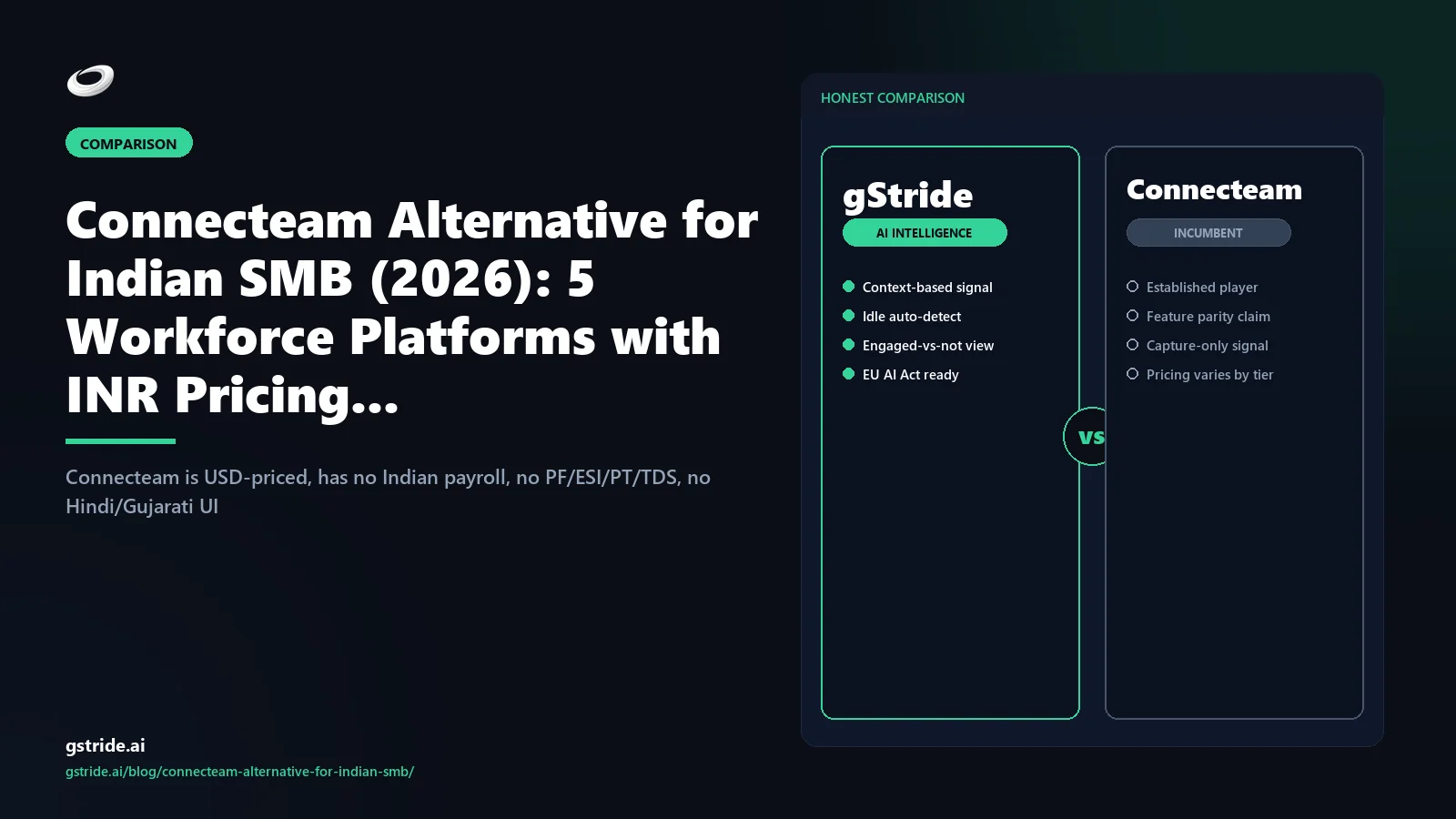
If you are a 50-to-200 person Indian SMB on Connecteam and you keep stitching it to a separate Indian payroll vendor every month, the closest like-for-like replacement is gStride — an AI productivity intelligence platform that bundles configurable monitoring, AI-assisted timesheets, shift and leave management with rotating/split/comp-off, and Indian-statutory payroll (EPF, ESIC, Professional Tax, TDS, gratuity, Form 16) in one INR-priced workspace defaulted to IST and aligned to the Indian financial year. Connecteam was built for US/EU SMB deskless workflows; the India SMB build of the workforce stack looks different.
The rest of this article walks through why Connecteam doesn't fit Indian SMBs, the six India-specific gaps it leaves open, the five alternatives worth comparing, and a clean migration path. If you only want the comparison table, jump to the alternatives section.
Why Indian SMBs outgrow Connecteam
Connecteam is a competent product for what it was built for: US, UK, Canada, and Australia SMB deskless-workforce coordination — chat, scheduling, time clock, forms, training, and a global payroll integration layer. For an Indian SMB ops or HR lead at 50-200 employees, four specific gaps create monthly friction that compounds quickly.
First, USD pricing. Connecteam's published 2026 plans are quoted in USD per active user per month . For an Indian SMB this means forex card surcharges on every renewal (typically 1.5-3.5%), GST under reverse charge on the imported service which the buyer must self-remit and then claim as input credit, and budget volatility because INR-USD moves 5-12% in a typical year. At 50-200 seats, that volatility alone is a meaningful line item.
Second, no Indian payroll, period. Connecteam's payroll integrations as documented in May 2026 cover Gusto, QuickBooks, Xero, Paychex, ADP, and a handful of US/UK/AU providers. None of those run Indian statutory deductions — EPF, ESIC, Professional Tax, TDS under Section 192, gratuity accrual, or Form 16 issuance . Indian SMBs running Connecteam end up with two systems and a monthly reconciliation between them.
Third, no Hindi, Gujarati, Tamil, or other regional UI. For SMBs in retail, manufacturing, logistics, field-services, and security where floor staff or drivers don't have English fluency, the English-only UI is a real adoption blocker. Indian HRMS competitors like Beehive and Zoho People have invested years in regional language support; Connecteam has not.
Fourth, no Shops & Establishments Act shift logic. Indian state-by-state Shops Acts each set their own working-hours caps, weekly off, statutory leave minimums, and women-employees-at-night provisions. Connecteam's scheduling has no concept of state-specific Indian compliance windows, comp-off accrual, or night-shift allowances under Indian labour codes.
The 6 India-specific gaps Connecteam doesn't fill
For an Indian SMB at 50-200 employees, the floor of "India-fit" is a specific list. This is what an Indian HR or ops lead actually needs the platform to handle natively — not as a separate vendor stitched on top.
- INR pricing and Indian invoicing. Plans quoted in INR. GST-compliant invoice from an Indian-registered seller (so AP doesn't have to deal with reverse-charge mechanics). UPI, NEFT, and corporate card billing supported. No forex friction on renewal.
- EPF and ESIC integration. Monthly EPF Electronic Challan-cum-Return (ECR) generation to the EPFO portal, UAN tracking per employee, EPS and EDLI splits, ESIC monthly return file, IP number tracking for eligible employees earning up to ₹21,000/month.
- Multi-state Shops & Establishments Act. State-by-state configuration for working hours, weekly off, public holidays under the Negotiable Instruments Act, women-night-shift permissions, statutory leave minimums (earned, sick, casual). Each state — Maharashtra, Karnataka, Delhi, Tamil Nadu, West Bengal, Gujarat, Telangana — has its own provisions and the platform needs to apply the right rules per location.
- Contract labour compliance. Records under the Contract Labour (Regulation and Abolition) Act, 1970 for vendor-supplied staff, including principal-employer obligations, monthly returns, and identity records — relevant for SMBs in retail, manufacturing, and logistics that run mixed direct + contract workforces.
- Multi-language interface. Hindi at minimum, plus Gujarati, Tamil, Telugu, Marathi, Kannada, or Bengali for SMBs whose floor staff or drivers operate in a regional language. English-only is fine for IT services and ITES; it is a real blocker for mass-employer SMB verticals.
- BPO and ITES shift cycles. Rotating shifts (24x7 floors), split shifts, comp-off accrual, night-shift allowance computation, women-at-night transport-and-warden compliance windows, and the rotating-shift handover logic that Indian BPO licensing requires under the applicable Shops Act or Factories Act. For SMBs at the 100-200 seat band running US/UK/AU client time zones, this is operationally non-negotiable.
A platform that ships only chat, scheduling, and time clock and offloads all six of these to separate vendors is not a workforce platform for an Indian SMB — it is a coordination tool plus an integration problem.
5 Connecteam alternatives compared for Indian SMBs
Here is the honest 5-tool comparison, scoped to what an Indian SMB ops or HR lead actually buys on. All competitor and pricing claims were checked on May 7, 2026 against vendor public pages.
| Tool | INR pricing | EPF / ESIC native | Multi-state Shops Act | Multi-language UI | BPO shift cycle | Cost floor (50 emp) | AI signal layer | EU AI Act ready |
|---|---|---|---|---|---|---|---|---|
| gStride | Yes | Yes — native | Yes — state config | English only | Rotating, split, comp-off | From ₹9,950/mo (50 × ₹199) | Productivity intelligence | Yes — published |
| Connecteam | USD only | No | No | English + a few global | Scheduling only | ~₹1,12,000/mo (USD $30 × 50 Operations) | Activity rate | Not specifically |
| Keka HR | Yes | Yes — pioneer | Yes — mature | English only | Mature | From ₹6,999/mo flat (up to 100 employees) | No native | Not published |
| GreytHR | Yes | Yes — payroll-deep | Yes — strong | English + Hindi | Basic shift | From ₹4,495/mo (Welter plan, 25 employees + ₹30/extra) | No | Not published |
| Zoho People + Payroll | Yes | Yes — full suite | Yes — broad | Multi-language | Basic | From ₹4,900/mo (50 × ₹98 People + Payroll combined entry) | Bolt-on (Cliq, WorkDrive) | Zoho group DPA |
| Beehive HRMS | Yes | Yes | Yes | Hindi, Gujarati, more | Standard shift | Custom quote (typically ₹50-80/user/mo) | No | Not published |
See gStride on your own team's data
A 15-minute walkthrough on the configuration surface — productivity intelligence without surveillance, screenshots off by default. No SDR gate, straight to a product engineer.
Book a 15-min demo → Prefer to look at numbers first? See gStride pricing.The split is clear. Connecteam is the wrong category for Indian SMBs because it has no Indian payroll, no Shops Act logic, USD pricing, and no regional language UI. Keka and GreytHR are mature Indian HRMS pioneers but treat productivity intelligence as a missing layer or out-of-scope. Zoho People is broad and multi-language but shallow on productivity signal. Beehive is the strongest fit for retail/manufacturing SMBs that need vernacular UI. gStride is the option that replaces Connecteam like-for-like in an Indian SMB context with the addition of an AI productivity intelligence layer plus EU AI Act readiness for SMBs serving cross-border clients.
Deep-dive: the 5 alternatives
gStride — productivity intelligence + Indian payroll bundled
gStride is built as an AI productivity intelligence platform, not a time tracker, and the India SMB build was designed against the six-gap list above. The bundle includes configurable productivity monitoring (per-user, per-project toggles, screenshots off by default), AI-assisted timesheet review and idle classification, shift, leave, and attendance management with rotating shifts, split shifts, comp-off accrual, and women-night-shift compliance windows, and native payroll with EPF, ESIC, Professional Tax, TDS, gratuity accrual, and Form 16 issuance. INR pricing, IST default timezone, Indian financial year (April-March) for payroll cut-offs, and state-by-state Shops Act configuration. If your SMB is an IT services or outsourcing shop, the same stack is packaged as workforce AI built for India IT services, with client-audit and DPDP evidence flows layered on top.
Where gStride wins versus Connecteam for an Indian SMB: bundled Indian payroll instead of a parallel HRMS, configurable monitoring with privacy-first defaults instead of always-on activity tracking, INR pricing without forex/GST friction, and an AI productivity intelligence layer that turns capture into management signal rather than just minutes-on-task — the category-canonical framing of that capture-to-signal-to-recommendation-to-action stack is in our AI productivity intelligence platform pillar guide. EU AI Act readiness is published, which matters for SMBs serving EU clients post August 2, 2026. Where gStride is weaker than Beehive or Zoho: Hindi or regional-language UI is not yet shipped — knowledge-work SMBs do fine, mass-employer SMBs in retail/manufacturing should evaluate the multi-language alternatives.
Keka HR — Indian HRMS pioneer for mid-market
Keka is one of the most mature pure-play Indian HRMS platforms, with strong EPF/ESIC/PT/TDS handling, comprehensive payroll, attendance with biometric integrations, and a large customer base across Indian SMBs and mid-market . Where Keka does well: payroll depth, statutory compliance across all major states, employee self-service, performance review modules, and a polished UX that Indian HR teams adopt quickly. Where Keka is missing for Indian SMBs evaluating against Connecteam: there is no native productivity intelligence layer. No idle-time AI, no project-context activity capture, no configurable monitoring at the desktop or browser level, and EU AI Act readiness is not specifically published.
Keka pricing starts around ₹6,999/month flat for up to 100 employees on the entry tier, with module-based add-ons for higher tiers . For an Indian SMB whose primary buy is HRMS-first and who treats productivity as out-of-scope, Keka is a strong choice. For an SMB that wants both productivity intelligence and Indian payroll in one bundle, gStride is the closer fit.
GreytHR — Indian payroll specialist with deep statutory depth
GreytHR has the deepest pure-payroll statutory depth in the Indian SMB market, with very strong EPF, ESIC, Professional Tax, TDS, LWF, gratuity, and a large library of state-specific Shops Act and Factories Act compliance reports . The platform is widely used by mid-market Indian SMBs and CA firms managing payroll for client SMBs. Where GreytHR does well: statutory depth, multi-state compliance, payroll automation, and a Hindi UI option for select modules. Where GreytHR is thinner: shift management is basic, productivity intelligence is absent, and the UX is closer to traditional HRMS than to a modern productivity platform.
GreytHR pricing starts at ~₹4,495/month for the Welter plan covering 25 employees, with an additional ~₹30/employee/month for extra headcount . Higher-tier plans add performance, leave-management depth, and document workflow. For an Indian SMB where the Connecteam replacement priority is payroll-first and shift is a secondary need, GreytHR is the safest choice.
Zoho People + Zoho Payroll — Zoho-stack integrated suite
Zoho People paired with Zoho Payroll covers the Indian compliance baseline well, with EPF, ESIC, PT, TDS, Form 16, and statutory leave handling all present . Multi-language support including Hindi and several regional languages is a real strength. The buying logic is usually existing Zoho-stack customers — SMBs already running Zoho CRM, Zoho Books, and Zoho Mail get a coherent integrated experience. Zoho's monitoring story is weaker; productivity insights come from cross-product analytics in Zoho Cliq, WorkDrive, and TeamInbox, which is bolt-on rather than a unified productivity intelligence layer.
Zoho People starts at around ₹48/user/month and Zoho Payroll at around ₹50/user/month on entry plans , which is the most aggressive INR pricing in this comparison. For 50 employees on combined entry plans, that is roughly ₹4,900/month all-in. The trade-off is depth — at the SMB end Zoho is excellent value; at 100-200 employees, Indian SMBs often hit module limits or want a more focused productivity layer and end up consolidating onto Keka, GreytHR, or gStride.
Beehive HRMS — multi-language Indian SMB suite
Beehive is an Indian-built HRMS suite focused on the SMB and mid-market band, with strong multi-language support (Hindi, Gujarati, and several regional languages), full EPF/ESIC/PT/TDS payroll, and good Shops Act compliance coverage . For SMBs in retail, manufacturing, logistics, and field-services where floor staff need vernacular UI, Beehive is the most practical fit on this list. Pricing is custom-quote (typically ₹50-80/user/month range based on modules and headcount), so it is harder to benchmark from public pages alone.
Where Beehive wins versus Connecteam: full Indian statutory payroll, vernacular UI, INR pricing. Where Beehive is thinner than gStride: no AI productivity intelligence layer, no published EU AI Act readiness, and the productivity-monitoring story is closer to traditional attendance than to modern signal capture. For an Indian SMB whose primary buyer is an HR generalist managing a multi-language floor workforce, Beehive is a strong choice. For SMBs with a mixed knowledge-work and floor workforce that also need productivity intelligence, gStride bundles more.
The 50-200 SMB sweet spot: when each tool fits
Indian SMBs are not one buyer. A 50-person fintech in Bengaluru and a 150-person logistics SMB in Surat have very different needs. Here is the honest fit map.
| Indian SMB profile | Best fit | Why |
|---|---|---|
| 50-200 IT services / ITES / SaaS / fintech, knowledge-work, English-fluent, may serve EU clients | gStride | Productivity intelligence + Indian payroll + EU AI Act readiness in one bundle |
| 50-200 consulting / services / professional services, HR-led buying, payroll-first | Keka HR | Mature India HRMS, polished UX, deep statutory; productivity is out-of-scope |
| 25-100 SMB where payroll statutory depth and CA-firm support matter most | GreytHR | Deepest pure-payroll statutory; widely used by Indian CA firms for client payroll |
| 25-100 SMB already on Zoho stack (CRM, Books, Mail), price-sensitive | Zoho People + Payroll | Cheapest INR entry pricing; coherent with existing Zoho stack; multi-language |
| 50-200 retail / manufacturing / logistics / field-services, multi-language floor staff | Beehive HRMS | Hindi, Gujarati, and regional UI; built for mass-employer Indian SMB verticals |
| 100-200 BPO, ITES floor with US/UK/AU client time zones, rotating 24x7 shifts | gStride or Keka | Both handle BPO shift cycles; gStride adds productivity intelligence, Keka adds HRMS depth |
For deeper BPO-specific evaluation, see our BPO workforce management software India guide. For Indian SMBs comparing other US-built tools, see our Hubstaff alternative for India guide.
Migration playbook: Connecteam to Indian-fit platform in 3 steps
If you are running Connecteam plus a separate Indian payroll vendor today and the monthly reconciliation is hurting, here is the cleanest migration path to a unified Indian-fit platform.
- Pick a payroll-month boundary and export master data. Indian payroll typically closes between the 25th and the 1st of each month. Cut over on day one of a fresh month so you don't reconcile mid-cycle. Avoid March (financial year close, Form 16 generation) and the month after a hike cycle. Pull from Connecteam: time entries, shift schedules, team rosters, custom fields, and any active forms or training modules. Pull from your current Indian payroll vendor: PF UAN per employee, ESIC IP number for eligible employees, PAN for TDS, state for Professional Tax, declared investments under Section 80C/80D for the current FY, basic-DA-HRA structure per the appointment letter, gratuity accrual to date, and any LWF state participation.
- Configure the new platform end-to-end before cutover. Map projects, teams, and shift templates from Connecteam. Configure state-by-state Shops Act rules per branch location. Set up EPF, ESIC, Professional Tax, and TDS rules per state. Run a dry-run payroll for the prior closed month against last month's actual numbers from your current vendor — match within 1% before going live. If you are switching to gStride, also configure the productivity-monitoring policy (per-team toggles, screenshot frequency or off, idle-time thresholds) and update your employee monitoring notice and consent under India's Digital Personal Data Protection Act 2023 — see productivity monitoring without surveillance for the framing.
- Run parallel for one cycle, then cancel. Keep Connecteam and the old payroll vendor live in read-only for one full payroll cycle so you can answer audit questions while the new system stabilizes. Run the first live payroll out of the new platform at month-end. Validate EPF ECR submission to EPFO portal, ESIC return file generation, Professional Tax remittance, and TDS quarterly Form 24Q against the prior cycle's filings. Issue Form 16 for the relevant period if you are cutting over near financial year close. Cancel both old systems at the end of month two.
Most Indian SMBs at the 50-200 band complete the cutover in two to three weeks of active work, with a one-month parallel-run buffer on top.
The honest TCO frame for Indian SMBs
The Connecteam price tag is only the visible cost for an Indian SMB. The real total cost of ownership has four layers.
| Cost layer (50-employee Indian SMB) | Connecteam stitched stack | gStride bundled |
|---|---|---|
| Workforce coordination (chat, scheduling, time clock) | Connecteam Operations @ ~$30/user/mo × 50 = ~$1,500/mo (~₹1,26,000) | Included in bundle |
| Indian payroll (separate vendor) | Keka or GreytHR @ ~₹100/user/mo × 50 = ₹5,000/mo | Included in bundle |
| Productivity intelligence layer | Not present (or separate tool) | Included in bundle |
| Forex + GST reverse-charge friction | 1.5-3.5% on Connecteam USD invoice | None (INR invoice) |
| Reconciliation labour (finance + HR) | 4-8 hours per month | Minimal (single source of truth) |
| All-in monthly | ~₹1,30,000-1,50,000 + reconciliation labour | From ₹9,950/mo at 50 seats |
For most 50-200 person Indian SMBs, the bundled approach is 50-70% cheaper on a like-for-like feature comparison, before counting the reconciliation labour. For exact current pricing on your team size, see gStride pricing. Connecteam's published USD plans are at connecteam.com/pricing .
Frequently asked questions
What is the best Connecteam alternative for an Indian SMB?
For a 50-200 person Indian SMB that needs deskless or hybrid workforce management plus Indian statutory payroll, gStride is the closest like-for-like alternative to Connecteam. Connecteam has no Indian payroll, no EPF/ESIC, USD-only pricing, and no Shops & Establishments Act shift logic. gStride bundles AI productivity intelligence, configurable monitoring, shift and leave management, and full Indian statutory payroll (EPF, ESIC, Professional Tax, TDS) in INR-priced plans. For HRMS-first buyers, Keka HR and GreytHR are mature alternatives.
Does Connecteam handle EPF and ESIC in India?
No. As of May 2026, Connecteam's payroll integrations cover Gusto, QuickBooks, Xero, Paychex, ADP, and similar US/UK/AU providers. None of those compute Indian statutory deductions — EPF, ESIC for employees earning up to ₹21,000/month, Professional Tax slabs, or TDS on salary under Section 192. Indian SMBs on Connecteam end up running it for shift and chat while a separate Indian payroll vendor such as Keka or GreytHR handles statutory payroll.
Is Connecteam priced in INR or USD?
USD only. Connecteam's published 2026 plans are quoted in USD per active user per month, with billing through international payment methods. For an Indian SMB this means three layers of friction every renewal: forex card or wire surcharges (typically 1.5-3.5% per transaction), GST under reverse charge on the imported service which AP must self-remit and then claim as input tax credit, and budget volatility because INR-USD has moved 5-12% in a typical year. INR-priced alternatives like gStride, Keka, GreytHR, and Beehive carry none of this.
What Indian compliance does a workforce platform need to handle for SMBs?
At minimum: EPF contributions with monthly ECR challan generation, ESIC for eligible salary brackets, Professional Tax per the applicable state slab, TDS on salary under Section 192, gratuity accrual under the Payment of Gratuity Act, statutory leave per the relevant state's Shops and Establishments Act, public holidays under the Negotiable Instruments Act, contract labour records for vendor staff, and shift compliance under the Factories Act or applicable Shops Act. Connecteam handles none of these natively.
Does gStride support Hindi or regional languages for Indian floor staff?
gStride's interface is currently English-only, which matches the working language of most Indian IT services, BPO, and corporate workforces. SMBs that need Hindi, Gujarati, Tamil, Telugu, or Marathi UI for floor staff or field operators should evaluate Beehive HRMS or Zoho People, which have invested more in regional language support. For knowledge-work teams English is rarely a blocker; for retail, manufacturing, and logistics SMBs, multi-language UI tilts the choice toward Beehive.
Can gStride handle multi-state Shops & Establishments Act compliance?
Yes. gStride supports state-by-state Shops & Establishments Act configuration for working-hours caps, weekly off, statutory leave minimums, women-employees-at-night rules, and overtime windows. The Shops Acts of Maharashtra, Karnataka, Delhi, Tamil Nadu, West Bengal, Gujarat, Telangana, and Haryana each have different provisions — for example, Karnataka caps weekly hours at 48 with daily 9, Maharashtra at 48/9, while women-night-shift permissions vary by state. gStride lets you set the state per workspace location and applies the right rules per branch. Connecteam has scheduling but no concept of state-specific Indian Shops Act windows.
Can gStride handle BPO 24x7 shift cycles and night-shift allowance?
Yes. gStride's shift module supports rotating shifts (24x7 BPO floors), split shifts, weekly off rotation, comp-off accrual, night-shift allowance computation, and the women-at-night transport-and-warden compliance windows that Indian BPO licensing requires. For a 100-200 seat BPO floor in Bengaluru, Pune, or Hyderabad running US/UK/AU client time zones, the rotating-shift compliance under the applicable Shops Act or Factories Act is operationally significant — Connecteam's scheduling does not handle comp-off, night-shift differential, or Indian statutory shift windows. For a deeper BPO comparison, see our BPO workforce management software India guide.
How much does it cost to switch from Connecteam to an Indian-fit platform?
For a 50-employee Indian SMB, a stitched stack (Connecteam at ~$30/user/mo plus Keka or GreytHR at ~₹100/user/mo for payroll) runs roughly ₹1,30,000-1,50,000 per month before reconciliation labour. A bundled India-fit platform like gStride starts around ₹9,950/mo for 50 seats. The bundled approach is typically 50-70% cheaper at the 25-200 employee band, before counting 4-8 hours of monthly reconciliation labour saved. Migration usually takes 2-3 weeks of active work plus a one-month parallel run.
Does Connecteam comply with India's DPDP Act 2023 and EU AI Act for cross-border SMBs?
Connecteam documents GDPR and CCPA compliance with US/EU primary data residency. India's DPDP Act 2023 is not specifically called out in its public DPA, and there is no India data-residency option as of May 2026. For Indian SMBs serving EU clients, Connecteam's monitoring features may also fall under the EU AI Act high-risk classification for workplace AI, enforced from August 2, 2026. gStride publishes DPDP and EU AI Act readiness with India data-residency options. Verify with counsel.
Related reading on gStride
- gStride vs Connecteam: full feature-by-feature comparison
- gStride vs Monitask — SMB screenshot timer vs behavior-signal productivity intelligence
- Hubstaff Alternative for India: Workforce Platform with Indian Payroll
- gStride vs Keka — India HR suite vs AI productivity intelligence
- BPO Workforce Management Software in India: 2026 Buyer's Guide
- Payroll & Payments — native, multi-currency, Indian-statutory
- Shift, Leave & Attendance — rotating, split, comp-off
- gStride pricing — INR plans for Indian SMB teams
Three honest ways to de-risk the decision
No lock-in, no sales gate. Pilot gStride on one team before touching your Connecteam setup — if it does not fit your workflows, you deprovision it and your attendance and timesheet data stays exportable.
Run gStride on one team cohort with INR pricing and IST defaults. No card required — check the shift, leave, and Indian-statutory payroll fit against Connecteam on your own roster.
Start the free trial →Score any shortlisted vendor in 14 questions and get a verdict band on consent posture, data residency, and purpose limitation — free, no email to score; verify with counsel.
Run the free check →Model the one-time cost of moving off Connecteam — parallel-run overlap, roster export, team onboarding, payroll-integration cutover. Runs in about 5 minutes, no email required.
Estimate my switch cost →Want to walk through the pilot setup? Book a 15-min pilot review →
See gStride for your Indian SMB
Productivity intelligence, configurable monitoring, AI-assisted timesheets, shift/leave management, and Indian-statutory payroll — bundled in INR pricing with IST defaults and state-by-state Shops Act compliance. The fastest way to compare is to look at the configuration surface side-by-side.
Book a 15-min demo → View INR pricing See payroll featuresAll competitor and pricing references in this article were verified on May 7, 2026 from vendor public pages: connecteam.com/pricing, keka.com/pricing, greythr.com/pricing, zoho.com/people/pricing, and beehivehrms.com. Vendor capabilities and pricing change frequently — verify on the vendor's own site before making a decision. Indian statutory rates (EPF wage ceiling, ESIC bracket, Professional Tax slabs, gratuity formula) are subject to change by the relevant authorities; consult a qualified Chartered Accountant for compliance-critical decisions.