
The pain — verbatim from the founder call
"We can't measure or bridge the junior/senior productivity gap. Our seniors are 3-5x more productive but I have no way to show juniors specifically what to learn."
— An Ahmedabad IT services CEO running an MSP, on an advisor call, April 2026
The founder runs a managed-services practice with a mixed engineering team — about a third senior, two-thirds mid-and-junior. The seniors are 3-5x more productive on his subjective measure (tickets closed per week, customer-facing PRs merged per sprint, internal mentorship hours absorbed). His honest admission is that he has no instrument to show a junior specifically what to learn. The closest his managers come is the year-end review conversation: "Be more like Senior X." That sentence does not tell the junior whether the problem is meeting overload, blocker-recovery latency, fragmented focus, or under-prepared PRs.
This is a category of pain that surveillance tools make worse, not better. A screenshot every 10 minutes does not teach a junior anything. What teaches a junior is a signal-by-signal comparison to a senior on the same team, run through a weekly mentor-loop with a person who can interpret the gap.
Why the gap exists — four reasons
1. Pattern compression
Seniors have seen this ticket before. A senior who has been a backend engineer for nine years has resolved roughly 5,000 to 8,000 tickets of varying difficulty across her career. She recognises the shape of the current problem in the first 90 seconds and skips the three dead-end branches a junior must walk to learn that the bug is in the connection-pool config, not in the application layer. Pattern compression is the single largest contributor to the 3-5x gap. It is also the slowest to close — it follows the apprenticeship curve.
2. Focus-block length
Seniors hold 90-to-120-minute uninterrupted focus blocks because they have fewer unresolved unknowns to context-switch into. A junior facing the same task switches every 12-18 minutes to a Stack Overflow tab, a Slack DM to a senior, a documentation search, a teammate question. Each switch costs 12-25 minutes of re-warmup before the junior is back at depth. Across an 8-hour day, the senior produces three to four flow-state blocks; the junior produces zero to one. The output gap on deep-work tasks compounds against the focus-block gap.
3. Blocker-recovery latency
When a senior hits a blocker, she knows which Stack Overflow tab, which colleague, which doc, or which Slack channel has the answer. Mean blocker recovery is under 8 minutes. When a junior hits the same blocker, she tries three search queries, opens five tabs, reads two unrelated docs, posts a question in #help, and waits 18 minutes for a response. Mean blocker recovery is 25-40 minutes. Across a day with four blockers, the senior loses 32 minutes; the junior loses 100-160 minutes. That gap is invisible to the manager and to the junior on a punch-card view.
4. Commit-quality first-pass rate
Seniors push PRs that merge in 1-2 review rounds. The internalised quality bar (test coverage, error handling, naming, comment density, edge-case handling) is high enough that the reviewer asks for refinement, not rework. Juniors push PRs that need 4-6 rounds of review feedback before merge. Every extra round is a context-switch for both the junior and the senior reviewer — the gap propagates into the senior's productivity too, which is part of why scaling junior headcount without scaling mentorship machinery can reduce total team output rather than increase it.
The per-signal benchmark model — what AI productivity intelligence surfaces
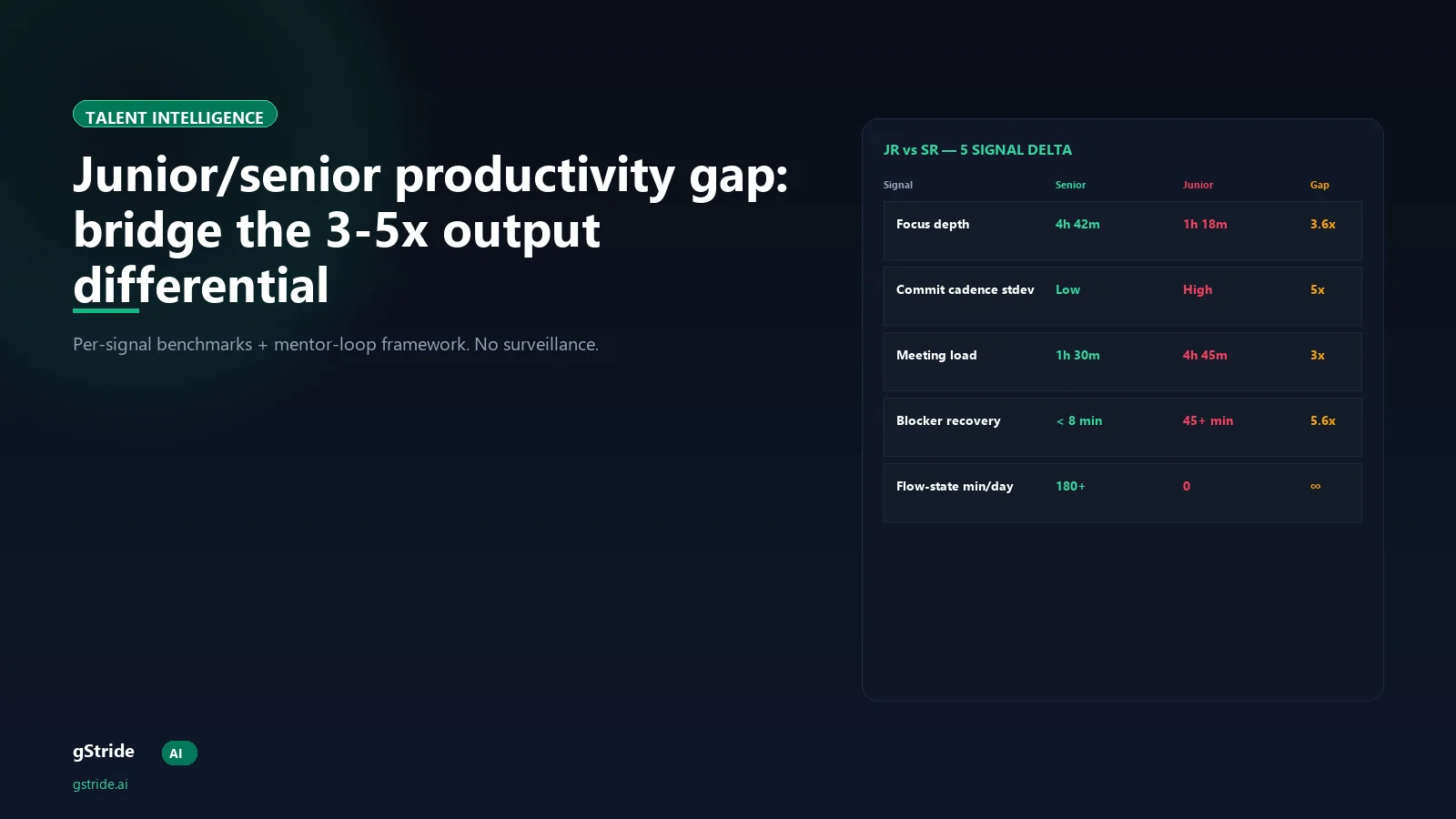
The benchmark model below is what gStride's AI productivity intelligence feature ships with for engineering teams. The benchmark is not a target to punish the junior on; it is a learning curve to mentor against. The point is that the junior, the senior mentor, and the engineering manager all see the same data — and the conversation is grounded in the same signal.
| Signal | Junior benchmark (month 3) | Mid benchmark (month 12) | Senior benchmark |
|---|---|---|---|
| Focus-block length (median) | 15-25 min | 30-50 min | 60-120 min |
| Flow-state minutes / day | 30-60 min | 90-150 min | 180-240 min |
| Blocker-recovery (median) | 25-40 min | 12-20 min | 4-8 min |
| Commit-quality (review rounds to merge) | 4-6 rounds | 2-3 rounds | 1-2 rounds |
| Commit cadence / day | 1-2 commits, irregular | 3-5 commits, steady | 5-8 commits, steady |
The four behaviour deltas that the platform surfaces against the seniority benchmark:
- Flow-state delta. The gap between the junior's actual flow-state-minutes per day and the seniority benchmark. A junior at 30 min/day against an expected 60 min/day has a -30 min flow-state delta. The intervention is meeting-load rebalancing, calendar protection, and removing the cross-team interrupts that fragment the morning.
- Blocker-recovery delta. The gap in mean blocker-recovery latency. A junior at 32 min against a senior at 6 min has a +26 min blocker-recovery delta. The intervention is mentor-led "how I would have unblocked this" walkthroughs — the senior shows her actual search shape, which docs she would have read, which colleagues she would have pinged.
- Commit-quality delta. The gap in review rounds to merge. A junior at 5 rounds against a senior at 1.5 has a +3.5-round commit-quality delta. The intervention is pre-PR self-review checklist, paired commit-prep sessions, and graduated PR scope (start the junior on 50-line PRs, scale to 200, then 500).
- Focus-block delta. The gap in median focus-block length. A junior at 18 min against a senior at 75 min has a -57 min focus-block delta. The intervention is calendar protection (block out a 90-min morning block), notification-discipline coaching, and structural changes to how the junior is interrupted by senior questions.
The mentor-loop framework — 15 minutes a week, 90 days
The benchmark only matters if it is mentored against. The mentor-loop framework is the operational shape that converts visibility into capability transfer. The full productivity intelligence pilot framework covers the platform rollout; the mentor-loop is the human layer on top.
Assignment (week 1)
Every junior is paired with one senior mentor. The pairing is not based on org-chart proximity — it is based on signal-shape complementarity. The senior mentor's specific strength (deep-focus engineer, fast blocker-recovery engineer, high commit-quality engineer) is matched to the junior's largest delta. A junior with a high blocker-recovery delta is paired with the senior who has the shortest blocker-recovery on the team, regardless of whether that senior is technically the junior's reporting manager.
Weekly 15-minute mentor-loop (week 2 onward)
Every Friday afternoon, the mentor pair sits for 15 minutes. The mentor opens the junior's per-signal dashboard for the week, picks the one signal furthest from the seniority benchmark, and walks the junior through how she herself would have handled it differently. The conversation is grounded in the same data both sides see. The output is one concrete commitment for the following week ("I will use the IDE focus-mode for two 90-minute blocks before lunch every day"). The mentor logs the commitment; the platform tracks whether the commitment was honoured the following week.
Monthly review (week 4, 8, 12)
Every fourth week, the junior, the mentor, and the engineering manager sit for 30 minutes. The conversation is the four behaviour deltas: flow-state delta, blocker-recovery delta, commit-quality delta, focus-block delta. The platform shows the trend on each. The manager confirms or adjusts the trajectory, the mentor flags any pattern the data does not capture, and the junior asks any question the data raised.
90-day outcome review (week 13)
The 90-day milestone is when the four-delta picture is reviewed against the apprenticeship curve. Most juniors close roughly half their delta on the most-coachable signals (blocker-recovery, focus-block length) in 90 days. The slower-moving signals (commit-quality, flow-state minutes) take 6-12 months. The 90-day review documents the trajectory, sets the next-90-day priority signal, and feeds the appraisal-cycle integration.
Free: 5-Signal Productivity Self-Audit Worksheet
30-min audit you can run on your own engineering team today — focus depth, commit cadence, meeting load, flow-state minutes, blocker recovery. PDF + Google Sheets calc. Drop-in template for IT-services Ops Heads and Founders.
Outcome — the composite picture at 90 days
On the founder's question — "I have no way to show juniors specifically what to learn" — the 90-day outcome looks like this. Every junior on the team has four named behaviour deltas with a numeric current value and a numeric seniority benchmark. Every junior has an assigned senior mentor and a 15-minute weekly conversation grounded in the same data both sides see. Every junior has one concrete commitment per week and a tracked compliance rate on that commitment. Every junior has a monthly review of the trend on each delta, with the engineering manager looped in. Every junior has a 90-day milestone that feeds the appraisal cycle and the promotion conversation.
The composite outcome at 90 days, drawn from small-IT customer rollouts: blocker-recovery delta closes by 55-70%, focus-block delta closes by 35-50%, commit-quality delta closes by 25-40%, and flow-state minutes per day grows by 30-45%. The 3-5x productivity gap moves to roughly 1.8-2.5x. That is the typical 90-day shape; the rest follows the apprenticeship curve.
The most underappreciated outcome is at the senior level. The mentor-loop framework creates structured mentorship time that previously did not exist on the senior's calendar. The senior's own management capability grows alongside the junior's productivity. That capability accumulation is the foundation for the senior's own promotion to staff or lead — which is the long-run answer to retaining seniors in a small IT shop.
Free: CISO Procurement Checklist for AI Productivity Vendors
10 questions every CISO and IT-services CEO should ask before signing — data residency, DPIA, AI auditability, breach SLA, retention, SCIM/SSO, sub-processors, right to audit. Includes scoring rubric and pass / hold / walk thresholds.
Further reading on gStride
Frequently asked questions
Why are seniors 3-5x more productive than juniors at small IT shops?
The gap is structural, not effort-based. Seniors compress decisions: they recognise patterns from 5,000+ prior tickets and skip the dead-end branches a junior must walk. Seniors hold longer focus blocks (90+ minute flow-state) because they have fewer unresolved unknowns to context-switch into. Seniors recover from blockers in under 8 minutes because they know which Stack Overflow tab, which colleague, or which doc has the answer; a junior loses 25-40 minutes per blocker. Seniors commit cleaner code on first push because they internalise the team's code-review feedback patterns. None of those advantages are about hours-in-chair — they are about per-signal efficiency. The gap is closable, but only if the signal is surfaced.
What is a per-signal benchmark by seniority?
A per-signal benchmark sets the expected range for each behaviour signal (focus depth, commit cadence, flow-state minutes, blocker recovery, commit-quality) for each seniority level on the engineering team. A senior engineer's expected flow-state-minutes-per-day might be 180 minutes; a junior's expected baseline at month 3 might be 60 minutes, growing to 120 by month 9. The benchmark is not a target to punish the junior on; it is a learning curve to mentor against. The benchmark makes the gap visible, specific, and triable in a one-on-one — instead of leaving the junior to guess what "be more like the senior" means.
Does this require screenshots or keystroke logging?
No. Every signal in the benchmark model — focus depth, commit cadence, flow-state minutes, blocker recovery, commit-quality — reads from operational metadata: the OS reports the active window, Git reports the commit cadence and PR-review iterations, the calendar reports meeting load. None of those signals require content capture. The platform never reads what the developer typed, never screenshots the screen, never captures URL history. This is the difference between productivity intelligence and surveillance.
How does the mentor-loop framework work?
The mentor-loop framework is a 15-minute weekly one-on-one between the junior and an assigned senior mentor, anchored on the per-signal benchmark report. The senior opens the junior's dashboard for the week, picks the one signal furthest from the seniority benchmark, and walks the junior through how they themselves would have handled the day differently. The conversation is not "work harder" or "be more disciplined" — it is "I see you spent 47 minutes on this blocker, here is how I would have unblocked it in 12." The conversation is grounded in the same data both parties see. Over 90 days, the junior's per-signal benchmark moves toward the senior's. The loop is mentor-led, not surveillance-led.
What is "commit-quality" as a signal?
Commit-quality is the count of post-review iterations required before a junior's PR merges. A junior who pushes a PR that needs 6 rounds of review feedback before merge has a commit-quality score that signals "still learning the team's quality bar." A senior pushing PRs that merge in 1-2 review rounds has internalised the bar. The signal reads from Git/GitHub/GitLab metadata — review comments per PR, time-to-merge, number of force-pushes — not from code content. Commit-quality is the strongest predictor of senior promotion-readiness in our internal small-IT data.
How long does it take to bridge the 3-5x gap?
In small-team data, juniors mentored on the per-signal model close roughly half the productivity gap within 90 days (from 3-5x to roughly 1.8-2.5x). Closing the rest typically takes 12-18 months — that is the time scale for pattern accumulation, code-review feedback internalisation, and cross-domain exposure. The platform compresses the visibility timeline; it does not skip the apprenticeship timeline. The right question for the founder is not "when will the junior match the senior?" but "how do I make every junior's first 12 months 2x more efficient than the last cohort's first 12 months?" The mentor-loop framework answers that.
What if the junior pushes back on being benchmarked?
Pushback comes from one of three things: (1) the benchmark feels punitive — solved by framing as a learning curve, not a target; (2) the senior is also not visible in the system — solved by making senior signal visible alongside the junior's, so the comparison is symmetric, not surveillance; (3) the junior worries the data will be used in appraisal without context — solved by writing the appraisal-cycle integration policy upfront, so the junior sees how signal feeds review and what the manager-discretion override looks like. With those three guardrails, pushback drops below 10% in small-IT rollouts.
Does the per-signal benchmark replace the 1-on-1?
No. The benchmark grounds the 1-on-1; it does not replace it. A senior mentor still needs to listen to the junior, understand the personal context behind a low-focus week, and judge when the data does not capture the full picture (a family emergency, a hard blocker, a shifting team priority). The platform handles the "what happened" question. The 1-on-1 still handles the "why" and the "what next" question. Founders who try to skip the 1-on-1 and let the dashboard do mentorship get worse outcomes than founders who run weekly 1-on-1s with no platform at all.
See per-signal benchmarks on your team in 30 minutes
Focus-block length, blocker recovery, commit-quality, flow-state minutes — by seniority. Self-view enabled day one. No screenshots.
Book a 30-min walkthrough Read the anti-surveillance stackThe Ahmedabad IT services CEO quoted gave the founder feedback in a private advisor call and is not publicly named. Per-signal benchmark ranges are drawn from anonymised aggregate data across small-IT customer deployments. The five-signal model is the working measurement framework on the gStride platform as of May 2026.