
Why pilot framework matters more than vendor selection in India ITES
The India IT services and BPO segment has unusual pilot dynamics. Procurement cycles are CFO-led, signal density is high (calendar, ticket, code, support-platform data all already exists), and the deployments are large enough that a wrong-shape vendor signature can absorb 12 to 18 months of operational distraction before it is unwound. The cost of a bad pilot is not the pilot cost — it is the opportunity cost of the procurement window the pilot consumed.
Three structural reasons the 30-day pilot framework matters more than vendor selection in this segment:
- Signal density makes early verification cheap. An IT services workforce already runs Jira/Linear/GitHub/Zendesk/Confluence at scale. Connecting an AI productivity intelligence platform to those sources at the metadata layer can produce a full week-1 baseline inside 3 to 5 working days. There is no excuse for a 90-day "implementation" before signal verification.
- DPDP Act 2023 grants employees grievance rights. Section 12 of the DPDP Act requires the data fiduciary to publish a grievance redressal process. A pilot that runs without the grievance walkthrough in week 2 is exposed to the same compliance overhead at full scale that it could have addressed inside the pilot envelope.
- Margin pressure makes ROI verification operational. IT services margins compress under fixed-bid SLAs and AI-driven productivity benchmarks. A pilot that does not produce a clear before-and-after on ticket throughput or focus density does not unlock the procurement signature. The framework below is designed around ROI verification as the week-4 gate, not as a post-deployment retrospective.
The playbook below is built from the deployments we have walked through with eight India ITES buyers in 2026, ranging from a 96-seat Pune AI/ML services firm to a 480-seat Bangalore-Hyderabad bilateral platform engineering team. The shape is consistent across the range; the calibration values change.
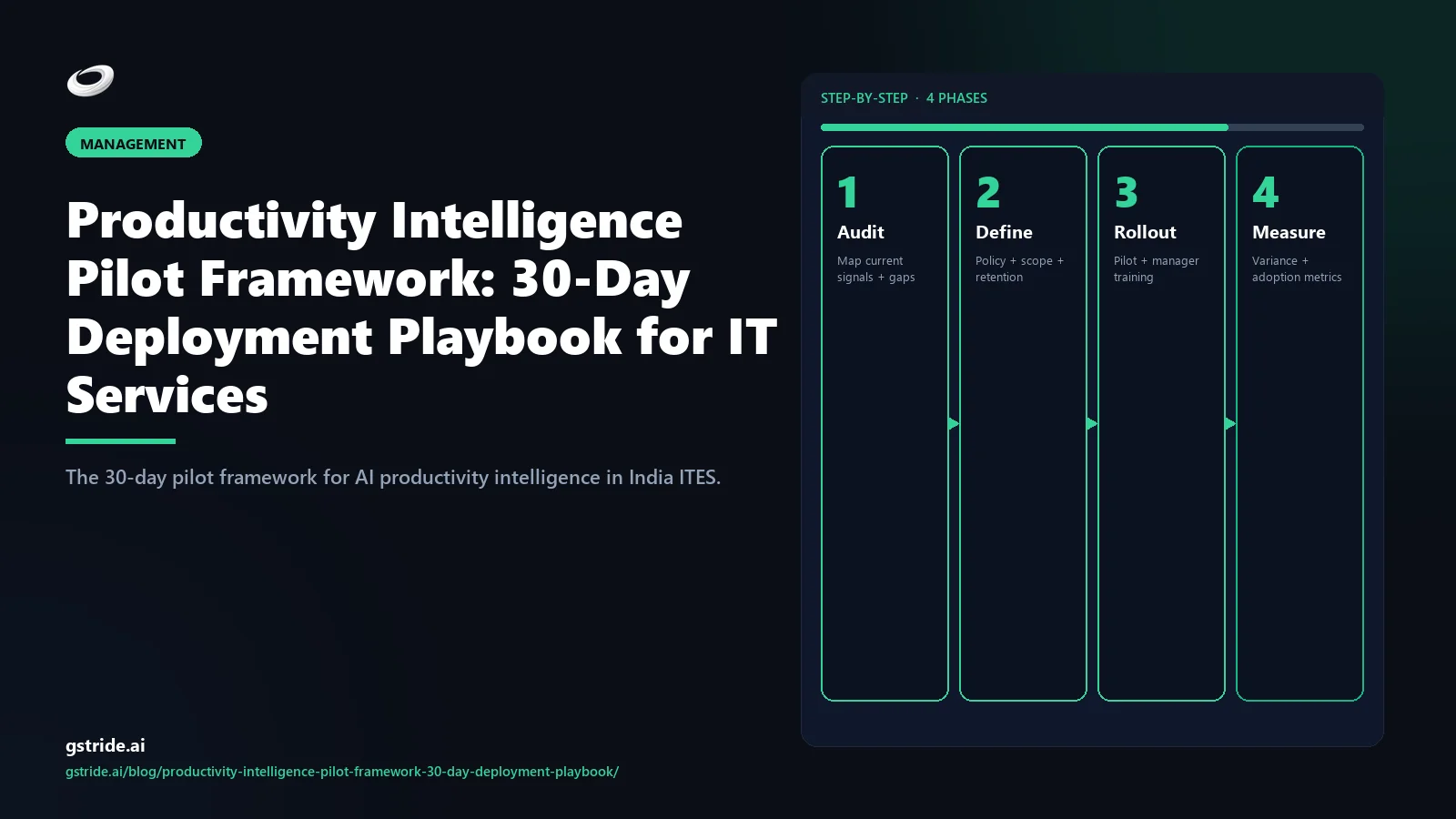
The 30-day pilot at a glance
| Week | Phase | Owner | Exit criteria |
|---|---|---|---|
| 1 | Data connection + signal baseline | IT lead + platform owner | 5 behavior signals baselined across pilot cohort over 5 working days |
| 2 | Governance gate + works/labour committee notice | HR head + DPO + CISO | Transparency notice published; FRIA filed; DPDP grievance walkthrough complete |
| 3 | Classification calibration + recommendation surface | Engineering lead + people manager | Activity classification calibrated; employee self-view live; bidirectional recommendation feed firing |
| 4 | ROI verification + procurement decision | CIO + CFO + CISO + HR head | 5 success criteria measured; 3-of-5 threshold cleared; signature decision |
Week 1 — Connect data sources and baseline the 5 behavior signals
Week 1 is the data-plumbing phase. The pilot cohort is selected (typically 1 to 3 engineering teams plus 1 customer-support or service-delivery team, totalling 80 to 500 seats) and the data source connections are made:
- Calendar API. Google Workspace or Microsoft 365 calendar metadata — meeting count, duration, attendee count, recurrence pattern. No meeting body or attachment content.
- Ticket platform API. Jira, Linear, GitHub Issues, Zendesk, ServiceNow, Asana — ticket count, status transitions, time-in-status, assignee changes. No ticket body or comment content.
- Foreground application agent. Lightweight macOS/Windows/Linux agent that captures foreground application name only — no window content, no URL bar, no screen capture, no keystroke logging.
- Notification platform metadata. Slack and Microsoft Teams API for notification activity windows (used for focus density boundary detection).
Any legacy screenshot or keystroke capture from previous tools is disabled at the start of week 1. The 5 behavior signals — focus density, calendar load, ticket flow, application context, deep-work continuity — are baselined over the first 5 working days. The baseline is the floor against which week-4 ROI is measured. Our 5 behavior signals framework walks through each signal with operational depth.
Common Week 1 pitfalls
- Pilot cohort too narrow. A pilot of one team produces too little cross-role signal — calibrate against at least 2 role types (engineering + support, or engineering + design).
- Baseline window too short. Three days is not enough to see meeting and ticket flow cycles. Five working days is the floor; seven is better.
- Capture not disabled. Running screenshots alongside the new signal layer doubles the compliance overhead and confuses the ROI comparison. Disable capture as a hard prerequisite for week 2.
ROI Calculator — free. Estimate 30-day pilot ROI for your seat count, average loaded cost, and current legacy tool spend. Includes EU AI Act and DPDP Act compliance overhead modelling.
Run the ROI calculatorWeek 2 — Governance gate and DPDP grievance walkthrough
Week 2 is the governance phase. The pilot cannot scale past the cohort without the governance gate cleared, and the gate has to clear before classification calibration in week 3 starts producing scores. Three sub-deliverables:
- Transparency notice published to pilot cohort. The notice covers what data is being collected, what the AI system does with it, how the score is computed, what decisions the score will inform, and the employee's rights under DPDP Act 2023 (and EU AI Act + GDPR where applicable). The vendor's transparency notice template should be adapted to the deployment context.
- FRIA template filed. If any EU sub-processor is in the data path, the EU AI Act Article 27 Fundamental Rights Impact Assessment is filed under the buyer's DPO. The vendor's adaptable FRIA template should be used as the starting point. The FRIA is non-optional for high-risk AI systems from 2 August 2026 enforcement.
- DPDP Section 12 grievance redressal walkthrough. The Indian Digital Personal Data Protection Act 2023 Section 12 requires the data fiduciary to publish a grievance redressal mechanism. The walkthrough confirms that an employee can raise a grievance, the response SLA is documented, and the route to the Data Protection Board is published. A vendor that cannot operationally support this inside the platform is a procurement risk.
Governance gate exit criteria
- Transparency notice published to all pilot-cohort employees with acknowledgement tracked.
- FRIA filed (where applicable) or non-applicability documented under DPO sign-off.
- DPDP grievance route published and tested with one synthetic grievance case end-to-end.
- CISO sign-off on Article 28 DPA equivalent (India: data fiduciary contract under DPDP).
Week 3 — Classification calibration and bidirectional recommendation surface
Week 3 is where the platform stops being a measurement tool and starts being an operational tool. The activity classification rules — which application is "productive" for which role, which calendar pattern is "deep-work" vs "fragmented," which ticket transition is "completion" vs "blocked-then-restart" — are calibrated against the role types in the pilot cohort. The employee self-view is activated so each employee sees their own 5 signals in the same surface the manager sees. The bidirectional recommendation feed is fired — workload imbalance, focus erosion, meeting consolidation prompts go to both the manager and the employee.
Classification calibration sequence
- Day 11-12 (Tue-Wed of Week 3): Role-type classification rules. Engineering — VS Code, IntelliJ, Cursor, GitHub, Jira as productive. Support — Zendesk, Salesforce Service Cloud, Confluence as productive. Design — Figma, Sketch, Adobe XD as productive.
- Day 13 (Thu of Week 3): Employee self-view activation across pilot cohort. Manager and employee see the same dashboard.
- Day 14 (Fri of Week 3): Bidirectional recommendation feed live. First weekly recommendation digest pushed.
- Day 15 (Mon of Week 4): Recommendation-acted measurement begins. Track how many recommendations the manager and employee act on within 5 working days.
This is the phase that the older monitoring tools cannot replicate — they have a manager dashboard but no employee self-view, so the recommendation surface is one-way and the action rate stays low. Our productivity without surveillance piece covers the bidirectional surface pattern in depth.
Week 4 — ROI verification and procurement decision
Week 4 is the gate. The platform pulls a baseline-vs-pilot comparison across the 5 operational success criteria and the procurement-decision gate runs with CIO, CFO, CISO, and HR head as the four-corner sign-off. The five criteria and the typical target deltas:
| # | Success criterion | Measurement | Target delta vs baseline |
|---|---|---|---|
| 1 | Ticket throughput | Closed tickets per engineer per week | +15 to +25% |
| 2 | Focus density | Uninterrupted blocks per day, average length | +25 to +50% blocks, +20-40% length |
| 3 | Meeting load | Meeting hours per engineer per week | -10 to -20% |
| 4 | Deep-work continuity | Average single-task focus length | +30 to +60% |
| 5 | Timesheet accuracy | Auto-derived vs manual entry agreement | Above 85% |
Pilots that hit 3 of 5 criteria typically advance to full-fleet procurement. Pilots that hit 4 or 5 are a clear signature. Pilots that hit 0 to 2 either had the wrong pilot shape (mismatched cohort, broken baseline, governance gate slipped) or the wrong vendor — either way, the playbook has saved a 24-month wrong-shape purchase.
The procurement-decision gate: who signs and what they ask
The week-4 gate runs as a 90-minute four-corner review:
- CIO/CTO reviews technical integration, signal quality, and roadmap alignment. Pass: pilot data integrates cleanly with existing stack.
- CFO/Head of Finance reviews the ROI math: per-seat cost, payback window, opportunity cost of the legacy stack. Pass: payback inside 9 months at full-fleet pricing.
- CISO/DPO reviews the governance package: DPA, sub-processor list, audit trail, DPDP/AI Act conformance. Pass: 9-point verification framework cleared at 7+/9.
- HR head/CHRO reviews employee impact and policy fit: transparency notice acceptance rate, grievance count, employee survey delta. Pass: net positive employee signal, no policy collisions.
Four-corner sign-off with all four passing is a clean procurement. Two or three passes typically means a 30-day extension to address the specific gaps. Fewer than two passes means walk-away. Our CISO procurement questions piece covers the governance-side review surface; the scoring methodology verification piece covers the audit dimension.
Common pilot anti-patterns to avoid
- Pilot too long. 60-day or 90-day pilots typically don't produce better signal than 30-day pilots; they produce decision fatigue.
- Pilot too narrow. Single-team pilots produce single-role signal, which doesn't survive contact with the multi-role workforce.
- Governance left to the end. Filing FRIA and publishing transparency notice in week 4 collapses the timeline; the pilot exits without governance signal.
- No employee self-view. Pilots that don't activate the self-view in week 3 don't get the bidirectional recommendation behaviour change.
- No baseline comparison. Pilots that don't baseline the 5 signals in week 1 cannot prove ROI in week 4.
Worked example: 240-seat Bangalore IT services firm
A 240-engineer Bangalore IT services firm we walked through this framework in early Q2 2026 hit 4 of 5 success criteria at week 4: ticket throughput +21%, focus density +44% block count and +27% block length, meeting load -16%, deep-work continuity +52%, timesheet accuracy 89%. Two engineering teams (Java backend, mobile platform) and one customer-success team participated; cohort total 86 seats. Governance gate cleared in week 2 with DPDP grievance walkthrough complete and EU AI Act FRIA filed (one EU sub-processor in the analytics path). Procurement decision unanimous four-corner at week 4 review; full-fleet rollout signed for the remaining 154 seats with 6-week phased ramp. Gartner Q1 2026 enterprise software research places this outcome within the upper quartile of 30-day pilot outcomes in workforce intelligence.
Where gStride sits in the pilot framework
gStride is built for the 30-day pilot shape. Data source connectors for Google Workspace, Microsoft 365, Jira, Linear, GitHub, Zendesk, ServiceNow, Asana, Slack, and Teams ship in the base package with under-2-day connection time. The transparency notice template publishes in English plus four EU languages plus Hindi for India ITES deployments. The FRIA template is adaptable. The DPDP Section 12 grievance route is operationalised inside the platform. The employee self-view is live by default — no toggle to enable. The recommendation surface is bidirectional from week 3. The week-4 ROI verification pulls a structured baseline-vs-pilot report with all 5 success criteria measured. The architectural detail is in the AI productivity intelligence platform pillar; the operational detail is in the BPO workforce management for India piece.
Further reading on gStride
Free: 5-Signal Productivity Self-Audit Worksheet
30-min audit on your team. Focus depth + commit cadence + meeting load + flow-state + blocker recovery. PDF + Google Sheets calc. For Ops Heads, Founders, Eng Managers.
Frequently asked questions
What is a productivity intelligence pilot framework?
A productivity intelligence pilot framework is a structured 30-day deployment of an AI productivity intelligence platform on a defined cohort of 80 to 500 employees, designed to verify operational signal quality, governance posture, and measurable ROI before full-fleet procurement. It covers data source connection, capture disablement, governance gates (transparency notice, FRIA, DPDP Section 12 grievance), classification calibration, bidirectional recommendation activation, and ROI verification against pre-defined success criteria.
How long does an AI productivity intelligence pilot take in IT services?
A complete pilot from data source connection to procurement decision is typically 30 working days for India ITES deployments at 80 to 500 seats. Week 1 connects data sources and baselines signals. Week 2 clears governance gates. Week 3 activates classification calibration and bidirectional recommendation. Week 4 verifies ROI against pre-defined success criteria. Multi-tenant or works-council deployments may extend to 6 to 8 weeks.
What success criteria should a 30-day pilot measure?
Five operational outcomes should be measured against the week-1 baseline: ticket throughput (closed tickets per engineer per week, target +15 to +25%); focus density (uninterrupted blocks per day, target +25 to +50%); meeting load (meeting hours per engineer per week, target -10 to -20%); deep-work continuity (average single-task focus length, target +30 to +60%); and timesheet accuracy (auto-derived vs manual entry agreement, target above 85%). Pilots that hit three of five criteria typically advance to full-fleet procurement.
Who participates in the procurement-decision gate at week 4?
The week-4 gate runs as a four-corner review with CIO/CTO (technical integration, signal quality, roadmap fit), CFO/Head of Finance (per-seat cost, payback window, legacy stack opportunity cost), CISO/DPO (governance package — DPA, sub-processors, audit trail, DPDP/AI Act conformance), and HR head/CHRO (transparency notice acceptance, grievance count, employee survey delta). Unanimous four-corner sign-off is a clean procurement; two or three passes typically extend the pilot 30 days; fewer than two means walk-away.
What pilot cohort size works best for India ITES deployments?
80 to 500 seats with at least 2 role types represented (typically engineering plus support, or engineering plus design). Below 80 seats the cross-role signal density is too thin to calibrate the activity classification rules; above 500 seats the governance gate consultation overhead extends week 2 past its 7-day envelope. The 96-seat to 480-seat range is where we see the cleanest 30-day timeline.
Does the pilot framework comply with DPDP Act 2023?
Yes — the week-2 governance gate explicitly covers DPDP compliance. The transparency notice satisfies Section 8(5) and the employee notice obligation. The grievance redressal walkthrough satisfies Section 12. The audit trail of every methodology change satisfies the data fiduciary accountability obligation. The employee self-view operationalises the data principal's access and correction rights under Sections 11 and 12. The Article 28-equivalent contract is the data fiduciary agreement under DPDP.
What is the typical ROI breakeven on a successful 30-day pilot?
From the 2026 IT services deployments we have observed, median ROI breakeven on full-fleet rollout (post-successful pilot) is 6 to 9 months, with payback driven by three sources: ticket-throughput uplift converting to billable utilisation, meeting load reduction freeing engineering capacity, and timesheet automation removing 1 to 2 hours per engineer per week of manual entry. IDC and Gartner enterprise software research place this outcome inside the upper quartile of workforce intelligence ROI.
What if the pilot hits only 1 or 2 of the 5 success criteria?
1 or 2 of 5 typically indicates one of three causes: (a) wrong pilot cohort — too narrow, single role, mismatched seniority; (b) governance gate slipped — week 2 wasn't completed before week 3, which suppresses week-3 activation; or (c) wrong vendor — the platform genuinely doesn't fit the workforce shape. The forensic walkthrough at week-4 review usually identifies which cause; a 30-day extension with a different cohort or a different governance posture often resolves causes (a) and (b). Cause (c) means walk-away and re-pilot a different vendor.
How does the pilot framework handle legacy tool migration?
Legacy capture-led tools (Hubstaff, Time Doctor, Keka in capture mode) are disabled at the start of week 1 — that is a hard prerequisite, not a phased migration. The signal layer is rebuilt from week 1 on the new metadata-led platform, so the comparison at week 4 is "legacy capture baseline vs new signal baseline." Our migration playbook from Hubstaff/Time Doctor/Keka covers the legacy-to-signal handoff in operational depth.
Can the pilot framework be compressed below 30 days?
It can be compressed to 21 days for cohorts under 150 seats with a single-role focus, by running data connection and governance gate in parallel during week 1 and collapsing the calibration and recommendation activation into a single week. This works only when the buyer's DPO and CISO have pre-approved templates ready, and when the works-council/labour-committee consultation is not on the critical path. The 30-day shape is the safer default for first-time pilots; 21-day is appropriate for buyers who have run the framework before.
Plan your 30-day pilot — book the procurement walkthrough
30-minute call covering pilot cohort selection, data source connections, governance gate sequencing, success criteria calibration, and the week-4 four-corner review. Built for India ITES deployments at 80 to 500 seats.
Book a 30-min walkthrough Run the ROI calculatorThis article is a deployment playbook, not legal advice. DPDP Act 2023, EU AI Act, and works-council consultation timelines vary by jurisdiction, deployment shape, and sub-processor topology. Validate the governance sequencing against current DPO advice and qualified counsel before signature.