
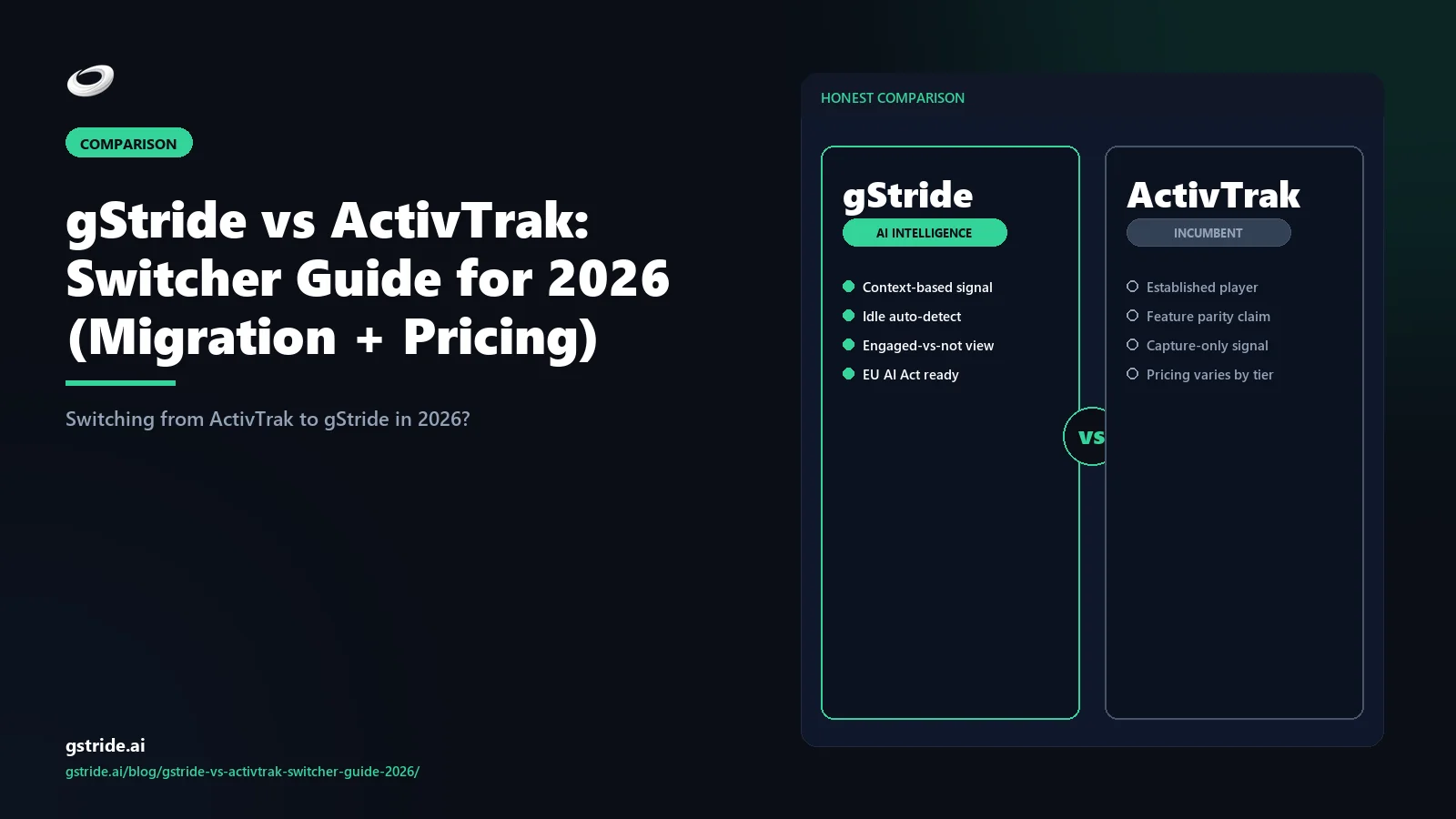
The side-by-side comparison table
The table covers the ten criteria HR directors and procurement leads have been working through in the ActivTrak-to-gStride pilots since H2 2025. Pricing reflects each vendor's public list as of 2026-05-18 — verify on the ActivTrak pricing page and gStride pricing page before procurement signature.
| Criterion | gStride | ActivTrak |
|---|---|---|
| Category | AI productivity intelligence platform | Workforce analytics + passive activity monitoring |
| EU AI Act Annex III | Compliant by design; FRIA template + conformance package as standard | Conformance posture varies; tenant-side DPIA + FRIA work required for EU deployments |
| DPDP Act 2023 (India) | Built-in audit trail + India residency option + Indian payroll bundled | Limited India market presence; no India-residency tier as of 2026-05-18 |
| HIPAA support | HIPAA-ready BAA on Enterprise; no PHI captured in the platform by design | HIPAA support on Enterprise; BAA required and not standard collateral |
| Pricing per user/month | $4 Starter, $7 Growth, Enterprise on quote | $10 Essentials, $17 Professional, Enterprise on quote |
| AI explainability | Per-signal weights visible to manager and employee — see Article 22 piece | Productivity score is a composite index; no per-signal weight breakdown |
| Signal latency | Real-time signal classification — focus density and deep work hours visible same day | Lagging signal — most insights surface in the weekly or fortnightly report |
| Operational workflow | Timesheets, leave, shift coverage, payroll handoff bundled in the platform | Workforce analytics only; operational workflow feeds a separate WFM stack |
| API + integrations | 35+ native + Make + Zapier; webhook on every signal | ~30 native; Power BI + Tableau focus |
| Direct demo booking | cal.com/gstrideai/15min — no SDR routing | Sales-call gate for Enterprise; self-serve trial otherwise |
| Indian payroll engine | Bundled — PF, ESI, PT, TDS, gratuity, leave encashment native | Not available — third-party payroll integration required |
| Employee self-view | Employee sees own focus density, classifications, and recommendations | Employee self-view (Personal Insights) available; classification taxonomy is admin-managed |
See gStride on your own team's data
A 15-minute walkthrough on the configuration surface — productivity intelligence without surveillance, screenshots off by default. No SDR gate, straight to a product engineer.
Book a 15-min demo → Prefer to look at numbers first? See gStride pricing.ActivTrak is the most balanced row-by-row comparison in this switcher series — both vendors share a productivity-intelligence-leaning posture and a default-off screenshot model. The decisive rows tend to be AI depth (per-signal explainability), signal latency (real-time versus weekly), operational scope (workflow versus analytics-only), and India fit (residency + Indian payroll bundled). Procurement teams that buy on workforce-analytics-only typically stay on ActivTrak; teams that want the signal to feed action inside the same platform move to gStride.
Why teams switch from ActivTrak to gStride — the 5 reasons
Across the ActivTrak-to-gStride pilots since H2 2025 the migration conversation lands on the same five themes. We sequence them in the order they show up on the procurement memo.
1. AI explainability depth
ActivTrak's productivity score is a composite index — productive minutes plus unproductive minutes plus active minutes plus idle minutes, classified against an admin-managed taxonomy. The score is presentable but opaque on per-signal contribution. gStride classifies productivity into focus density, deep work hours, meeting load, ticket flow, and project burn, and exposes the per-signal weights in both the manager and the employee dashboards. Under GDPR Article 22 and the EU AI Act explainability obligations the per-signal breakdown is the operational form of the right to meaningful information about automated processing — see our Article 22 piece. The depth gap shows up most clearly in roles where the productive-versus-unproductive classification feels inadequate (engineering, design, customer success).
2. Real-time signal versus lagging insight
ActivTrak's reporting cadence is weekly to fortnightly for most operational insights — the manager dashboard updates throughout the week but the productivity coaching surface and the team-level pattern recognition land on the weekly cycle. gStride's signal pipeline runs real-time — focus density and deep work hours visible same day, meeting load classified at the calendar boundary, ticket flow tied to live project burn. For HR business partners running active coaching cycles the real-time signal is the difference between coaching this week and coaching next week. The latency gap is operationally relevant on teams where the productivity intervention is daily, not weekly.
3. Operational scope and WFM stack consolidation
ActivTrak is a workforce analytics product. It feeds productivity signal into the HR dashboard and the manager review session, and integrates with WFM, HRIS, and payroll via API. gStride is the operational layer — timesheets, leave, shift coverage, and payroll handoff live inside the platform, and the productivity signal feeds the operational decision directly. For teams running ActivTrak + a separate WFM (BambooHR, Keka, Darwinbox) + a separate payroll engine, the switch to gStride collapses the stack. The TCO line in the ROI tile lower in this article shows the savings on a 100-person team; model the migration-side cost with the free Switch Cost Estimator.
4. HIPAA gap and regulated-industry support
ActivTrak supports HIPAA-aligned deployments on the Enterprise tier with a BAA available on request. gStride ships a HIPAA-ready BAA as standard collateral and captures no PHI in the platform by design — the behavior-signal-only capture model means the data architecture is HIPAA-friendly without tenant-side workflow. For healthcare-adjacent buyers (telehealth platforms, healthtech SaaS, clinical research orgs), the HIPAA fit is a procurement-time deciding factor. The compliance package on gStride also covers EU AI Act, GDPR, DPDP, and ICO monitoring guidance as standard collateral.
5. India market fit
ActivTrak's market presence is North America and Europe. gStride ships INR pricing, India-residency option, Indian payroll (PF, ESI, PT, TDS, gratuity, leave encashment) bundled in the Growth tier, IST-hours support staffed in Bangalore and Pune, and a DPDP Act 2023 audit trail built into the data architecture. For a 180-engineer Hyderabad fintech firm migrating from ActivTrak, the bundled-payroll line alone covers the migration cost in year one; the time-zone overlap on customer success was the second deciding factor. Our India-SMB alternatives piece covers the broader India-market context, and if DPDP exposure is the trigger for your switch, start with our ActivTrak alternative built for DPDP guide.
Free: AI Monitoring Policy Template (2026 EU AI Act + GDPR + DPDP ready)
Drop-in policy template — capture defaults, employee notice, FRIA pointers, transparency clause, retention table, right-to-object workflow. Built for the ActivTrak-to-gStride migration but works as a standalone HR document.
The 30-day migration playbook
The playbook is the version we run on the average 50 to 250 person ActivTrak-to-gStride switch. The aim is to keep the migration reversible until day 28 — no team should be locked into the new platform before the data shows the productivity signal is at least as good as the one it replaced.
Day 1-7 — Parallel run
Install the gStride agent alongside ActivTrak on a 10 to 25 person pilot cohort. Both tools capture in parallel — ActivTrak continues its passive activity monitoring and weekly classification; gStride captures behavior signals with the real-time classification engine. No policy change, no employee disruption. The phase output is a side-by-side dataset of the productivity signal both tools generate for the same person doing the same work.
Day 8-21 — Pilot full deployment
Roll gStride to the full pilot team. The gStride policy template applies with screenshots off, signal aggregated to team level by default, individual-level access requires manager justification. ActivTrak continues in shadow mode for continuity. The pilot team uses gStride as their primary tool; managers review the AI productivity signal in the gStride dashboard. The phase output is 14 days of operational data on focus density, deep work hours, meeting load, ticket flow, and project burn alongside the ActivTrak weekly report.
Day 22-28 — Decision review
Run a manager review session and an employee feedback survey. Compare cost per insight, AI explainability, signal real-time latency, integration depth, and operational scope across both tools. The expected output is a switch / extend / rollback memo. About 80% of teams confirm switch by day 22 once the signal real-time latency and the operational consolidation are in view.
Day 29-30 — Switch confirmation or rollback
If the pilot lands and the team consents, deprovision ActivTrak and complete the migration — onboarding, integrations cut over, payroll handoff scheduled, employee notice published. If the operational fit is weak (typical when the buyer's binding requirement is workforce analytics for an executive dashboard and not an operational workflow), archive gStride and continue on ActivTrak with no friction. The 30-day pilot is structurally reversible.
Pricing + ROI — the 100-person annual math
The pricing comparison below shows the realistic annual delta on three team sizes — 50, 100, and 250 employees — at each vendor's middle tier (gStride Growth $7 vs ActivTrak Professional $17). The numbers are list-price; both vendors discount on annual commitment, so the realistic signature delta varies with volume.
| Team size | gStride Growth (annual) | ActivTrak Professional (annual) | Bundled-payroll + WFM savings (gStride) | Net delta |
|---|---|---|---|---|
| 50 employees | $4,200 | $10,200 | ~$3,600 | $9,600 saved on gStride |
| 100 employees | $8,400 | $20,400 | ~$7,200 | $19,200 saved on gStride |
| 250 employees | $21,000 | $51,000 | ~$18,000 | $48,000 saved on gStride |
The bundled-savings column assumes the ActivTrak buyer is also paying a separate Indian payroll vendor at ~$6 per employee per month. Buyers running US-only or Europe-only teams will see a different delta; the operational consolidation (WFM + payroll moving inside the platform) still tilts year-1 TCO toward the switch even without the India payroll line. See our productivity software ROI calculator for a full per-team-size model.
Free: CISO Procurement Checklist for AI Productivity Vendors
10 questions every CISO should ask before signing — data residency, DPIA, AI auditability, breach SLA, retention, SCIM/SSO, sub-processors, right to audit. Built around the EU AI Act + GDPR + DPDP procurement gate.
See the gStride side of the switcher table in 15 minutes
30-day pilot — no credit card required. Migration playbook bundled. Side-by-side metric comparison run in your tenant against your existing ActivTrak data.
Book a 15-min demo Start the free trialRelated switcher and migration content
- Migration playbook — Hubstaff, Time Doctor, Keka to gStride
- Productivity intelligence platform vs employee monitoring — category split
- CISO procurement questions for AI productivity vendors
- Employee productivity software ROI calculator
- Explainable AI under GDPR Article 22
- gStride vs ActivTrak — original comparison page
Free: 5-Signal Productivity Self-Audit Worksheet
30-min audit on your team. Focus depth + commit cadence + meeting load + flow-state + blocker recovery. PDF + Google Sheets calc. For Ops Heads, Founders, Eng Managers.
Frequently asked questions — ActivTrak to gStride switch
Will my ActivTrak data migrate to gStride?
gStride imports the activity history, productivity classification rules, project structure, and user roster from ActivTrak via CSV export and a guided onboarding session. ActivTrak's classification taxonomy is mapped to the gStride per-signal model in the onboarding phase. Raw screenshot history, if enabled in your ActivTrak tenant, is not imported by default — gStride is a behavior-signal-only platform.
Can we run ActivTrak and gStride in parallel for the pilot?
Yes, the standard migration playbook runs both tools in parallel for the first 21 days. ActivTrak continues its passive activity monitoring while gStride captures behavior signals with its AI productivity intelligence engine. The pilot decision is made at day 22 with both data sets in hand.
How is the pricing different between gStride and ActivTrak?
ActivTrak lists three tiers as of 2026-05-18 — Essentials at $10, Professional at $17, and Enterprise on quote. gStride lists three tiers — Starter at $4, Growth at $7, and Enterprise on quote — with AI productivity intelligence, EU AI Act conformance, Indian payroll, and operational workflow bundled. The gStride Growth tier covers features that ship in ActivTrak Professional. Verify on each vendor pricing page before signature.
What about historical reports — can I keep ActivTrak dashboards?
The ActivTrak dashboards remain accessible in your ActivTrak tenant for the duration of your contract. gStride imports the historical timesheet, productivity classification, and project burn data into the gStride reports surface so the year-on-year continuity is preserved. The 90-day comparison view in gStride lets the manager validate that the productivity signal stayed consistent across the cutover.
Does the AI scoring interface differ between ActivTrak and gStride?
Yes. ActivTrak's productivity score is a composite of productive, unproductive, active, and idle minutes against an admin-managed taxonomy. The score is presentable but opaque on per-signal contribution. gStride classifies productivity into focus density, deep work hours, meeting load, ticket flow, and project burn, and exposes the per-signal weights in both the manager and the employee dashboards. The per-signal breakdown is the operational form of the GDPR Article 22 explainability obligation.
How long does the gStride switch actually take?
The agent install is 30 minutes. The pilot phase is 30 days end-to-end. The full team rollout after pilot confirmation is typically 5 to 10 business days for a 100-person team including integration cutovers and the employee notice publication. The Indian payroll cutover, if required, is run on the calendar month boundary to preserve continuity.
Does gStride support HIPAA-aligned deployments?
Yes. gStride ships a HIPAA-ready BAA as standard collateral on the Enterprise tier. The behavior-signal-only capture model means no PHI is captured by design, so the HIPAA fit is structural rather than configurational. For healthcare-adjacent buyers (telehealth, healthtech SaaS, clinical research orgs), the HIPAA package is part of the Enterprise procurement bundle alongside the EU AI Act and GDPR collateral.
What is the difference between ActivTrak Personal Insights and the gStride employee self-view?
ActivTrak Personal Insights gives the employee visibility into their own productivity classification against the admin-managed taxonomy. gStride's employee self-view exposes the same per-signal data the manager sees — focus density, deep work hours, meeting load, ticket flow, project burn — and includes the per-signal weights, the recommendations the platform is feeding to the manager, and a right-to-object workflow. The depth difference is the bidirectional surface — gStride's self-view mirrors the manager surface; ActivTrak's Personal Insights is a derived view.
Can we switch back to ActivTrak if the pilot does not land?
Yes. Deprovision the gStride agent, restore the ActivTrak client to primary, and your team continues on ActivTrak with no friction and no data loss. The parallel-run phase means the productivity signal stayed continuous in ActivTrak throughout the pilot. The 30-day pilot is structurally reversible.
Is there a free trial or do we need to commit upfront?
The 30-day pilot is no credit card required. The full migration playbook including the manager review session and the employee survey is bundled into the pilot. The procurement decision happens at day 28 with the data in hand — there is no upfront commitment.
Who has switched from ActivTrak to gStride?
The switcher cohort through H1 2026 is concentrated in three segments — India-headquartered SaaS firms (typical 100 to 300 engineers, bundled-payroll motivation), US healthcare-adjacent SaaS (typical 50 to 200 employees, HIPAA + AI explainability motivation), and EU mid-market HR teams (typical 80 to 200 employees, EU AI Act + operational scope motivation). We do not publish customer names in public collateral by policy; the pattern is illustrative of the migration shape.
Does gStride match ActivTrak on Power BI and Tableau integration?
gStride ships native API and webhook integration to Power BI and Tableau, plus Looker, Metabase, and Snowflake. The integration depth covers the standard ActivTrak BI use cases. For teams running deep custom Power BI dashboards on ActivTrak today, the migration phase includes a dashboard rebuild on the gStride API; the standard migration template covers the common dashboard shapes.
Three honest ways to de-risk the pilot
No lock-in, no sales gate. The 30-day pilot is structurally reversible — if the signal does not land, you deprovision gStride and continue on ActivTrak with your data intact.
Run gStride alongside ActivTrak on one team cohort. No card required — compare the AI explainability layer against ActivTrak’s composite score on your own live data before any procurement decision.
Start the free trial →Score your current ActivTrak configuration against EU AI Act Annex III and DPDP consent obligations — free, no email gate to run. Know your compliance gap before you sign anything.
Run the free audit →See the one-time cost to move off ActivTrak before you commit — parallel-run overlap, CSV import, policy rollout, and integration cutover. The Switch Cost Estimator runs in 5 minutes, no email required.
Estimate my migration cost →Want to walk through the pilot setup? Book a 15-min migration review →
Run the 30-day pilot
Parallel run with your ActivTrak tenant, side-by-side signal comparison, manager and employee feedback survey, reversible until day 28. No credit card required.
Book the 15-min demo Start the free trial Get the policy template14-day free trial · no credit card · pilot reversible at day 28 · cancel anytime
Pricing reflects each vendor's public list as of 2026-05-18 — verify on the ActivTrak pricing page and gStride pricing page before procurement signature. This article is migration guidance, not legal advice. EU AI Act conformance, GDPR proportionality, HIPAA, and DPDP Act 2023 positions evolve through new EDPB guidance, AI Act delegated acts, and national DPA decisions. Verify vendor claims against the current DPA and conformance package before signing.