
Why this comparison still trips up procurement teams in 2026
The procurement confusion is structural, not lazy. For most of the last decade, "time tracking" was the recognisable shelf label for any tool that observed work. Toggl, Clockify, Harvest, Hubstaff, Time Doctor, ActivTrak, Teramind, Insightful — eight products, three very different categories, but they all showed up in the same Capterra section and the same RFP table. A 2026 buyer who inherits that frame still asks the AI productivity intelligence vendor for time-tracking demos, and ends up scoring intelligence depth on duration accuracy.
The split that procurement teams now treat as binding has three drivers — the regulatory one, the operational one, and the talent one — and each one independently makes the 7 criteria below load-bearing.
- Regulatory driver. The EU AI Act classifies workplace AI used to evaluate, allocate, or monitor employees as high-risk under Article 6. The conformance burden landing 2 August 2026 sits on AI productivity intelligence products that score activity — not on duration-only time tracking. Buyers must therefore evaluate scoring methodology, transparency artefacts, and bias-and-accuracy testing as separate criteria, not as a sub-line of the time tracking row.
- Operational driver. The eight largest IT services and BPO buyers we have spoken with through Q1 and Q2 2026 now run a unified workforce stack — timesheet, payroll, leave, shift coverage, productivity score — on a single platform. A duration-only time tracker forces a second platform for the workflow layer, doubling integration cost and policy drift. The action criterion (#4 below) is therefore not optional.
- Talent driver. Candidates ask in interviews whether the employer uses keystroke logging or screenshot capture; the answer on Glassdoor moves application volume. Productivity intelligence ships with monitoring features off by default and an employee self-view; time tracking is closer to neutral. The defaults and employee-surface criteria (#5 and #7) are now talent-side, not just compliance-side.
The 7 criteria below are sequenced from the easiest to evaluate from public collateral (signal source) to the hardest (employee self-view, which usually requires a live demo). Buyers who score in this sequence find that vendors self-disclose category placement by criterion 3 — useful when you have 12 vendors on the longlist and 4 weeks to evaluation.
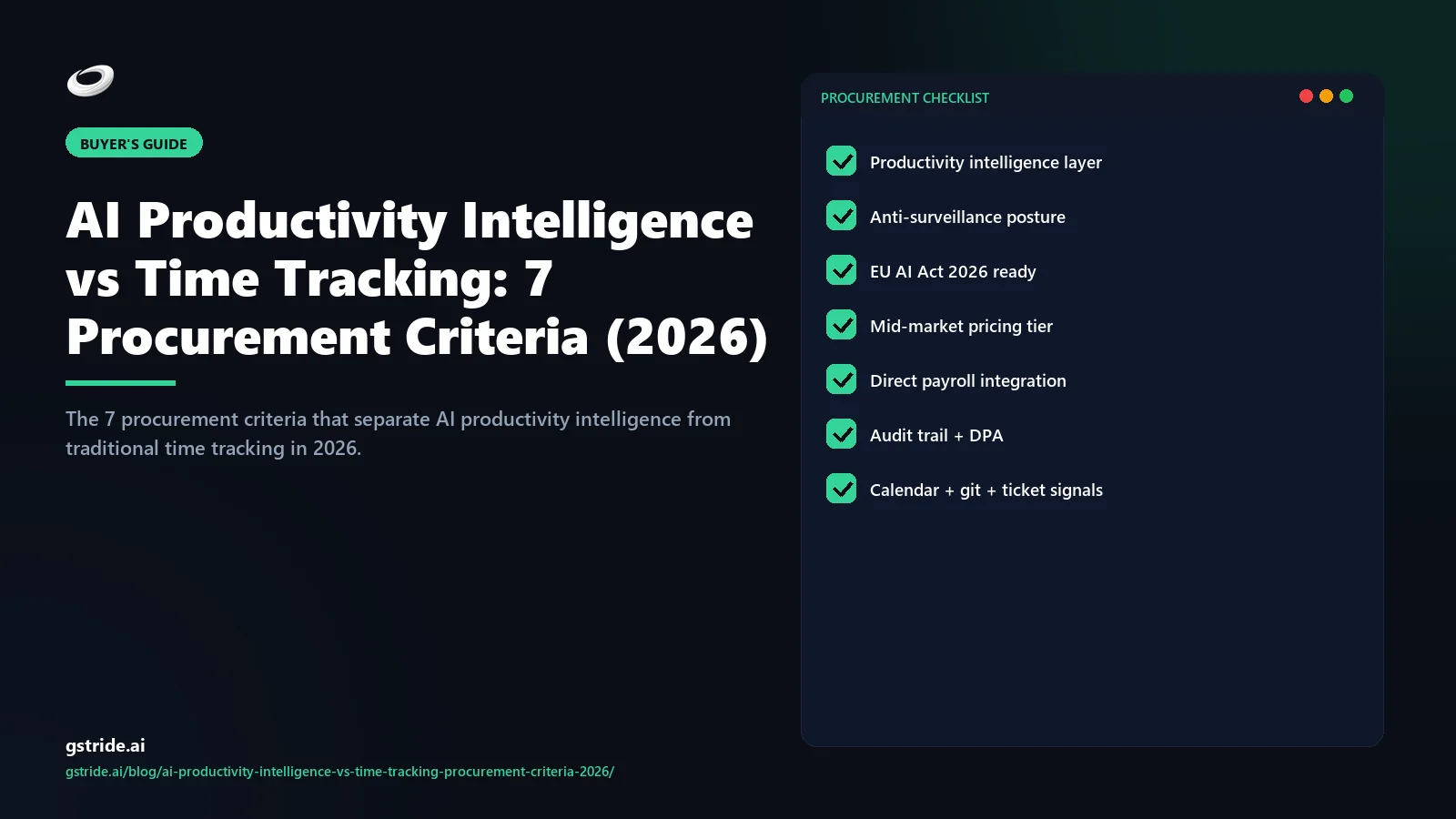
The 7 procurement criteria
| # | Criterion | AI productivity intelligence | Traditional time tracking |
|---|---|---|---|
| 1 | Signal source | Operational metadata: calendar density, app focus, ticket flow, commit cadence, AI-classified activity buckets. | Manual entries, timer starts/stops, optional screenshot at duration check. |
| 2 | Scoring methodology | AI-classified activity with explainability surface and documented bias-and-accuracy testing. | Hour totals against tasks/projects/clients. No scoring. |
| 3 | Recommendation surface | Bidirectional — manager and employee both see workload, focus, and intervention prompts. | One-way report to manager (timesheet review). |
| 4 | Action layer | Native workflow — timesheets, approvals, payroll, leave, shift coverage run inside the platform. | Export-only — duration feeds external payroll/billing system. |
| 5 | Defaults | Capture features (screenshots, URL log, keystroke) off by default. Enable per role with audit trail. | Duration capture always-on. Optional features (screenshot) usually opt-in but inconsistent. |
| 6 | Governance package | EU AI Act conformance, FRIA template, transparency notice template, Article 28 DPA, EU residency by default. | Standard Article 28 DPA; AI Act not applicable when no AI scoring; residency varies. |
| 7 | Employee self-view | Employee sees own focus density, classification feed, recommendations — same signal as manager. | Employee sees own timesheet. No signal or score surface. |
Criterion 1 — Signal source: metadata vs manual entries
The signal-source criterion is the easiest to evaluate from public collateral. Open the vendor's product tour page and read the first bullet under "what we capture." If the language is duration, hours, tasks, projects, billable codes — that is a time tracker. If the language is focus density, application context, calendar load, ticket flow, commit cadence — that is productivity intelligence. The deeper test is whether the AI classification step is documented: a category-1 productivity intelligence platform publishes which activity buckets the classifier uses, how the buckets are defined, and what training data shaped them. A duration-led product has no equivalent because there is no classification step. Our piece on what productivity intelligence actually means walks through the signal-source distinction with worked examples.
Criterion 2 — Scoring methodology and EU AI Act exposure
This criterion is procurement-binding under the EU AI Act because scoring is the trigger for high-risk classification. Any AI productivity intelligence platform that produces a per-employee or per-team productivity score is processing the kind of evaluation Article 6 of the AI Act classifies as high-risk. Per Regulation 2024/1689 Article 6, the conformance documentation that follows is non-optional once enforcement opens 2 August 2026.
What to verify on the scoring methodology criterion
- The vendor publishes a per-score explainability surface — what inputs fed the score, how each input was weighted, what threshold triggered any flag.
- Bias-and-accuracy testing artefacts are available as standard collateral, not deal-stage negotiation.
- A fundamental rights impact assessment (FRIA) template is published and adaptable by the buyer.
- The transparency notice template covers Article 22 GDPR automated-decision-making rights, not just the AI Act surface.
A traditional time tracker that records hours but does not generate AI-derived scores typically falls outside Article 6 high-risk — useful as a TCO simplifier but not a substitute for a platform that needs to score work. Our EU AI Act compliance checklist for workplace AI covers the conformance package in line-item depth.
Free download. The 10-page Employee Monitoring Policy Template covers AI Act + GDPR Article 25 + Article 22 explainability in one document. Use it as the policy artefact that should ship with the vendor's governance package.
Get the policy templateCriterion 3 — Recommendation surface: bidirectional or one-way
This is the criterion most often missed in a 60-minute vendor demo. A productivity intelligence platform's recommendation surface is bidirectional: the AI classifies activity, identifies workload imbalance or focus erosion, and pushes interventions to both the manager and the employee being measured. The employee sees the same recommendation feed the manager sees. A time tracker's recommendation surface is the timesheet review — one-way reporting to the manager, no feedback loop to the employee.
The bidirectional surface matters because it is what makes the platform an operational tool rather than a reporting tool. When the recommendation is visible to the employee, the intervention does not require a calendar invite from the manager — the employee can act on it. Our piece on productivity without surveillance covers the recommendation-surface inversion in detail.
Criterion 4 — Action layer: native workflow vs export-only
The action criterion separates platforms that drive the operational workflow (timesheets, approvals, payroll, leave, shift coverage) from products that export duration to a separate workflow stack. The TCO consequence is large. A 240-engineer Bangalore IT services firm we walked through a build-vs-buy comparison this quarter found that a pure time tracker plus a separate WFM platform plus a payroll integrator was running roughly 1.7x the per-seat cost of a unified AI productivity intelligence platform — before counting the policy-drift overhead of two vendors maintaining two separate signal models.
The criterion is testable: ask the vendor to demo the workflow that goes from a captured signal to a payroll-ready timesheet to an approval-routed leave decision, in one tenant, with no integration plumbing. Our AI timesheet scoring enterprise pillar walks through what that native-action workflow looks like.
Criterion 5 — Defaults: off-by-default vs always-on
The defaults criterion is the single most predictive line in the 7-criteria matrix. It tells you almost everything about the rest of the product. A productivity intelligence platform on the modern category shape ships monitoring features disabled — every screenshot, every URL log, every idle classifier. Turning a feature on requires a documented justification, role-based scope, audit-log entry, and (in better platforms) an employee notice trigger.
Time trackers in the duration-only category usually ship duration capture always-on (that is the product) but ship the optional monitoring features (screenshot, URL log) in inconsistent default states. The buyer is expected to configure them per jurisdiction. Under EDPB Guidelines 4/2019 on GDPR Article 25, the buyer inherits the default-state compliance liability if those features ship enabled. The criterion is asked at demo time: "open a fresh tenant from the default policy template, and show me which capture features are enabled."
Criterion 6 — Governance package: published or per-deal
Governance is where procurement timelines diverge by weeks. A productivity intelligence platform that has done its 2026 homework publishes the governance package as standard collateral — Article 28 DPA with EU residency as a default clause, EU AI Act Article 6 high-risk conformance statement, FRIA template, transparency notice template, documented data-subject-rights workflow, bias-and-accuracy testing artefacts, sub-processor list.
A time tracker without AI scoring needs a thinner package (no AI Act surface) but should still publish the DPA, residency clause, sub-processor list, and retention policy. If those are deal-stage negotiation rather than published collateral, the procurement round-trip stretches four to eight weeks. Our CISO procurement questions for AI productivity vendors piece is the line-item version of this criterion.
Criterion 7 — Employee self-view: same signal or view-only timesheet
The seventh criterion is the one buyers ignore until a works council asks. Productivity intelligence platforms expose the same signal to the employee being measured that they expose to the manager. The employee opens their own dashboard, sees their own focus density, sees how the AI has classified their activity, sees the recommendations the platform is feeding their manager, and exercises an Article 21 GDPR right to object inside the product.
Time trackers expose the employee's own timesheet — a duration view of their entered hours. That is necessary for billing reconciliation but is not the same surface as the AI productivity intelligence self-view, which exposes classifications and recommendations. The criterion is testable in a live demo: ask to log in as an employee user and look at what they see. Our piece on Article 22 explainability walks through what the self-view has to expose to satisfy GDPR automated-decision-making rights.
How to use the 7 criteria on an RFP scoresheet
The 7 criteria are not equally weighted across all buyers. The weighting we have seen on 2026 enterprise RFPs:
- Defaults (criterion 5) — 20 pts. Predicts compliance overhead.
- Governance package (criterion 6) — 18 pts. Predicts procurement round-trip time.
- Scoring methodology (criterion 2) — 15 pts. Predicts EU AI Act exposure.
- Action layer (criterion 4) — 15 pts. Predicts unified-stack TCO.
- Recommendation surface (criterion 3) — 12 pts. Predicts operational tooling, not reporting.
- Employee self-view (criterion 7) — 12 pts. Predicts works-council and talent posture.
- Signal source (criterion 1) — 8 pts. Easiest to confirm from public collateral.
A vendor that scores below 65/100 on this rubric typically belongs in a different RFP. A vendor that scores above 80 is a category-1 productivity intelligence platform. Vendors in the 65 to 80 band are usually time trackers adding AI scoring to a duration product — useful but transitional. Our decision-criteria companion walks through which category fits which operational shape.
What to ask in the 30-minute shortlist demo
The four questions that move every vendor across the 7 criteria in under 30 minutes:
- "Open a fresh tenant from your default policy template. Which capture features are enabled? Which are disabled?" (Tests criterion 5.)
- "Show me the published governance package — DPA, EU AI Act conformance statement, FRIA template, transparency notice template." (Tests criterion 6.)
- "Log in as an employee user. What does the employee see in their own dashboard?" (Tests criterion 7.)
- "Walk a signal from capture through to a payroll-ready timesheet inside this tenant, without any integration plumbing." (Tests criterion 4.)
If the demo handles all four cleanly, the remaining criteria are usually well-aligned. If the demo struggles on questions 1 or 2, the vendor is closer to a duration product than a category-1 productivity intelligence platform — fine, but a different RFP. Our category split piece covers the adjacent decision (intelligence vs monitoring) that often runs in parallel.
Where gStride sits on the 7 criteria
gStride is an AI productivity intelligence platform that scores cleanly on all 7 criteria. Signal source is operational metadata, not duration only. Scoring methodology includes published explainability and bias-and-accuracy testing under the EU AI Act Article 6 high-risk track. Recommendation surface is bidirectional. Action layer is native — timesheet, payroll, leave, shift coverage run in one tenant. Defaults ship monitoring features off. Governance package is published collateral, EU residency by default. Employee self-view exposes the same activity classifications the manager sees. The architectural detail is in the AI productivity intelligence platform pillar; the build-vs-buy is in the build-vs-buy productivity software guide.
Free: CISO Procurement Checklist for AI Productivity Vendors
10 questions every CISO should ask before signing — data residency, DPIA, AI auditability, breach SLA, retention, SCIM/SSO, sub-processors, right to audit. Includes scoring rubric and pass / hold / walk thresholds.
Further reading on gStride
Free: 5-Signal Productivity Self-Audit Worksheet
30-min audit on your team. Focus depth + commit cadence + meeting load + flow-state + blocker recovery. PDF + Google Sheets calc. For Ops Heads, Founders, Eng Managers.
Frequently asked questions
What is AI productivity intelligence and how is it different from time tracking?
AI productivity intelligence is a category of workplace software that measures the shape of work — focus density, meeting load, ticket flow, AI-classified activity — and surfaces signal plus recommendations to both managers and employees. Time tracking is a single capability that records duration of work against tasks, projects, or clients. Productivity intelligence treats time capture as one of eight or more inputs; time tracking treats time capture as the product. Under EU AI Act and GDPR proportionality reviews in 2026, the category split is becoming procurement-binding.
What are the 7 procurement criteria that separate AI productivity intelligence from time tracking in 2026?
The 7 procurement criteria are: (1) signal source — operational metadata vs duration only; (2) scoring methodology — AI-classified activity with explainability vs hour totals; (3) recommendation surface — bidirectional manager-and-employee feedback vs manager-only reporting; (4) action layer — native workflow vs export to payroll; (5) defaults — capture off by default vs always-on duration logging; (6) governance package — EU AI Act conformance documentation as standard collateral vs DPA per deal; (7) employee self-view — same signal as manager vs view-only timesheet.
Is AI productivity intelligence regulated differently from time tracking under EU AI Act?
Yes. Workplace AI systems that evaluate, allocate tasks to, or monitor employees are classified as high-risk under Article 6 of the EU AI Act (Regulation 2024/1689). Enforcement opens 2 August 2026. This applies to AI productivity intelligence platforms that score activity or recommend interventions — but not to pure time tracking that only records duration without AI classification. Buyers procuring AI productivity intelligence in 2026 must verify the vendor has a conformance package: an Article 6 high-risk statement, a fundamental rights impact assessment template, a transparency notice template, and bias-and-accuracy testing artefacts.
How should an RFP scoresheet weight the 7 criteria?
From the 2026 enterprise RFPs we have seen, the typical weighting is: defaults 20 pts, governance package 18 pts, scoring methodology 15 pts, action layer 15 pts, recommendation surface 12 pts, employee self-view 12 pts, signal source 8 pts. A vendor below 65/100 on this rubric usually belongs in a different RFP. Above 80 is category-1 AI productivity intelligence. The 65-80 band is typically a duration product adding AI scoring — useful but transitional.
Can a single platform satisfy both AI productivity intelligence and time tracking requirements?
Yes — and that is generally the more efficient procurement outcome. A category-1 productivity intelligence platform includes time capture as one capability among many: timer-led entries, AI-derived duration suggestions, payroll-ready timesheet aggregation. The reverse is rarely true — a duration-led time tracker bolting AI scoring on top usually fails criteria 2 (explainability), 3 (bidirectional recommendation), and 7 (employee self-view) because the underlying architecture was built for capture, not classification.
What is the TCO difference between unified AI productivity intelligence and time tracking plus a separate WFM stack?
In the IT services and BPO sample we have walked through this quarter, the unified platform runs roughly 0.55x to 0.65x the per-seat cost of a time tracker plus separate WFM plus payroll integrator stack — before counting integration plumbing maintenance and the policy-drift overhead of two separate signal models. The unified path also collapses procurement from three vendor reviews to one. Our build-vs-buy guide covers the full cost decomposition.
What is the simplest first question to ask any vendor on this comparison?
"Open a fresh tenant from your default policy template — which capture features are enabled by default, and which are disabled?" The answer to that single question lands every vendor on one side of criterion 5 (defaults) and predicts almost every other criterion. A vendor whose defaults are off-by-default with audit trail is on the productivity intelligence side. A vendor whose defaults are always-on or inconsistent is on the time tracking or monitoring side.
How long does the 7-criteria evaluation take on a 12-vendor longlist?
On the 2026 enterprise procurements we have observed, criteria 1, 2, 5, 6 can be scored from public collateral in 20 to 30 minutes per vendor — 4 to 6 hours total. Criteria 3, 4, 7 require a 30-minute live demo per shortlisted vendor — typically 3 to 5 shortlisted, so 90 to 150 minutes. Total elapsed evaluation time on a 12-to-3 longlist-to-shortlist filter is 6 to 9 hours over 1 to 2 weeks. That is roughly 40 to 60 percent shorter than the same procurement run without category separation.
See a category-1 AI productivity intelligence platform live
Capture off by default. Signal aggregated. Recommendation bidirectional. Action native. Governance published. Employee self-view live. Walk the 7 criteria against a 15-minute tour.
Book a 15-min demo CISO procurement questionsThis article is a procurement framework, not legal or compliance advice. EU AI Act conformance and GDPR Article 25 default-state interpretations evolve through new EDPB guidance, AI Act delegated acts, and national DPA decisions. Verify each vendor claim against the current DPA, conformance package, and transparency notice template before procurement signature.