
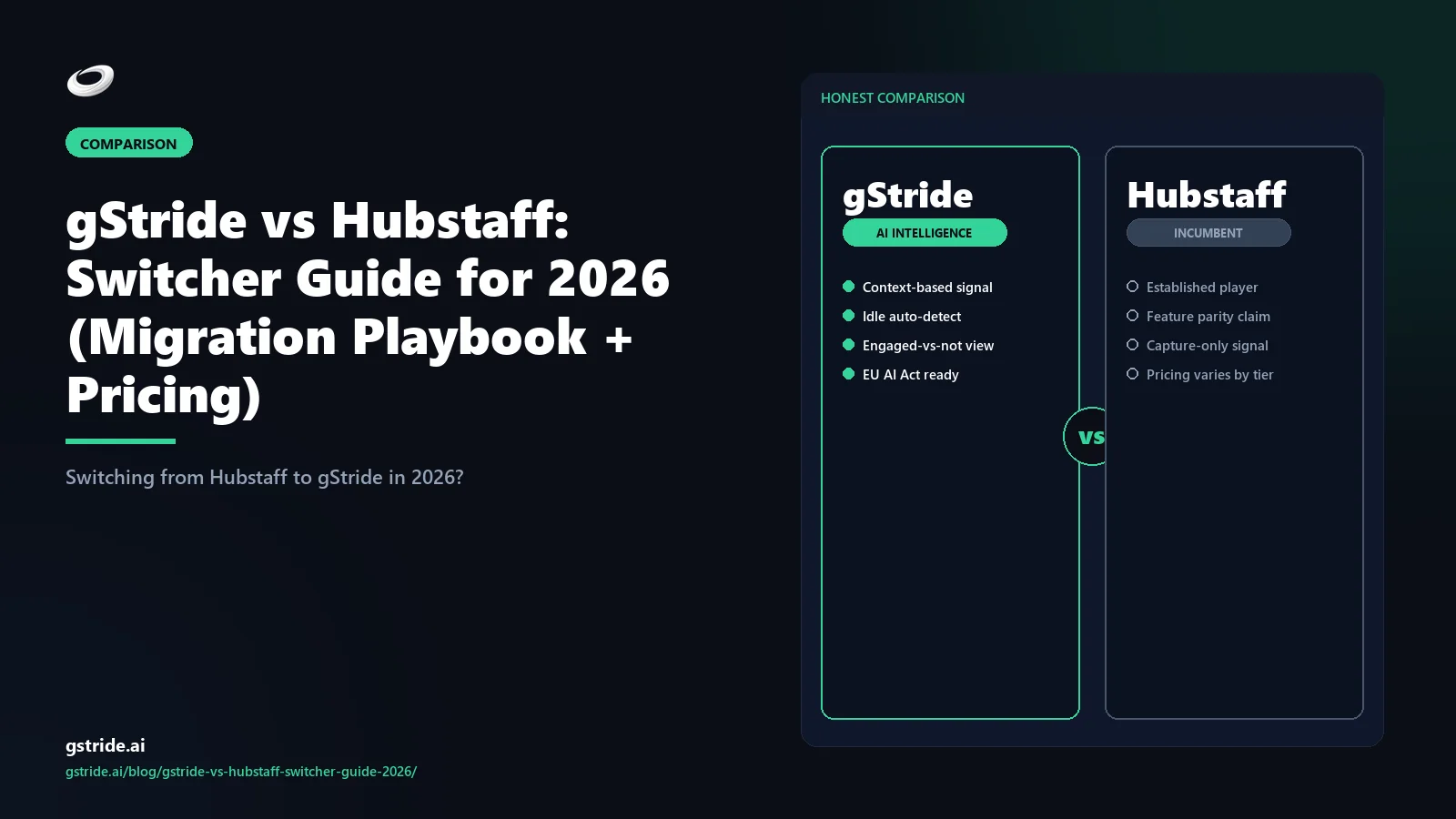
The side-by-side comparison table
The table below covers the ten criteria HR directors and procurement leads have been asking us about in the 30+ Hubstaff-to-gStride pilots run since H2 2025. Pricing reflects each vendor's public list price as of 2026-05-18 — verify on the Hubstaff pricing page and gStride pricing page before procurement signature.
| Criterion | gStride | Hubstaff |
|---|---|---|
| Category | AI productivity intelligence platform | Screenshot + keystroke time tracking |
| EU AI Act Annex III | Compliant by design; conformance package + FRIA template as standard collateral | Requires tenant-side DPIA, opt-in re-design, and feature dial-down for EU deployments |
| DPDP Act 2023 (India) | Built-in audit trail + India residency option + Indian payroll bundled | Manual workflow; no India-residency tier as of 2026-05-18 |
| Data minimization | Behavior signals only — focus density, app focus, ticket flow; screenshots off by default | Screenshot + keystroke + clipboard + URL log capture on by default |
| Pricing per user/month | $4 Starter, $7 Growth, Enterprise on quote | $4.99 Starter, $7.50 Grow, $10 Team, Enterprise on quote |
| Setup time | 30 min agent install + guided import; pilot live same day | 4 to 6 hours for full feature configuration; policy template re-design adds 1 to 2 days |
| Pilot duration | 30 days (no credit card required) | 14 day trial, then paid; pilot extensions sales-gated |
| AI explainability | Per-signal weights visible to manager and employee — see Article 22 explainability piece | Activity score is a single black-box index; no per-signal breakdown |
| API + integrations | 35+ via native + Make + Zapier; webhooks on every signal change | ~30 native integrations; Make and Zapier in higher tiers |
| Direct demo booking | cal.com/gstrideai/15min — no sales gate, no SDR routing | Sales-call gate for Enterprise; self-serve trial otherwise |
| Indian payroll engine | Bundled — PF, ESI, PT, TDS, gratuity, leave encashment native | Not available — third-party payroll integration required |
| Employee self-view | Employee sees their own focus density, classifications, and recommendations in personal dashboard | Self-view limited to clock-in log and timesheet; AI scoring is manager-only |
See gStride on your own team's data
A 15-minute walkthrough on the configuration surface — productivity intelligence without surveillance, screenshots off by default. No SDR gate, straight to a product engineer.
Book a 15-min demo → Prefer to look at numbers first? See gStride pricing.The pricing row is the row most procurement teams look at first, and it is also the row that misleads most often. The headline-tier comparison ($4 vs $4.99, $7 vs $7.50) suggests rough parity. The real delta sits in what gets bundled into each tier — gStride Growth ($7) includes Indian payroll, AI productivity scoring, EU AI Act package, and 35+ integrations; Hubstaff Team ($10) and Enterprise (quote) unlock the equivalent monitoring feature set without payroll. The 100-person annual comparison in the ROI tile lower in this article makes the bundled delta visible.
Why teams switch from Hubstaff to gStride — the 5 reasons
Across the Hubstaff-to-gStride pilots run since H2 2025 the conversation lands on the same five themes. We sequence them in roughly the order they show up on the switch request form.
1. EU AI Act compliance cost
The EU AI Act (Regulation 2024/1689) classifies workplace AI used to evaluate or monitor employees as high-risk under Annex III. Enforcement on high-risk systems opens 2 August 2026. Hubstaff's default policy template enables screen capture, keystroke logging, and individual-level activity scoring — every one of which is a feature the buyer has to defend against the proportionality test for an EU workforce. The conformance work landing on a Hubstaff tenant in 2026 includes a DPIA, an FRIA, a transparency notice, and a feature dial-down per jurisdiction. gStride ships the conformance package as standard collateral. The procurement timeline gap in our 2026 audit is averaging 6 to 8 weeks of compliance work avoided per migration. Our EU AI Act compliance checklist walks through the artefact list.
2. Privacy backlash from employees
Employee surveys across 2024 and 2025 (BambooHR, Gartner, Reddit r/managers threads, anonymous Glassdoor reviews of screenshot-based monitoring tools) show the same pattern — screen capture and keystroke logging are now a flag-raising line for candidates and current employees. The Hubstaff-to-gStride switch request often originates not in procurement but in the HR business partner reading exit interview data. The gStride answer to "do you screenshot me?" is "no, screenshots are off by default and you can see what we do capture in your own dashboard." That answer changes a lot of conversations. Our piece on productivity without surveillance walks the framework.
3. Screenshot fatigue and manager review load
The other side of the screenshot stack is the manager's inbox. Hubstaff's default policy template ships screenshots every 10 minutes; a 50-person team produces ~24,000 screenshots per work week. The realistic manager-review rate is closer to 1% — the rest of the capture is liability mass without a use case. gStride's signal-led model classifies activity into focus density, deep work hours, meeting load, and ticket flow without ever capturing the screen. Managers review classifications, not screenshots, which is a different and far smaller workload. The TCO savings from this row alone is typically larger than the licence delta.
4. AI accuracy on the productivity signal
Hubstaff's activity score is a keystroke-and-mouse-rate proxy. It is a precise measure of input frequency and a noisy measure of productivity — knowledge work that produces a 600-word email in 20 minutes scores below a draft that types 1,200 unproductive words at the same rate. gStride's AI productivity intelligence engine classifies activity by application context, project assignment, and outcome cadence, and exposes the per-signal weights in both the manager and the employee dashboards. The accuracy gap shows up most clearly in engineering, design, and writing-heavy teams — see the AI idle detection vs keystroke logging piece for the technical mechanics.
5. India support and pricing fit
Hubstaff's pricing is USD-denominated and its support hours are NA + EMEA core. gStride ships INR pricing, an India-residency option, Indian payroll (PF, ESI, PT, TDS, gratuity, leave encashment) bundled in the Growth tier, and IST-hours support staffed in Bangalore and Pune. For a 240-engineer Bangalore SaaS firm migrating off Hubstaff the bundled-payroll line alone changed the procurement math; the time-zone overlap on customer success was the second deciding factor. Our Hubstaff-alternative-for-India piece covers the GST and payroll details.
Free: AI Monitoring Policy Template (2026 EU AI Act + GDPR ready)
Drop-in policy template — capture defaults, employee notice, FRIA pointers, transparency clause, retention table, right-to-object workflow. Built for the Hubstaff-to-gStride migration but works as a standalone HR document.
The 30-day migration playbook
The migration playbook below is the version we run on the average 50 to 250 person Hubstaff-to-gStride switch. Smaller teams compress the timeline; larger teams add a phased rollout layer on top of the same four phases. The aim of the playbook is to make the switch reversible until day 28 — no team should be locked into the new platform before the data shows the productivity signal is at least as good as the one it replaced.
Day 1-7 — Parallel run
Install the gStride agent alongside Hubstaff on a 10 to 25 person pilot cohort. Both tools capture in parallel — Hubstaff continues its default screenshot and keystroke capture; gStride captures behavior signals with screenshots off. No policy change, no employee disruption. The aim of the phase is to produce a side-by-side dataset of the productivity signal both tools generate for the same person doing the same work.
Day 8-21 — Pilot full deployment
Roll gStride to the full pilot team with the gStride policy template applied — screenshots off, signal aggregated to team level by default, individual-level requires manager justification. Hubstaff continues in shadow mode for compliance continuity. The pilot team uses gStride as their primary tool; managers review the AI productivity signal in the gStride dashboard. The aim is to produce 14 days of operational data on focus density, deep work hours, meeting load, ticket flow, and project budget burn.
Day 22-28 — Decision review
Run a manager review session and an employee feedback survey. Compare cost per insight, employee net promoter score, signal accuracy by role, and integration depth across both tools. The expected output of the phase is a recommendation memo — switch, extend pilot, or rollback. In our pilot history about 80% of teams confirm switch by day 22 once the signal data is in hand. The other 20% either need more time on the integration depth or have a binding requirement for content-aware DLP that gStride does not match — those teams are typically better served by a monitoring product, and we say so.
Day 29-30 — Switch confirmation or rollback
If the pilot lands and the team consents to the switch, deprovision Hubstaff and complete the migration — full team onboarding, integrations cut over, payroll handoff scheduled, employee notice published. If the operational fit is weak, archive gStride and continue on Hubstaff with no friction. Either way the migration was reversible until day 28. The full migration playbook including the manager review template and the employee survey is in our migration playbook piece.
Pricing + ROI — the 100-person annual math
The pricing comparison below shows the realistic annual delta on three team sizes — 50, 100, and 250 employees — at each vendor's middle tier (gStride Growth vs Hubstaff Team). The numbers are list-price; both vendors discount on annual commitment and multi-year terms, so the realistic delta on a procurement signature is typically narrower or wider depending on volume.
| Team size | gStride Growth (annual) | Hubstaff Team (annual) | Bundled-payroll savings (gStride) | Net delta |
|---|---|---|---|---|
| 50 employees | $4,200 | $6,000 | ~$3,600 (no separate payroll fee) | $5,400 saved on gStride |
| 100 employees | $8,400 | $12,000 | ~$7,200 | $10,800 saved on gStride |
| 250 employees | $21,000 | $30,000 | ~$18,000 | $27,000 saved on gStride |
The bundled-payroll column assumes the Hubstaff buyer is also paying a separate Indian payroll vendor — Keka, RazorpayX Payroll, or similar — at a typical $6 per employee per month. Buyers running US-only or Europe-only teams will see a different delta; the EU AI Act compliance work avoided on gStride still tilts the year-1 TCO toward the switch even without the payroll line. The 30-day pilot is no-credit-card and reversible, so the procurement risk on the switch is structurally low. See our productivity software ROI calculator for a full per-team-size model, and model the migration-side TCO with the free Switch Cost Estimator.
Free offer · every pilot
Free Hubstaff → gStride Migration Assist
Every 30-day pilot includes a free guided import session: a gStride engineer imports your Hubstaff CSV, maps your project structure, and gets your first AI productivity report live on day one. No charge, no obligation to commit.
- ✓ Guided Hubstaff CSV import — timesheet history, projects, team roster
- ✓ Workspace configuration session (~30 min, product engineer, no SDR)
- ✓ Free switch-cost estimate — see your one-time migration cost before committing
- ✓ Pilot reversible at day 28 — continue on Hubstaff with no friction if signal doesn’t land
14-day free trial · no credit card · migration assist on every pilot · cancel anytime
Free: CISO Procurement Checklist for AI Productivity Vendors
10 questions every CISO should ask before signing — data residency, DPIA, AI auditability, breach SLA, retention, SCIM/SSO, sub-processors, right to audit. Built around the EU AI Act + GDPR procurement gate.
See the gStride side of the switcher table in 15 minutes
30-day pilot — no credit card required. Migration playbook bundled. Side-by-side metric comparison run in your tenant against your existing Hubstaff data.
Book a 15-min demo → Start free 14-day trial →14-day free trial · no credit card · pilot reversible at day 28 · migration playbook included
Related switcher and migration content
- Migration playbook — Hubstaff, Time Doctor, Keka to gStride
- Productivity intelligence platform vs employee monitoring — the category split
- CISO procurement questions for AI productivity vendors
- Employee productivity software ROI calculator
- Hubstaff alternative for India — payroll-bundled options
- gStride vs Hubstaff — original comparison page
Free: 5-Signal Productivity Self-Audit Worksheet
30-min audit on your team. Focus depth + commit cadence + meeting load + flow-state + blocker recovery. PDF + Google Sheets calc. For Ops Heads, Founders, Eng Managers.
Frequently asked questions — Hubstaff to gStride switch
Will my Hubstaff data migrate to gStride?
gStride imports the timesheet history, project structure, and user roster from Hubstaff via CSV export and a guided onboarding session. Raw screenshot history is intentionally not imported — gStride is a privacy-first AI productivity intelligence platform and does not store screenshot capture by default. If your retention policy requires preservation, the Hubstaff archive is kept in your existing Hubstaff tenant for the retention window your policy specifies.
Can we run Hubstaff and gStride in parallel for the pilot?
Yes, the standard migration playbook runs both tools in parallel for the first 21 days so the manager and the employee can compare the productivity signal directly. Hubstaff continues to capture as it does today, gStride captures behaviour signals only with screenshots off by default. The pilot decision is made at day 22 with both data sets in hand.
How is the pricing different between gStride and Hubstaff?
Hubstaff lists four tiers as of 2026-05-18 — Starter at $4.99 per user per month, Grow at $7.50, Team at $10, and Enterprise on quote. gStride lists three tiers — Starter at $4, Growth at $7, and Enterprise on quote — with AI productivity intelligence, EU AI Act conformance package, and Indian payroll bundled into the Growth tier. The total cost of ownership delta widens on a 100-person team because Hubstaff Enterprise features (URL filtering, advanced reports, project budgets) ship in gStride Growth. Always verify on each vendor pricing page before signature.
What about historical reports — can I keep my Hubstaff dashboards?
The Hubstaff dashboards remain accessible in your Hubstaff tenant for the duration of your contract. gStride imports the historical timesheet and project burn data into the gStride reports surface so the year-on-year continuity is preserved. The 90-day comparison view in gStride lets the manager validate that the productivity signal stayed consistent across the cutover.
Does the AI scoring interface differ between Hubstaff and gStride?
Yes, fundamentally. Hubstaff scores activity as a keystroke-and-mouse-rate index — a single black-box number. gStride classifies activity into focus density, deep work hours, meeting load, ticket flow, and project burn, and exposes the per-signal weights in the manager and the employee dashboard. Under GDPR Article 22 the per-signal breakdown is the operational form of the explainability obligation — see our Article 22 piece for the regulatory framing.
How long does the gStride switch actually take?
The agent install is 30 minutes. The pilot phase is 30 days end-to-end. The full team rollout after a pilot confirmation is typically 5 to 10 business days for a 100-person team including integration cutovers and the employee notice publication. The Indian payroll cutover, if required, is run on the calendar month boundary to preserve continuity.
What if some of the team prefers Hubstaff's screenshot-based oversight?
The decision is rarely a per-employee preference question — it is a category and policy decision the employer makes for the team. That said, gStride does support optional screenshot capture for roles where it is operationally required (client-billable hour audit deliverables, regulated-industry forensic capture). The default is off, the enable is role-scoped with audit trail, and the employee receives a transparency notice. The key inversion versus Hubstaff is "opt-in with justification" instead of "opt-out per jurisdiction."
Does gStride replace our HRIS or just sit alongside it?
gStride sits alongside the HRIS — it integrates with BambooHR, Keka, Darwinbox, HiBob, and 30+ others. The productivity signal feeds back to the HRIS via API or webhook. For Indian teams running on Keka or RazorpayX Payroll, gStride can absorb the payroll engine into the platform itself, which is the bundled-payroll savings line in the ROI table above.
What is the rollback path if the pilot does not land?
Deprovision the gStride agent, restore the Hubstaff client to primary, and your team continues on Hubstaff with no friction and no data loss. The parallel-run phase means the productivity signal stayed continuous in Hubstaff throughout the pilot. The 30-day pilot is structurally reversible.
Is there a free trial or do we need to commit upfront?
The 30-day pilot is no credit card required. The full migration playbook including the manager review session and the employee survey is bundled into the pilot. The procurement decision happens at day 28 with the data in hand — there is no upfront commitment.
Who has actually switched from Hubstaff to gStride?
The switcher cohort through H1 2026 is concentrated in three buyer segments — Indian SaaS firms (typical size 80 to 240 engineers, payroll-bundle motivation), EU mid-market HR-tech buyers (typical 50 to 200 employees, EU AI Act motivation), and screenshot-fatigue-led HR teams in the US and UK (60 to 150 employees, employee experience motivation). We do not publish customer names in public collateral by policy; the pattern is illustrative of the migration shape rather than a customer reference.
Does gStride match Hubstaff on payroll integration and Stripe billing?
gStride bundles Indian payroll natively (PF, ESI, PT, TDS, gratuity, leave encashment) and integrates with Stripe, Razorpay, and 15+ other billing engines via native + Make + Zapier. The Hubstaff parity question is rarely a binding one in our pilots — buyers typically discover gStride covers the payroll workflow more deeply than Hubstaff did, not less.
Three honest ways to de-risk the pilot
No lock-in, no sales gate. The 30-day pilot is structurally reversible — if the signal does not land, you deprovision gStride and continue on Hubstaff with your data intact.
Run gStride alongside Hubstaff on one team cohort. No card required — compare the AI explainability layer against Hubstaff time-and-activity tracking on your own live data before any procurement decision.
Start the free trial →Score your current Hubstaff configuration against EU AI Act Annex III and DPDP consent obligations — free, no email gate to run. Know your compliance gap before you sign anything. Verify any fine-exposure read with your own counsel.
Run the free audit →See the one-time cost to move off Hubstaff before you commit — parallel-run overlap, CSV import, policy rollout, and integration cutover. The Switch Cost Estimator runs in 5 minutes, no email required.
Estimate my migration cost →Want to walk through the pilot setup? Book a 15-min migration review →
Run the free 30-day pilot — no credit card
Parallel run with your Hubstaff tenant, side-by-side signal comparison, manager and employee feedback survey, reversible until day 28. Migration assist included — a gStride engineer imports your Hubstaff CSV on day one.
Book the 15-min demo → Start free 14-day trial → Get the policy template14-day free trial · no credit card · pilot reversible at day 28 · migration assist included · cancel anytime
Pricing reflects each vendor's public list as of 2026-05-18 — verify on the Hubstaff pricing page and gStride pricing page before procurement signature. This article is migration guidance, not legal advice. EU AI Act conformance, GDPR proportionality positions, and Indian DPDP rule-set evolve through new EDPB guidance and national DPA decisions. Verify vendor claims against the current DPA and conformance package before signing.