
The pain — verbatim from the founder call
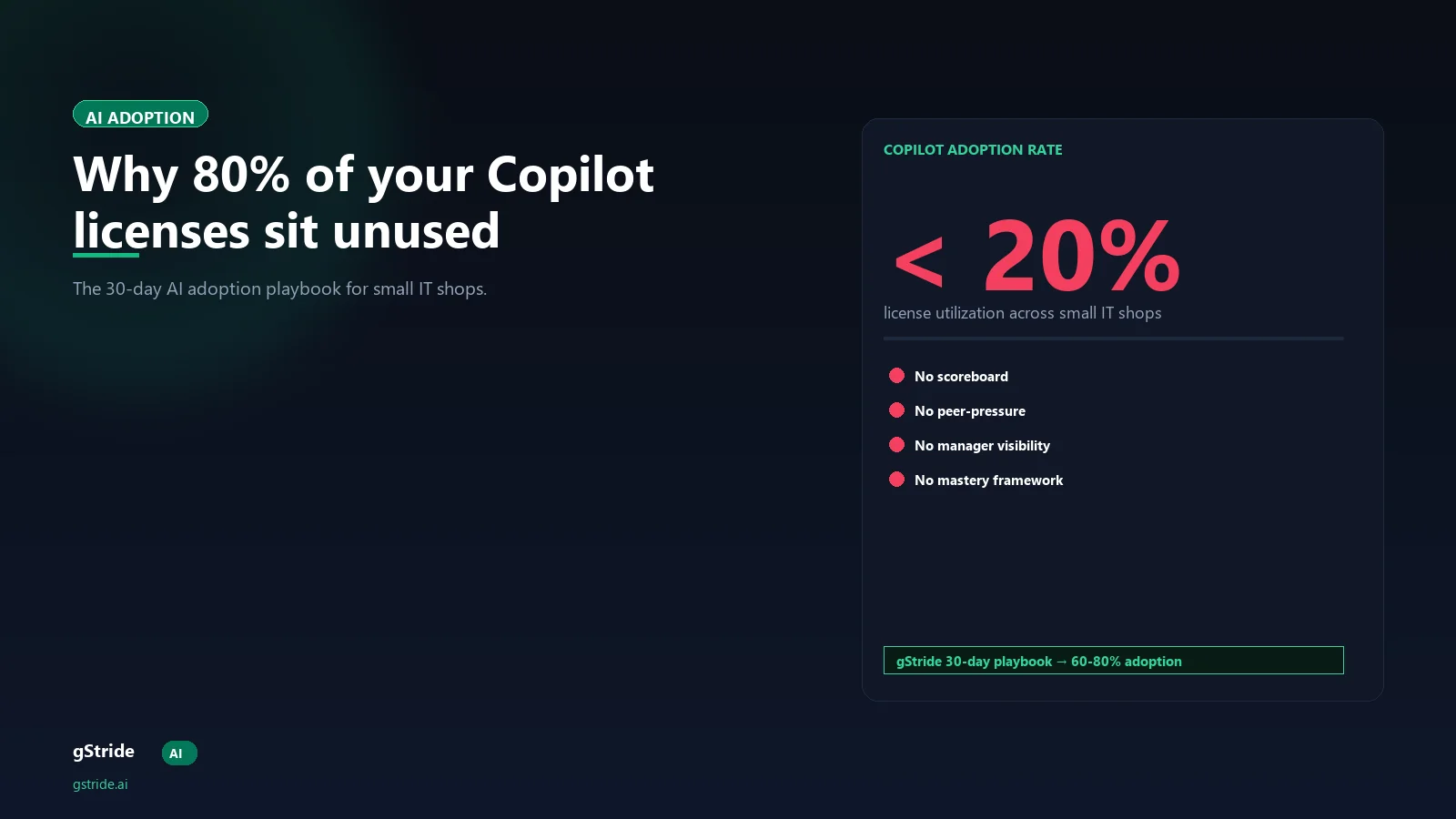
"We bought Copilot seats for the entire team. Adoption is below 20%. The license sits unused while the team continues doing things the old way."
— An Ahmedabad IT services CEO, on an advisor call, April 2026
The CEO bought Copilot for an engineering team of about 40 developers. The expectation was a measurable throughput lift in the first quarter post-rollout. The reality four months later was that fewer than eight developers were using the tool with any regularity, the rest had it installed and ignored, and the monthly license cost was now a recurring line item with no measurable return. The cancellation conversation was on the table. So was the harder question: do we keep paying for tools the team will not use, or do we run a real adoption playbook?
This is the most common AI-tool-rollout failure mode at small-to-mid Indian IT shops in 2026. The instrument that diagnoses it and the playbook that fixes it are the same shape we run for any team-wide AI tool — Cursor, Tabnine, Sourcegraph Cody, JetBrains AI Assistant, internal LLM gateways. The specifics of Copilot just make it the loudest example.
Why adoption stalls — four reasons
1. No scoreboard
The first reason is visibility. A developer who has installed Copilot but used it sparingly does not know whether her usage is below the team average, at the average, or above it. There is no scoreboard. The IDE plugin shows a small icon; the GitHub usage dashboard is opaque; the engineering manager does not surface any team-level signal. Without a scoreboard, "I have not really used it much" feels like a normal state — possibly even the responsible state. The developer is not being negligent; the system is not surfacing the signal that would prompt change.
2. No peer-pressure mechanism
The second reason is social. In every engineering team, there are 2-3 developers who are extracting real value from Copilot — they have refined their prompt shape, they know which file structures the model handles well, they have learned to reject suggestions on auth-sensitive code and accept on boilerplate. Those developers are invisible. Their colleagues do not know they exist, do not see their prompt shape, and do not benefit from their accumulated discipline. The peer-pressure mechanism that drives most tool adoption ("I want to do what the high-performers are doing") cannot fire because the high-performers are not surfaced.
3. No manager visibility
The third reason is conversational. The engineering manager has no per-developer adoption dashboard. She does not know who is using the license and who is not. The conversation that should happen — "I see you accepted 8% of suggestions, the team average is 31%, what is getting in the way?" — never happens because the manager does not have the data to start it. Adoption falls through the gap between the procurement decision (CEO/CFO) and the rollout responsibility (engineering manager) — and ends up nobody's job.
4. No time-to-mastery framework
The fourth reason is structural. Copilot has a real learning curve. There is a prompt shape — how you structure the surrounding code so the model produces useful suggestions. There is a rejection discipline — when to accept and when to reject. There is a bypass discipline — when to skip Copilot entirely (auth code, regulated-data handling, internal-DSL work). Most teams treat Copilot as install-and-go, the way they would treat a colour theme. The mastery curve takes 3-6 weeks for a competent developer with active coaching, and 3-6 months for one figuring it out alone. The latter mostly gives up before mastery — which is exactly what stall-at-20% looks like.
The 4-week adoption playbook
The playbook below moves a 40-developer engineering team from sub-20% adoption to above 70% within 30-45 days. It runs on top of an AI productivity intelligence layer that reads IDE-plugin telemetry, the OS active-window signal, and Git commit metadata. None of those signals capture code content. The full 30-day deployment playbook covers the platform shape; the playbook below is the AI-tool-adoption application of it. The signal model integrates with the same AI assistance feature we use for the broader productivity intelligence layer.
Week 1 — Adoption baseline + scoreboard
Install the AI productivity intelligence agent. Run the team for one week in capture-only mode. Baseline four signals per developer: suggestion-acceptance rate (% of Copilot suggestions accepted), focus-depth-while-using-Copilot (minutes of IDE focus with active Copilot interaction), prompts-attempted-per-session (engagement intensity), and bypass rate (% of work where Copilot is disabled or ignored).
At the end of week 1, surface the scoreboard. Anonymised display by default — developers see themselves named and others as "Developer A", "Developer B" with rank. Opt-in to display name (most developers opt in once they see a top-quartile rank). The scoreboard ships in the team dashboard plus an end-of-week email. No targets yet. Just visibility.
Week 2 — Senior champion + paired learning
Identify the top-quartile adopter from the week-1 scoreboard. Assign her as adoption champion. She runs two 45-minute paired learning sessions per junior/mid developer over the week. The format is screen-share: she shows her actual prompt shape on real production code, her rejection patterns (here is where I reject because the model hallucinates a deprecated API, here is where I reject because the suggestion is verbose), and her bypass patterns (here is auth code where I disable Copilot entirely).
Time-to-mastery measurement begins. The platform tracks each developer's signal trajectory against the champion's signal baseline. By end of week 2, most juniors have moved their suggestion-acceptance rate from 8-12% to 20-25%, and focus-depth-while-using-Copilot doubles.
Week 3 — Manager-visibility dashboard + commitment loop
The engineering manager opens the per-developer adoption dashboard. She runs a 30-minute team retro on Monday: shows the team-level adoption trend, names the three developers with the largest improvement (positive reinforcement, not punitive), and asks each developer to commit to one specific use-case to apply Copilot on this week ("unit-test generation for the auth module", "boilerplate for the new analytics endpoint", "doc-string generation on the legacy services").
Commitments are logged in the platform. The Friday review is 15 minutes per developer or 20 minutes for the whole team: did the commitment ship? What did the developer learn? What is the next-week commitment?
Week 4 — Outcome measurement + team rollout
The fourth week is when ROI gets measured. The platform shows per-developer outcomes: minutes-saved-per-day on AI-assisted tasks (measured against the week-1 baseline focus-depth-without-Copilot), PRs-shipped delta on AI-assisted vs unassisted tasks, blocker-recovery delta on AI-assisted blockers. Aggregate the per-developer numbers to a team ROI.
The team ROI is the conversation that closes the cancellation question for the CEO. If the ROI is positive (which it usually is by week 4, even with conservative assumptions), the playbook rolls to the next engineering team. If the ROI is genuinely negative for a specific team — say a compliance-code team where Copilot adds limited value — the cancellation conversation now has data behind it, and licenses can be reallocated to teams where the ROI is real.
The focus-depth-while-using-Copilot signal — why it matters
Most Copilot-measurement guides focus on raw suggestion-acceptance count. That signal is noisy. A developer can have a high acceptance rate by accepting uncritically (which damages downstream commit-quality) or a low acceptance rate by being highly selective (which is healthy). Acceptance count tells you nothing about whether the tool is integrated into the developer's workflow.
Focus-depth-while-using-Copilot is the share of a developer's IDE-focus minutes during which Copilot was actively interacted with — suggestions accepted, rejected, or actively prompted. A developer with 240 IDE-focus minutes and 180 of those involving Copilot interactions has high integration. A developer with 240 IDE-focus minutes and 12 involving Copilot has the license installed but is not using it. This is the single best signal for measuring real adoption.
Free: 5-Signal Productivity Self-Audit Worksheet
30-min audit on your current team — baseline focus depth, commit cadence, meeting load, flow-state minutes, blocker recovery. Same audit shape we use to set the week-1 baseline on Copilot adoption rollouts. PDF + Google Sheets calc.
Outcome — the composite picture at day 45
On the founder's question — "Adoption is below 20%, the license sits unused" — the day-45 outcome looks like this. Team-level adoption clears 70% (measured as developers above 25% suggestion-acceptance with above 60-minute focus-depth-while-using-Copilot per day). The top-quartile adopters from week 1 have grown into team-wide champions. Junior developers have moved from 8-12% to 28-35% suggestion-acceptance with healthy rejection discipline. The engineering manager has a per-developer dashboard and a documented weekly conversation loop. The CEO has a per-team ROI number that justifies the license spend.
The composite outcome, drawn from anonymised small-IT customer rollouts: total engineering capacity recovered per developer per day is 12-18 minutes on AI-assisted tasks, blocker-recovery latency on AI-assisted blockers drops by 30-45%, PR-throughput on AI-assisted work grows 18-25%, and the cancellation conversation moves off the table. The licenses that started as a 20%-utilised line item become a documented 70%+-utilised productivity multiplier. That is what running the playbook does that buying the licenses alone did not.
What this changes for the founder we opened with
The founder who said "the license sits unused while the team continues doing things the old way" was describing the gap between procurement and adoption. Procurement is one decision; adoption is 30 days of structured behaviour change. Most IT shops have done the first and skipped the second. The platform-plus-playbook model closes that gap with measurable signal and a 15-minute-a-week conversation loop. The same shape applies to the next AI tool the team buys — Cursor, Tabnine, an internal LLM gateway, a new AI-assisted code-review platform. The adoption infrastructure is reusable.
Further reading on gStride
Frequently asked questions
Why does Copilot adoption stall below 20% at IT shops?
Four reasons compound: no scoreboard, so developers cannot see whether they are above or below the team average; no peer-pressure mechanism, so the senior getting real value is invisible to the junior who is not; no manager visibility, so the coaching conversation never happens; and no time-to-mastery framework, even though Copilot has a real learning curve in prompt shape and rejection discipline. Fixing all four with a 30-day playbook moves adoption above 70%.
What is the focus-depth-while-using-Copilot signal?
Focus-depth-while-using-Copilot is the share of a developer's IDE-focus minutes during which Copilot suggestions were accepted, rejected, or actively prompted. A developer with 240 IDE-focus minutes and 180 of those involving Copilot interactions has high AI integration. A developer with 240 IDE-focus minutes and 12 involving Copilot has the license installed but is not using it. The signal reads from IDE-plugin telemetry and OS active-window data — not from code content. It is the most useful single signal for measuring real adoption, much better than raw suggestion-acceptance count.
Does measuring Copilot adoption violate developer trust?
Not if the measurement model ships the self-view on day one. The developer sees the same adoption dashboard the manager sees. The signal is operational metadata (prompts attempted, suggestions accepted, focus-depth-with-Copilot) — never code content. The conversation shifts from surveillance to coaching: "I see you accepted 8% of suggestions, the team average is 31%, here is how the champion adjusts her prompt shape." That is the adoption-coaching conversation that closes the gap.
What is a healthy Copilot suggestion-acceptance rate?
30-45% is the typical range for a competent user. Below 20% suggests the developer is not engaging seriously with the tool. Above 55% suggests the developer may be accepting too uncritically — and downstream commit-quality often drops. The healthy range is roughly 30-45% acceptance with a high rejection-quality (rejected because the suggestion was wrong, not because the developer did not read it). The platform surfaces acceptance rate and the focus-depth-while-using-Copilot signal together so a high-acceptance-low-engagement pattern is visible.
How long does the 30-day playbook take to show ROI?
Visible throughput delta starts in week 3 of the playbook. Statistically meaningful ROI lands in month 2-3 — that is when the throughput delta is large enough to subtract the license cost and still show net gain. Most IT shops on the playbook see net positive ROI by month 3, with the gain growing as more developers cross the mastery curve. The biggest single ROI lift is on junior and mid developers; senior developers tend to be early adopters and already get most of the value.
What if the team genuinely does not need Copilot?
That is the right question to ask before buying licenses, not after. In domains where AI assistants add limited value — specialised compliance code, embedded firmware, internal-DSL work — the answer may be not to buy team-wide. The adoption playbook is for teams where the tool is useful but the adoption mechanism has failed. The adoption-measurement signal shows within 30 days whether the value is real, and a low-acceptance-with-high-engagement pattern is the signal to cancel licenses, not coach harder.
Does this playbook work for tools other than Copilot?
Yes. The same four-week shape applies to any team-wide AI tool — Cursor, Tabnine, Sourcegraph Cody, JetBrains AI Assistant, ChatGPT Enterprise, Claude Code, internal LLM gateways. The signal model adjusts (the IDE-plugin telemetry differs across tools), but the four reasons adoption stalls and the four-week playbook structure are identical. The platform integrates with the tool's telemetry endpoint to read engagement metadata; no code content is captured.
How does adoption measurement connect to appraisals?
Adoption of paid AI tools is part of the team-skill upgrade trajectory. It is reasonable to include adoption rate and the ROI delta (PRs shipped on AI-assisted vs unassisted tasks, focus-depth-while-using-Copilot trend) as one input in the year-end appraisal — not as a punitive metric, but as a learning-velocity signal. The platform surfaces the trend so the appraisal conversation can include "this engineer adopted three new tools across the year and moved her PR-throughput by 28%" as documented signal rather than manager perception.
Start a free trial — measure your Copilot ROI in 30 days
Adoption baseline + paired-learning + manager visibility + outcome measurement. Self-view enabled day one. No screenshots.
Start free trial Book a 15-min demoThe Ahmedabad IT services CEO quoted gave the founder feedback in a private advisor call and is not publicly named. Adoption-rate ranges, ROI math, and outcome ranges are drawn from anonymised aggregate data across multiple small-IT customer deployments. The four-signal model and 30-day playbook are the working framework on the gStride platform as of May 2026.