
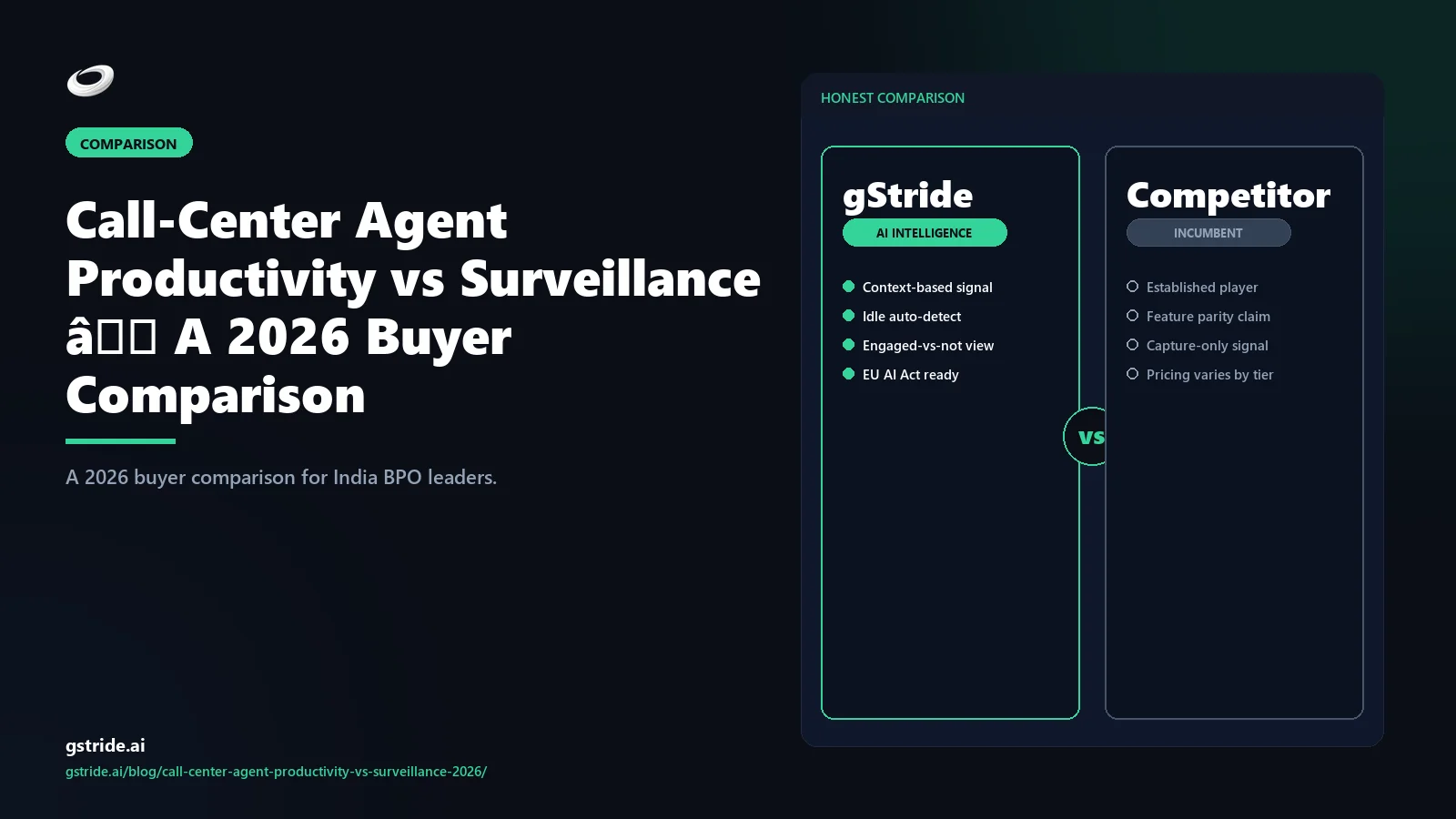
The category split — surveillance versus outcome signal
Surveillance-default monitoring captures inputs from the agent endpoint — screenshots, keystroke or mouse cadence, sometimes webcam frames. Outcome-signal productivity intelligence captures aggregate events from the work systems the BPO already runs — dialler, CRM, ticketing tool, QA workflow. The vendor home pages blur this distinction more than they used to, because the legal climate has shifted enough that even the surveillance vendors now describe themselves as productivity platforms. The architecture answer sits in the data dictionary, not the marketing copy.
Three diagnostic questions clear the category in the first procurement call.
- What does the platform capture on the agent endpoint by default? If the answer is screenshots, keystroke cadence, mouse-movement scoring, or webcam frames — surveillance category. If the answer is which work tool has OS focus, rolled up at the category level, with no screen content read — outcome-signal category.
- What does the QA team read off the platform? If the QA flow opens screenshot frames or keystroke timelines for context — surveillance. If the QA flow opens call recordings already produced by the dialler and the agent's signal panel — outcome-signal.
- What is the appeal path on a flag? If the agent cannot see the platform record their team leader sees, or if the appeal goes outside the platform into HR email — surveillance. If the agent reads the same panel on the same minute and the appeal is logged inside the platform — outcome-signal.
The architecture answer is structural. A vendor that defaults to screenshot capture cannot become outcome-signal by turning the screenshot off in a configuration screen, because the data dictionary, retention model, and dashboard layout were built around the input-capture posture. The reverse is also true — an outcome-signal platform that bolts on a screenshot module is no longer in the outcome-signal category for DPDP review purposes.
The DPDP Section 8 readiness lens
Section 8 of the Digital Personal Data Protection Act expects reasonable security and proportionate, itemised retention. For an agent-monitoring stack, that translates into four operational requirements — itemised retention per signal, agent-visible records, an appeal path the agent can file, and a per-purpose consent register. The category split lands here cleanly. Surveillance-default monitoring fails the itemised-retention test on the first signal — most platforms ship a single retention knob across screenshots, keystroke logs, and aggregate score histories.
The Section 8 audit a DPO runs in 2026 has five line items. Source-system list, per-signal retention table, consent ledger reference, appeal log, and quarterly DPO sign-off. A surveillance platform that captures four data types and sets one retention period across all four cannot produce a per-signal retention table without product changes. An outcome-signal platform that captures aggregate work events with per-signal retention lines passes the audit on default configuration.
Free: DPDP Vendor Risk Assessment Worksheet
The 16-question Section 4, Section 8, Section 10, Section 11 scoring sheet — built for India BPO Ops, Compliance, and DPO teams to run on the agent-monitoring vendor in the stack today.
Open the worksheetThe agent-retention lens
Agent attrition is the largest line item in any India BPO budget after salary, and the most under-modelled cost when a monitoring decision is made. The pattern across 2024-2026 deployments seen in procurement diligence — including an 850-seat Pune BPO and a 1,200-seat Bengaluru contact centre we worked through last quarter — is a 3 to 5 percentage-point uplift in voluntary attrition during the first eighteen months after surveillance-default monitoring is turned on, concentrated in the top quartile of agents. The bottom quartile attrition stays roughly flat; the gap opens at the top.
The mechanism is mundane. The top-quartile agent at a 500-seat BPO has options — three to four offers in the local market at any time. The screenshot-and-keystroke regime is the friction that turns a passive offer into an active resignation. The bottom-quartile agent does not have that option set and stays through the discomfort. The net effect is the team gets weaker, not stronger.
The cost shape on a 500-seat shop with a 28-32 per cent baseline annual attrition and a replacement cost of three to four months' fully loaded salary per agent runs roughly INR 1.4 to 2.6 crore in additional replacement spend over three years on the surveillance category. The same shop on an outcome-signal platform does not carry the delta. Better deployments show a small attrition reduction because the workload signal flags burnout patterns before they cluster into exit.
The five-vendor matrix
The matrix below scores the five common vendors a 200-2,000 seat India BPO is likely to be evaluating in 2026 on three criteria — DPDP Section 8 readiness, agent attrition impact, and cost. Scoring uses a simple three-band scale (low / medium / high) for the readiness and impact lines, and an indicative three-year range per seat for cost. The numbers below are illustrative of typical 2026 mid-market deployments; finance teams should anchor them against their own quotes and HR ratios.
| Vendor | Default capture | DPDP Sec. 8 readiness | Agent attrition impact | 3-yr cost per seat (INR, risk-adjusted) |
|---|---|---|---|---|
| Time Doctor | Screenshots, keystroke counts, app usage | Low — single retention knob, weak appeal path | High — top-quartile attrition uplift typical | INR 38,000-58,000 |
| Hubstaff | Screenshots, mouse / keyboard activity, app usage | Low — single retention knob, limited per-signal lines | High — top-quartile attrition uplift typical | INR 36,000-54,000 |
| ActivTrak | Activity classification, app and URL usage; screenshots optional | Medium — softer default capture, retention partly itemised | Medium — lower than Time Doctor / Hubstaff, still elevated | INR 30,000-48,000 |
| Insightful | Screenshots, productivity scoring, app and URL usage | Low — single retention knob, heavier capture posture | High — top-quartile attrition uplift typical | INR 40,000-60,000 |
| gStride | Aggregate events from dialler, CRM, ticketing, QA workflow | High — per-signal retention, agent-visible, appeal logged | Low — no top-quartile attrition delta observed | INR 22,000-36,000 |
Two notes on reading the matrix. First, the cost line is risk-adjusted — it includes the counsel-review band, the HR-FTE delta, and the attrition replacement spend, not just the platform list. The platform list across the five vendors sits in a much tighter 25 per cent band, which is what makes the surveillance category look cheap on the first procurement spreadsheet. Second, the Section 8 readiness scores assume the default capture configuration. A surveillance platform configured down to outcome-signal-only is a different conversation, but in our procurement diligence we have rarely seen those configurations survive a quarterly review — the defaults drift back on within two release cycles.
What surveillance still does well — the narrow case
The category is not zero-value in every contact-centre context. Three narrow scenarios still favour surveillance-default monitoring on the operations math.
- Regulated security workloads. Contact-centre operations handling cardholder data under PCI-DSS or healthcare data under HIPAA-equivalent frameworks may have a separate DLP and session-recording requirement. The monitoring spend in that case is a security line, not a productivity line, and the productivity-side decision sits separately. Scope to the cleared roles, not the full agent population.
- Audit-of-record roles. Specific senior agents handling escalations on regulated accounts where session recording is required for audit. Scoped to the role, with consent capture, retention itemisation, and an appeal path.
- Sunk-cost holds. Where an existing surveillance contract has twelve to eighteen months of term remaining and the switching cost defeats the migration case in the short window. The 850-seat Pune BPO we mentioned earlier sat in this band for two quarters before the renewal moment opened the category review.
Outside those scenarios, the buyer math at 200-2,000 seats in 2026 sits with the outcome-signal category in almost every modelled deployment. The framework for the agent scorecard is in the DPDP-safe call-centre framework blog; the fill-in scorecard template is in the BPO scorecard template blog.
Read the deeper anti-surveillance argument
The category-level case for outcome-signal monitoring across the workforce — not only call-centre — and the design principles behind a surveillance-default-off productivity stack.
Read the pillarThe questions to ask in the first procurement call
The CIO and Ops Head running the procurement review can disambiguate the category in a single call. The five questions below are the ones that produce a structural answer rather than a marketing answer.
- What is the default capture posture out of the box, screen-by-screen and signal-by-signal? The vendor that walks through screenshot capture, keystroke logging, and webcam streams in the default configuration is in the surveillance category, regardless of the soft-pedalling in the slide deck.
- What is the per-signal retention line? Not "data retention" as a single knob. Per signal — screenshot frames, keystroke logs, application categories, aggregate scores. If the answer is one number for all signals, the platform fails the Section 8 itemisation test on default.
- What does the agent see, on the same minute, that the team leader sees? If the answer is a back-office dashboard the agent cannot access, the appeal path under DPDP Section 11 is weakened in practice, even if the policy document promises it.
- What is the appeal path on a coaching note, and is the appeal record part of the audit trail? If the appeal goes outside the platform into HR email, the audit trail breaks. If it sits inside the QA workflow with timestamp, status, and resolution captured, the loop closes.
- What is the consent record format, and where is it stored? The vendor that points to a paragraph in the offer letter has imported a consent model from another jurisdiction. The vendor that points to a per-purpose ledger with timestamp, version, and withdrawal log is built for DPDP.
Free: Productivity Report Template (Weekly + Monthly)
The five-section weekly and seven-section monthly productivity report template — the rollup the BPO leadership cadence reads after the coaching cadence closes.
Open the report templateFAQ
Frequently asked questions
Is keystroke or screenshot monitoring legal for India BPO agents under DPDP?
Not categorically illegal, but rarely defensible without scoping. DPDP Section 4 requires a specific lawful purpose and proportionate collection. A screenshot every two minutes and keystroke-cadence capture fail that proportionality test for a coaching purpose, because the same outcome is reachable with the dialler, CRM, and QA-workflow data the contact centre already produces. Section 8 adds reasonable security and itemised retention — most India BPO deployments we reviewed could not produce a per-signal retention line for screenshot frames. Counsel review is required for each deployment.
How does surveillance monitoring affect agent attrition in a 500-seat India BPO?
Across 2024-2026 India BPO deployments seen in procurement diligence, the pattern is a 3-5 percentage-point uplift in voluntary attrition in the first eighteen months after surveillance-default monitoring goes live, concentrated in the top quartile of agents. On a 500-seat shop with 28-32 percent baseline attrition and a replacement cost of three to four months' salary per agent, that delta runs roughly INR 1.4-2.6 crore in added replacement cost over three years. Outcome-signal deployments do not carry the delta, and the better ones show a small attrition reduction.
Are Time Doctor, Hubstaff, ActivTrak, Insightful, and gStride the same category?
No. Time Doctor, Hubstaff, ActivTrak, and Insightful sit primarily in the employee-monitoring category, with default capture built around screenshots, keystroke or mouse cadence, and application logs. ActivTrak softens the default capture but still ships activity-level scoring; Insightful sits at the heavier end. gStride sits in the productivity-intelligence category — aggregate work events from the dialler, CRM, ticketing tool, and QA workflow, with no screenshot, keystroke, or webcam capture on the agent endpoint. The gap shows up in the data dictionary and default capture posture; see how gStride compares to ActivTrak on those defaults.
What does the total cost of ownership look like over three years for a 500-seat BPO?
At list price the platform line sits within a 25 percent band across the five vendors, at INR 700-1,200 per seat per month. The gap opens on hidden lines — DPDP counsel review typically runs INR 35-70 lakh for surveillance vendors versus INR 12-25 lakh for the productivity-intelligence vendor, and HR consent-and-grievance time runs 0.4-0.6 FTE versus 0.1-0.2 FTE. Adding the attrition delta, risk-adjusted three-year total cost for the surveillance stack typically lands 1.3 to 1.7 times higher on a 500-seat deployment. Counsel review is required.
What should a BPO Ops Head ask a monitoring vendor in the first procurement call?
Five questions. One — what is the default capture posture, signal by signal. Two — what is the per-signal retention line, not a single retention knob. Three — what does the agent see, on the same minute, that the team leader sees. Four — what is the appeal path on a coaching note, and is it logged in the audit trail. Five — what is the consent record format and where is it stored. A vendor that cannot answer all five carries DPDP and EU AI Act risk weight.
Related reading on gStride
- Call-centre agent productivity in 2026 — the 5-signal DPDP-safe framework
- BPO call-centre scorecard template — DPDP-safe edition
- The anti-surveillance productivity stack — pillar guide
- DPDP-compliant employee monitoring vendors for India 2026
- BPO workforce management software in India — buyer's guide
See an agent-monitoring stack a DPO will sign off
gStride reads the five DPDP-safe signals from the dialler, CRM, ticketing tool, and QA workflow the BPO already runs. Agent-visible. Per-signal retention. Appeal logged inside the platform. No screenshots, no keystroke capture.
See the platform Book a 30-min call