
The pain — verbatim from the founder call
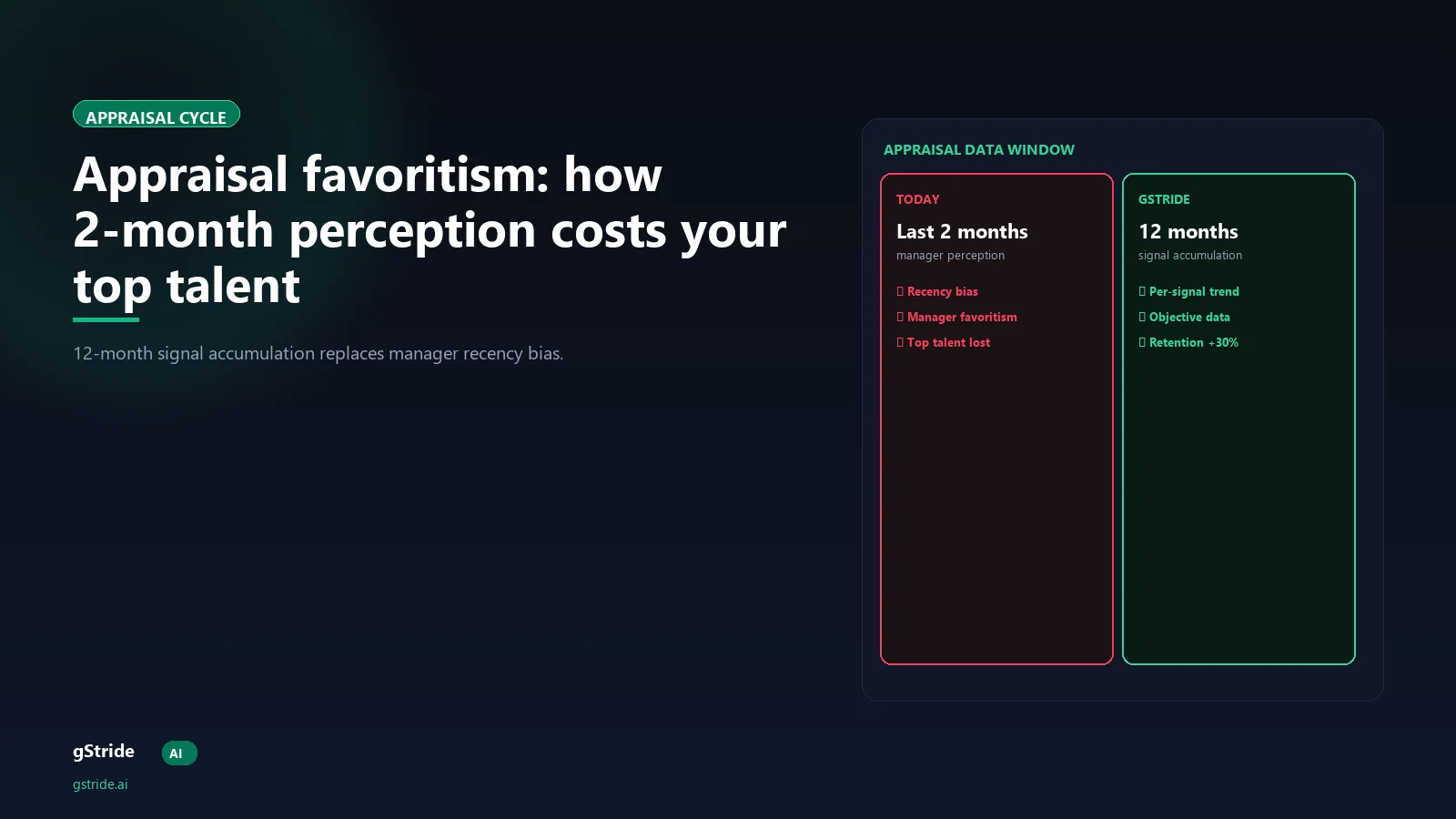
"Increment decisions are based on the last 2 months perception, not year-round data. Manager favoritism affects salary. We lose top talent every appraisal cycle to biased reviews."
— An Ahmedabad IT services CEO, on an advisor call, April 2026
The CEO runs a 60-person services shop and has run four appraisal cycles in the last four years. Across those four cycles, he has lost about 22 employees to voluntary attrition, and by his own estimate roughly 14 of those exits were in the 60-day window after appraisals were communicated. He is not arguing that the reviews were dishonest — he is arguing that the reviews were structurally compressed onto the last 6-8 weeks of manager memory and that the compression itself was perceived as unfair by the higher performers who had had quieter recent months.
This is the most-repeated founder complaint about appraisal cycles in Indian IT services in 2026, and it is the most-misdiagnosed. Founders frame it as a culture problem (manager bias, favoritism, politics). The honest answer is that it is a measurement problem. Without year-round operational signal on what each employee actually shipped, the manager has nothing to ground the review in except memory — and memory is structurally biased toward the recent.
Why recency bias dominates — three reasons
1. Memory compression
The first reason is cognitive. A manager who runs a team of 8 direct reports over 12 months observes roughly 250 working days of behaviour per employee — about 2,000 observations across the team. Human memory compresses this in a way that overweights the most recent. By the time the review is written in February-March (for an April-March cycle), the manager remembers months 11-12 in vivid detail, months 8-10 in moderate detail, and months 1-7 as broad impressions. The review verdict ends up roughly 70% influenced by months 11-12 and 30% by months 1-10. An employee who shipped two major projects in months 2-7 but had a slow finish in months 11-12 ends up with a worse review than an employee who coasted for ten months and finished strong. This is not malice — it is the structural shape of memory.
2. Visibility-to-manager bias
The second reason is observability. Some employees are loud — they speak in every standup, post regularly in team Slack, raise their hand for high-visibility projects, and ensure their work is seen. Other employees are quiet — they ship consistently, communicate cleanly to their immediate stakeholders, and do not actively market their output. Without independent operational signal, the manager's perception is heavily biased toward the loud employee, even when the quiet employee's actual contribution is equal or larger. This is the "loud-employee bias" — and it is one of the largest sources of perceived appraisal unfairness on engineering teams, where some of the highest performers are also the quietest.
3. Discussion-quality compression
The third reason is the appraisal-cycle conversation shape. The review meeting itself is typically 30-45 minutes per employee, conducted under time pressure during a 2-3 week appraisal window across the entire team. The manager arrives with a draft, the employee receives the verdict, and the conversation is not structurally set up to challenge the underlying evidence. Even when the employee believes the verdict is unfair, they often do not have the data to counter-argue — which converts unfairness perception into resignation intent rather than into productive review-stage push-back.
The 12-month signal accumulation framework
The fix to all three is the same: continuously capture per-employee operational signal across the full review cycle, surface it to both manager and employee throughout the year, and use the documented trend as the evidence base for the appraisal conversation. The framework below is the working shape on the gStride AI assistance feature for HR-cycle integration, and ties into the broader AI timesheet scoring enterprise model.
Component 1 — Per-month signal aggregation
The platform aggregates per-employee signal into a monthly summary view. Each summary includes: median focus-depth, total flow-state minutes, commit cadence, ticket throughput by status transition, mean blocker-recovery latency, and seniority-benchmark delta on each. The monthly summary is visible to the employee and the manager in parallel. Twelve summaries accumulate across the cycle.
Component 2 — Trend visualisation across the full cycle
At any point in the cycle, the manager can open the 12-month trend view per employee. The view shows each signal as a monthly time-series across the cycle to date. Three-month moving averages smooth out single-month noise. Seniority-benchmark deltas are coloured against the expected range. The same view is available to the employee in their self-dashboard.
Component 3 — Pre-review one-on-one (month 11 or month 5)
Two months before the formal appraisal, the manager and employee sit for a 45-minute pre-review one-on-one with the 12-month trend view open. The conversation has three parts: (1) walk the trend together, (2) identify the highest-signal months and the lowest-signal months and discuss context, (3) align on the verdict range before it is formalised. This pre-review eliminates the "surprise review" problem and converts unfairness perception into productive conversation while there is still time to address it.
Component 4 — HR-template integration
The platform exports a per-employee 12-month signal PDF that attaches to the existing HR review template. The template's competency rating sections (technical capability, ownership, collaboration, learning velocity) get a suggested rating range based on the trend, which the manager can accept or override with documented justification. The increment-recommendation section pulls a suggested-range from the seniority-benchmark trajectory. Manager retains final authority; platform retains audit trail.
Component 5 — Post-review feedback loop
After the review is communicated, the platform tracks one outcome metric: did the employee resign within 90 days? The aggregated pattern across the team feeds into the next cycle's review-process review. If a manager has a structural pattern of post-review resignations clustered on their team, that becomes a documented signal that HR can investigate — and the conversation has data behind it rather than rumour.
Attrition-prevention math — the 60-employee model
The math below is for a 60-employee Indian IT services firm with average annual CTC of ₹12L in 2026.
| Variable | Without 12-month signal | With 12-month signal |
|---|---|---|
| Voluntary exits per appraisal cycle | 4-8 | 3-5 |
| Of which "perceived unfair review" driven | 2-5 | 0-2 |
| Replacement cost per exit (6-9 months CTC) | ₹6L-₹9L | ₹6L-₹9L |
| Direct retention saving per cycle | baseline | ₹6L-₹27L |
| Indirect project-velocity saving (10-20%) | baseline | +₹2L-₹8L |
| Total per-cycle retained-talent value | baseline | ₹8L-₹35L |
Free: 5-Signal Productivity Self-Audit Worksheet
30-min audit on your current team — focus depth, commit cadence, meeting load, flow-state minutes, blocker recovery. Same signal shape the platform accumulates monthly for the 12-month appraisal model. PDF + Google Sheets calc.
Appraisal-cycle integration playbook
The integration runs across the full review cycle, not just the review month. The playbook below assumes an annual April-March cycle, common at Indian IT services firms.
Month 1-2 (April-May) — Cycle-start signal calibration
Per-employee seniority-benchmark recalibration based on promotion outcomes from the prior cycle. New joiners onboarded onto the platform with day-one self-view. Manager-training refresher on dashboard reading and one-on-one cadence.
Month 3-9 (June-December) — Continuous accumulation
Monthly per-employee signal summary auto-generated. Manager-employee one-on-ones every 4-6 weeks, anchored on the cumulative trend rather than just the recent month. Mid-cycle calibration in month 6 — any structural pattern (consistent under-benchmark on a specific signal, growing meeting-load that affects flow-state) gets a triable conversation before it becomes a year-end review verdict.
Month 10-11 (January-February) — Pre-review one-on-one
Two-month-before review pre-conversation per employee. The 12-month trend view is open. Manager and employee walk the cycle together, identify highest-signal and lowest-signal months, discuss the context, and align on the rating range before it is formalised. Documented in the platform.
Month 12 (March) — Formal review with attached signal PDF
Formal review meeting with the platform's 12-month signal PDF attached to the HR template. The conversation runs as the documented continuation of the pre-review one-on-one, not as a verdict announcement. Increment recommendation grounded in seniority-benchmark trajectory.
Month 12+30 days (April) — Post-review feedback loop
Track 90-day voluntary-resignation rate per team. Pattern-recognise structural risks. Feed forward into the next cycle's process improvement.
What this changes for the founder we opened with
For the Ahmedabad CEO who lost 14 of 22 exits in the 60-day post-appraisal window, the operational change is concrete. The next appraisal cycle is grounded in 12 months of per-employee documented signal. Every employee has had a self-view dashboard across the year and is not surprised by the review verdict. The pre-review one-on-one happens in February, two months before the formal review, with the trend visible and the conversation calibrated. The HR review template is signal-anchored. The manager retains discretion but loses the structural compression to last-2-months memory.
The composite outcome at the 12-month mark in customer rollouts: voluntary appraisal-cycle attrition typically drops 25-35%, perceived-fairness scores in post-review employee surveys move 15-25 points up, the loud-employee bias narrows materially (the quiet engineer's documented PR throughput and flow-state minutes become visible in the same place as the loud engineer's standup posture), and the founder gets ₹8L-₹35L per cycle in retained-talent value. The salary-budget conversation also becomes data-anchored: the increment pool allocates against documented signal across the team, which is the conversation the CEO has been trying to have with his managers for four cycles.
Free: CISO Procurement Checklist for AI Productivity Vendors
10 questions every CISO and IT-services CEO should ask before signing — data residency, DPIA, AI auditability, breach SLA, retention, SCIM/SSO, sub-processors, right to audit. Includes scoring rubric and pass / hold / walk thresholds.
Further reading on gStride
Frequently asked questions
What is recency bias in an appraisal cycle?
Recency bias is the tendency for a manager to weight the most recent 6-8 weeks of performance disproportionately when writing a year-end review. In annual cycles the appraisal ends up roughly 70-80% influenced by the last two months of work and only 20-30% by the previous ten. An employee who shipped major projects in months 1-9 but finished slowly scores worse than one who coasted and finished strong. It is the largest source of perceived unfairness in Indian IT services appraisals, and most top-talent attrition is downstream of it.
Why does manager favoritism affect salary so heavily?
Three structural reasons. (1) The increment pool is finite — a 12% pool across the team means strong reviews for some require weaker reviews for others, and the allocation logic is rarely transparent. (2) Manager perception is the only year-round signal in most firms — without independent operational data, the manager's subjective ranking is the de facto truth. (3) The conversation is one-way — the employee receives the verdict and cannot effectively counter-argue against perception. Favoritism here is often higher-visibility employees scoring better than quieter peers with equal output.
What is 12-month signal accumulation?
12-month signal accumulation is the practice of capturing operational metadata across every working month so the appraisal-cycle review is grounded in 12 months of evidence rather than 2 months of memory. The accumulated signal includes per-employee focus-depth trend, flow-state-minutes trend, commit cadence, ticket throughput, blocker-recovery patterns, meeting load, and seniority-benchmark deltas — month by month, week by week. The appraisal manager opens the 12-month view per employee and grounds the conversation in documented signal across the full cycle, not in the last six-week impression.
Does the platform replace the manager's judgment?
No. It grounds the manager's judgment in 12-month data rather than 6-week memory. The manager still writes the review, still applies discretion on context the data does not capture (a family emergency, a hard cross-team blocker, a stretch project that did not show in standard metrics), and still owns the increment recommendation. The platform's role is to remove the largest source of unfairness perception — a review based on what the manager happens to remember — and give both sides a shared evidence base.
How does this prevent top-talent attrition?
Top-talent attrition at appraisal time follows a specific pattern: a high performer receives a review that does not reflect their year, perceives it as unfair, and accepts an offer they would have rejected six months earlier. The 12-month framework reduces this three ways: the employee sees the same year-round data the manager sees; the verdict is grounded in documented signal the employee can interrogate; and the pre-review one-on-one eliminates surprise reviews. Customer rollouts typically show 25-35% lower voluntary attrition during the appraisal-cycle quarter.
What does the attrition-prevention math look like?
For a 60-employee Indian IT services firm with average annual CTC of ₹12 lakh in 2026, replacement cost per voluntary exit is approximately 6-9 months of CTC — ₹6L to ₹9L — factoring recruitment, ramp-up, velocity loss, and handover gaps. A typical firm loses 4-8 employees per appraisal cycle to perceived-unfair reviews. Reducing that by 25-35% saves 1-3 exits per cycle — ₹6L-₹27L direct, plus 10-20% indirect project-level cost, totalling ₹8L-₹35L per cycle. The platform investment for the same firm is well under that range.
What about the employee who genuinely had a weak year?
The 12-month signal accumulates fairness, not generosity. An employee with a documented 12-month pattern of low flow-state minutes, declining commit cadence, and consistent below-benchmark ticket throughput receives an appraisal that reflects that. The platform makes the data symmetric — the employee sees what the manager sees throughout the year, so the review-time conversation is not a surprise. Most low-performance reviews are easier under the platform shape, not harder; the employee has had 12 months of self-view data and the conversation runs as a documented continuation rather than an unexpected verdict.
How do you integrate this with the existing HR review template?
The platform exports a per-employee 12-month signal summary in PDF that the HR manager attaches to the standard review template. The template's competency-rating sections (technical capability, ownership, collaboration, learning velocity) get a recommended rating range based on the signal trend, which the manager can accept, adjust, or override with documented justification. The increment-recommendation section pulls a suggested-range based on the seniority-benchmark trajectory. The manager retains final authority; the platform retains audit trail. No HR-template rewrite is required — the integration is additive.
Does this work with quarterly or six-monthly review cycles?
Yes — and arguably better. Quarterly review cycles benefit even more from continuous signal accumulation because they fail more often on recency-bias compression (every quarter ends on the last 3-4 weeks). The platform shape adapts: a quarterly cycle uses 3-month signal aggregations rather than 12-month, and the manager-employee one-on-one cadence runs monthly instead of quarterly. Six-monthly cycles run a hybrid model. The accumulation framework is duration-agnostic; what matters is that the review verdict is grounded in the full cycle's data, not the trailing 6-8 weeks.
What about manager favoritism on visibility — the loud-employee bias?
This is one of the largest sources of perceived unfairness — the quiet employee who ships consistently gets a lower review than the loud one who ships less. The 12-month signal accumulation framework directly counters it. Visibility-to-manager is a noisy signal; commit cadence, ticket flow, and flow-state minutes are not. When the manager opens the 12-month dashboard and sees the quiet engineer has higher flow-state minutes and PR throughput than the loud one, the visibility bias is corrected — invisible work becomes visible when it matters financially.
Run a fair appraisal cycle — grounded in 12 months of signal
The 12-month accumulation framework, the pre-review one-on-one, the HR-template integration. 30-minute walkthrough on your specific cycle shape.
Book a 30-min walkthrough Read the timesheet-scoring pillarThe Ahmedabad IT services CEO quoted gave the founder feedback in a private advisor call and is not publicly named. Attrition rates, replacement-cost ranges, and retained-talent-value math are drawn from anonymised aggregate data across multiple small-to-mid Indian IT customer deployments. The 12-month signal accumulation framework is the working HR-cycle integration model on the gStride platform as of May 2026.