
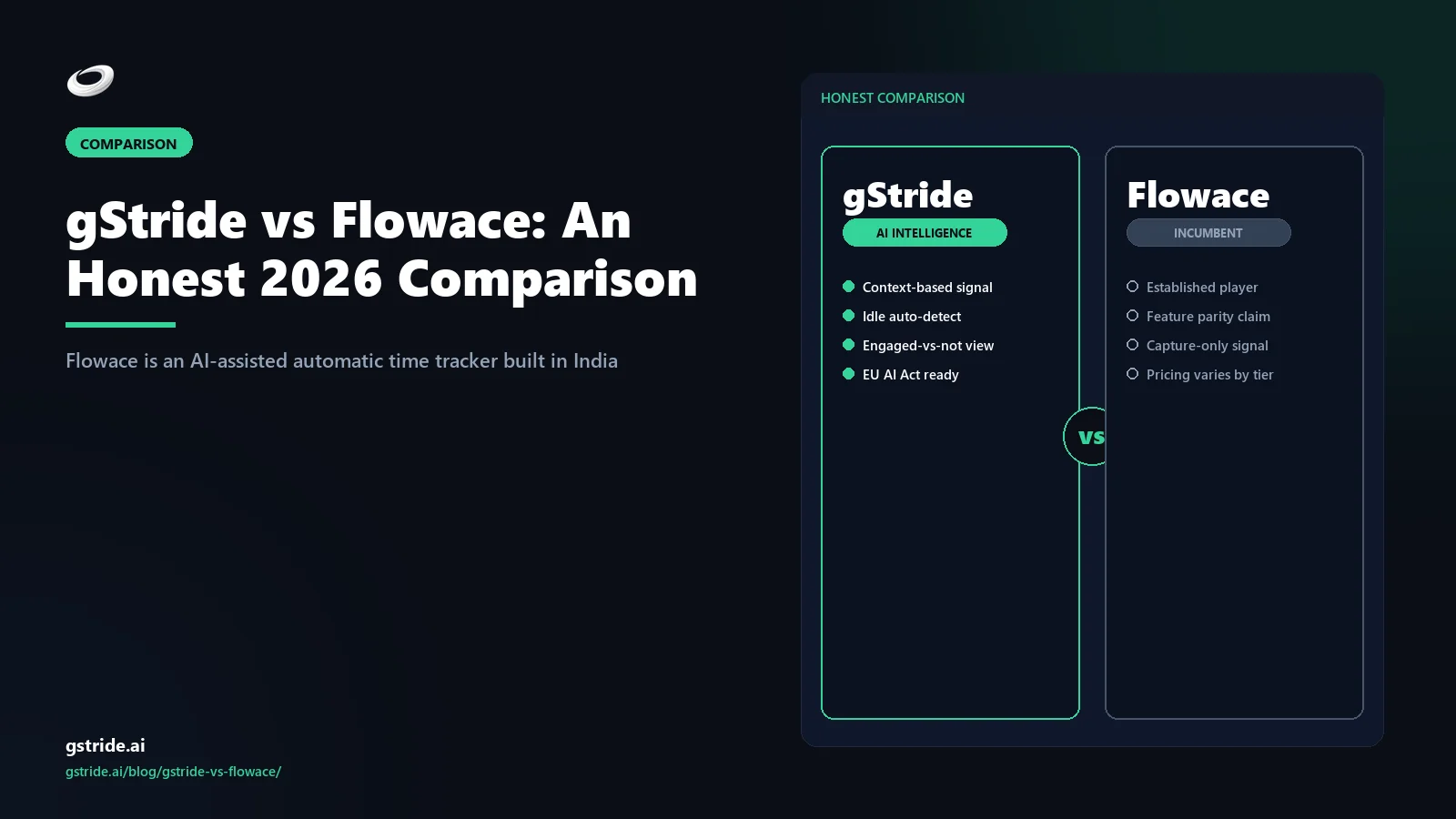
Why India buyers reconsider Flowace in 2026
Flowace is a competent India-native productivity and monitoring platform — founded in Bengaluru, priced for the India SMB and startup segment, and frequently cited in Indian HR communities. The reason India IT services and BPO buyers reopen the evaluation in 2026 is not a product defect. It is the regulatory floor moving underneath the procurement decision.
The DPDP Act 2023 reframes the question every India compliance officer now asks before signing any workforce vendor — including India-native ones: where does agent personal data live under a written commitment, what is it used for, and can a manager defend an AI-influenced appraisal decision when an employee disputes it? Being India-founded does not automatically answer any of these three questions. Verify with counsel.
Why India buyers reopen the Flowace evaluation — five reasons:
- Written data residency vs stated posture. Procurement-grade DPDP compliance requires India-region pinning as a contractual commitment in a data-processing addendum, not a marketing claim. India-founded does not equal India-residency-committed-in-writing under DPDP Section 16.
- Purpose limitation under DPDP Section 8. Screenshot capture, application tracking, and URL logging carry purposes beyond the stated monitoring purpose. A DPDP-compliant architecture limits processing to the consented purpose by design, not through configuration discipline the compliance team must maintain through every product update.
- Explainability gap for AI-influenced appraisals. When a productivity score feeds a PIP, increment, or bench decision, the employee has a reasonable expectation of a per-decision why-trail. A dashboard aggregate does not provide this. India’s H1 2026 appraisal season has sharpened the legal-risk perception around this gap.
- Fine-math asymmetry. The maximum DPDP Act 2023 penalty is INR 250 crore per instance for the most serious violations (Section 33, Schedule) — a figure that dwarfs the one-time switch cost for most India operations. Penalty tiers may change when the Rules are notified; verify with counsel.
- Customer-DPA flow-down. India IT services and BPO exporters carry dual GDPR and DPDP obligations from customer contracts. A monitoring tool that cannot produce a procurement-grade DPA for the customer audit cycle resurfaces as a commercial liability at every renewal.
- INR 250 crore — maximum financial penalty for the most serious DPDP Act 2023 violations as prescribed in Schedule 1, Section 33; purpose-limitation breaches and cross-border data-transfer failures are named violation categories; penalty tiers are subject to revision when the Rules are notified (DPDP Act 2023, Section 33; verify applicable tier with counsel).
- 5.4 million — direct employees in India’s IT-BPM sector as of 2023–24 (NASSCOM Strategic Review 2024); all are DPDP data principals whose personal data IT services and BPO operations process as Data Fiduciaries, making written vendor data-residency commitments a mandatory procurement item rather than a commercial preference.
- One to two quarters — typical payback window for a 100–500 seat India operation switching from a screenshot-based monitoring tool to a DPDP-aligned productivity intelligence platform, once the compliance-configuration cost of maintaining purpose-limitation discipline on a monitoring architecture is included in the total cost of ownership; model the exact figure with the free Switch Cost Estimator (verify with your finance team).
The three DPDP gaps to diligence in any Flowace alternative
Before comparing tools, fix the evaluation criteria. These are the three gaps that separate a DPDP-compliant alternative from a feature-equivalent one — and they apply to every vendor on your shortlist, not just Flowace.
Gap one — data residency in writing
India-founded does not mean India-residency-committed-in-writing. The DPDP-safe posture for an India operation is India-region data pinning written into the data-processing addendum as a contractual obligation — not an assumed default from the vendor’s headquarters location. The question to ask is not “where is the company based?” but “show me the DPA clause that commits agent personal data to an India region and prohibits cross-border transfer without a documented legal basis.” A vendor that points to its pricing page or a marketing FAQ rather than a contractual clause has not closed the residency gap. Verify with counsel.
Gap two — purpose limitation under DPDP Section 8
DPDP Section 8 limits processing to the purpose disclosed and consented at capture. Screenshot capture, application log tracking, and URL monitoring carry purposes beyond the stated monitoring purpose — behavioural profiling, attention inference, and comparative productivity scoring among peers. Unless each downstream purpose is separately consented with a working withdrawal pathway under DPDP Sections 5 to 7, the architecture leaks past the consented purpose boundary. The DPDP-compliant alternative is one where capture stays inside the consented purpose by design — API-first, deliverable-bound, no mandatory screenshot agent — not through configuration discipline a busy compliance officer must maintain through every vendor product update. Verify with counsel.
Gap three — explainability for appraisal defensibility
The gap most India buyers underweight in 2026. When an AI productivity score influences an increment, a PIP, a promotion shortlist, or a bench decision, the employee has a reasonable expectation — and under emerging legal interpretation a likely right — to a per-decision explanation of how the score was reached. A monitoring platform that surfaces a number or a productivity rank without a per-decision why-trail leaves the manager unable to defend the decision in a grievance hearing or a Data Protection Board inquiry. The alternative that closes this gap ships an explainable per-decision trail — rule-trace, attribution, counterfactual reasoning — not a dashboard aggregate or a percentile chart. Verify with counsel.
Flowace alternatives compared on the DPDP floor
The table below maps a realistic shortlist for an India IT, BPO, or growth-stage buyer against the three gaps. Treat it as a starting frame for your own RFP, not a substitute for the written commitments in a data-processing addendum. Verify current vendor capabilities directly before signature. Verify with counsel.
| Platform | India data residency | Purpose limitation by design | Per-decision explainability | Category |
|---|---|---|---|---|
| Flowace | India-founded; written DPA commitment to be confirmed with vendor | Screenshot and activity capture; configuration-dependent limitation | Dashboard aggregate; productivity rank | Monitoring |
| gStride | India region pinning | API-first, capture inside consented purpose | Explainable per-decision why-trail | Productivity intelligence |
| We360.ai | India-founded; written DPA commitment to be confirmed with vendor | Stated consent-first posture; configuration-dependent | Dashboard aggregate | Monitoring |
| Time Doctor | US-hosted default; regional on plan tier | Screenshot and activity capture; configuration-dependent | Dashboard aggregate | Monitoring |
| Hubstaff (screenshots off) | Regional on plan tier | Better with screenshots disabled | Dashboard aggregate | Time tracking |
The split that matters for an India buyer is the category column and the explainability column. Flowace, We360.ai, Time Doctor, and the time-tracking tools answer the question what did the screen or application do. The productivity intelligence category answers did the work produce value and can we defend the judgment. For an India IT services or BPO operation under DPDP, the second question is the one the compliance officer and the board both care about. Verify with counsel.
Why the category split decides the DPDP outcome for India buyers
Flowace is built in the employee monitoring category — the capture layer includes screenshots, application and URL logs, and team activity aggregates, with productivity scoring layered on top. That architecture means purpose limitation and explainability are retrofits rather than design properties. A monitoring tool can be configured toward DPDP alignment, but the compliance officer carries the burden of maintaining that configuration through every product update, every new feature release, and every customer DPA audit cycle.
A productivity intelligence platform inverts the architecture. The capture layer is API-first — time entries, calendar blocks, project tracker activity, and repository commits — with no mandatory desktop screenshot agent. Because capture is already purpose-bound to the deliverable rather than the screen, purpose limitation is a design property, not a setting. And because the AI scoring layer is built to produce a per-decision why-trail, explainability is native. For the India buyer, this is the difference between a tool you have to defend and a tool that defends the decision for you. Verify with counsel.
Treating “India-native” as a DPDP-compliance proxy. India-founded vendors face the same three DPDP gaps as US-based ones when their capture architecture is screenshot-based. A domestic address does not close the data-residency-in-writing gap, the purpose-limitation gap, or the explainability gap. Score on the gaps, not the HQ location.
The switch-cost math for moving off Flowace
If the evaluation lands on switching away from Flowace, the next question the CFO asks is what it costs. Switch cost is not the per-seat price difference. It is the sum of four components.
- Data export and migration. Export your Flowace reports and activity data; budget the effort to ingest a baseline into the new platform and to archive the export for the audit-retention window your customer DPAs require.
- The parallel-run window. A 30-day window where both platforms capture simultaneously and the data reconciles, so the team validates the new productivity signal before cutover. This is the component most India operations underestimate.
- Manager re-training. The new appraisal signal needs managers to trust it; budget the training and the first-cycle calibration against existing performance data.
- Contract-overlap period. The window where both contracts run; minimise it by aligning the cutover to the Flowace renewal boundary.
For a 100 to 500 seat India operation, the switch typically pays back within one to two quarters once the DPDP compliance-configuration cost of staying on a screenshot-based monitoring architecture is included in the total-cost-of-ownership model — the compliance-team hours maintaining purpose-limitation discipline, plus the audit-exposure carried on the procurement file through every customer renewal. Model your own number rather than trusting a rule of thumb.
The five output signals that replace screenshot monitoring
One question India buyers raise when evaluating a move from monitoring to productivity intelligence is: “If we stop taking screenshots, how do we know people are working?” The answer is that screenshot monitoring measures input activity — what the screen shows — rather than output value. Five output signals replace it without the DPDP risk of screenshot capture.
- Deliverable completion rate. Tasks completed versus tasks planned per sprint or work period. Directly measures what the organisation actually cares about.
- Calendar-to-delivery alignment. Whether meetings, deep-work blocks, and collaboration time map to the outputs they were supposed to produce. Surfaces misallocation without capturing screen content.
- Project-tracker velocity. Story points, tickets closed, commits merged — the signals teams already produce in their daily work, captured via API without a desktop agent.
- Collaboration quality index. The ratio of productive to unproductive meeting load; measures whether team time is being spent on decisions or ceremonies.
- Capacity headroom. Whether the team is running at a sustainable pace or building burnout risk — a leading indicator of productivity degradation rather than a lagging screenshot of past activity.
These five signals are auditable, DPDP-compatible, and defensible in an appraisal dispute because they measure what employees were hired to produce rather than what their screen showed. Score your team’s current signal coverage with the free 5-Signal Self-Audit Worksheet. Verify with counsel.
How the migration from Flowace runs in practice
The migration shape that minimises disruption for an India operation is a four-step sequence.
- Export and archive. Pull the Flowace data export, archive it for the retention window, and ingest a productivity baseline into the new platform.
- Parallel-run for 30 days. Both platforms capture simultaneously; reconcile the data; let managers see the new output signal alongside the familiar monitoring signal.
- Calibrate one appraisal cycle. Run the first calibration on the new output signal with managers and the compliance officer in the room; document the per-decision explainability trail so the first disputed appraisal decision has a defensible record.
- Cutover at the renewal boundary. Switch off Flowace at its renewal date to avoid contract overlap; keep the archived export for audit.
The step most operations underweight is the calibration cycle. The technical migration is straightforward; the organisational migration — getting managers to trust the new output signal and the compliance officer to sign off on the per-decision explainability trail — is where the real switch cost lives. Budget for it. Verify with counsel.
Five questions to ask in the alternative’s demo
Whichever shortlist you build, the demo is where the DPDP-compliance claims get tested. Five questions separate a tool that passes the floor from one that only looks like it does.
- Show me India data residency in the contract, not the slide. Ask for the data-processing addendum clause that pins agent data to an India region. A vendor that points to its HQ address or an FAQ page rather than a contractual clause has not solved residency.
- Walk one captured data point from capture to deletion. The vendor should trace a single time entry or activity record through its consented purpose, its retention window, and its deletion mechanic. A vendor that cannot trace one record cannot prove purpose limitation.
- Show me the explanation an employee sees when they dispute a productivity score. Ask to see the per-decision why-trail, not the manager dashboard. If the answer is a productivity rank or a screen-time chart, the explainability gap is open.
- Demonstrate a consent withdrawal end-to-end. The withdrawal pathway must work in the product, not in the policy PDF. Watch it execute; time it.
- Produce a sample audit pack. Ask for the consent extract, breach log, and sub-processor map a Data Protection Board inquiry would request. Time how long assembly takes from the vendor’s admin panel.
The vendor that answers all five with the product rather than the roadmap is the one that passes the DPDP floor in practice. Verify with counsel.
How this comparison fits the India procurement lifecycle
This comparison pairs with four artefacts to cover the full India DPDP procurement decision for teams evaluating a move from Flowace.
| Artefact | Use moment | Output |
|---|---|---|
| This comparison | Shortlist framing against the DPDP floor | Category fit + three-gap screen |
| DPDP Vendor Risk Assessment Worksheet | Score the shortlisted vendors | Audit-Ready / Process-Led / Tool-Led / Risk-Acceptance band |
| Switch Cost Estimator | Model the cost of moving from Flowace | Switch-cost figure with payback window |
| 5-Signal Self-Audit Worksheet | Map which output signals replace screenshot monitoring | Signal coverage score + gap list |
| DPDP Act Workforce Monitoring Buyer’s Guide | Reference pillar for full category context | Full selection framework |
Run them in that order and the procurement file assembles itself. Confirm all vendor-capability claims in a written data-processing addendum before signature. Verify with counsel.
For the Flowace-specific head-to-head feature comparison, see gStride vs Flowace (2026 comparison) and the Best DPDP-Compliant Employee Monitoring Software India 2026 buyer’s guide.
Score the alternative and model the switch from Flowace
Four free interactive tools for the India buyer evaluating a move off Flowace. Free to score — email-gate only at PDF download.
Frequently asked questions
Is Flowace DPDP-compliant for an India deployment?
Flowace is India-founded and has published DPDP-alignment content. However, procurement-grade DPDP compliance requires three written commitments in a data-processing addendum: India data residency in writing, purpose limitation (that screenshot and activity capture stays within the consented purpose under DPDP Section 8), and per-decision explainability for any AI-influenced appraisal output. Buyers should request these commitments in the contract rather than relying on marketing claims. Verify with counsel.
What is the best DPDP-compliant alternative to Flowace for India IT services?
For India IT services teams that need DPDP-by-design — India data residency, API-first capture without mandatory screenshots, and per-decision explainability — gStride is the structural fit because it is built in the productivity intelligence category rather than retrofitted from monitoring. We360.ai is a competitive India-native option for teams that prefer a monitoring-category tool with a consent-first posture. Score any shortlist against the DPDP Vendor Risk Assessment Worksheet before signature. Verify with counsel.
Does Flowace store India employee data in India?
Flowace is India-founded and operates data infrastructure in India; however, buyers should confirm in writing that agent personal data is pinned to an India region and will not transit or be processed in any cross-border jurisdiction without a documented legal basis. For organisations that carry GDPR sub-processor obligations from EU clients, confirm both DPDP and GDPR posture in the data-processing addendum. Verify with counsel.
How much does it cost to switch from Flowace to a DPDP-compliant alternative?
Switch cost has four components beyond the per-seat price difference: data export and migration effort, a 30-day parallel-run window where both platforms capture simultaneously, manager re-training on the new productivity signal, and any contract-overlap period. For a 100 to 500 seat India operation, the switch typically pays back within one to two quarters once the DPDP compliance-configuration cost of maintaining purpose-limitation discipline on a screenshot-based architecture is included. Use the free Switch Cost Estimator to model the number. Verify with your finance team.
What DPDP gaps should I diligence in any Flowace alternative?
Five gaps. Data residency — India-region pinning in writing in the data-processing addendum. Purpose limitation — whether screenshot and activity-log capture stays within the consented purpose under DPDP Section 8. Explainability — whether the AI produces a per-decision why-trail an employee can contest in an appraisal dispute. Consent granularity — per-purpose consent with a working withdrawal pathway under DPDP Sections 5 to 7. Breach-notification SLA — a pathway to the Data Protection Board under Section 8(6). Score all five with the DPDP Vendor Risk Assessment Worksheet. Verify with counsel.
Is gStride a monitoring tool like Flowace?
No. Flowace sits in the employee monitoring category — the capture layer includes screenshots, application tracking, and URL logs, with productivity scoring layered on top. gStride sits in the productivity intelligence category — the capture layer is API-first (time entries, calendar, project tracker, repository activity) with no mandatory desktop screenshot agent, and the AI scoring layer ships a per-decision explainability trail. A buyer evaluating productivity intelligence should not compare it against monitoring tools on the same feature-count scorecard; the categories answer different questions.
Can I migrate historical data from Flowace when switching?
Yes in most cases. Flowace supports data export for reports and activity logs, which lets the new platform ingest a baseline. The migration shape we recommend is a 30-day parallel-run window where both platforms capture simultaneously, the data reconciles between them, and managers validate the new productivity signal before cutover. Keep the Flowace export archived for the audit-retention window your customer DPAs require. Verify the retention obligation with counsel.
Flowace vs gStride for India teams: which is better for DPDP compliance?
Flowace is a competent India-native monitoring platform with a stated DPDP alignment posture. gStride is a productivity intelligence platform built DPDP-by-design — India data residency, API-first capture without mandatory screenshots, consent-bounded processing, and per-decision explainability. For teams whose primary concern is passing a procurement-grade DPDP audit, the structural difference matters: a monitoring tool maintained toward DPDP compliance carries ongoing configuration risk, while a platform built DPDP-by-design reduces that risk at the architecture level. Score both on the DPDP Vendor Comparison Scorecard. Verify with counsel.
Why are India companies switching from Flowace in 2026?
Three drivers. Explainability demand — AI productivity scores feeding appraisals, PIPs, and increments need a per-decision why-trail employees can contest; dashboard aggregates do not provide this. DPDP procurement pressure — enterprise buyers now require written data residency and purpose-limitation commitments in data-processing addenda, not marketing-level compliance statements. Category clarity — teams that realise they need to answer the question ‘did the work produce value and can we defend the judgment’ rather than ‘what did the screen do’ move from monitoring to productivity intelligence. Verify with counsel.
Three honest ways to de-risk the decision
No lock-in, no sales gate. Run gStride alongside Flowace on one team cohort — if the output signal does not land, you deprovision gStride and continue on Flowace with your data intact.
Run gStride on one cohort before any procurement decision. No card required — compare the consent ledger and per-decision explainability layer against your current Flowace configuration on live data.
Start the free trial →Score Flowace and your shortlist against 12 DPDP criteria — consent ledger, residency, audit log, breach SLA — free, no email gate to score. Know the gap before you sign; verify with counsel.
Run the free scorecard →See the one-time cost to move off Flowace before you commit — parallel-run overlap, data export, policy rollout, and integration cutover. Runs in about 5 minutes, no email required to see the estimate.
Estimate my migration cost →Want to walk through the pilot setup? Book a 15-min migration review →
Disclaimer. This comparison reflects the DPDP Act 2023 as enacted; Rules notification is expected during 2026 and may change operational specifics including cross-border posture, consent mechanics, and breach SLAs. Vendor capabilities described reflect publicly available information at publication and change frequently; confirm data residency, purpose limitation, and explainability commitments in a written data-processing addendum before signature. Switch-cost figures are illustrative ranges, not quotes. Verify all items with your own legal and finance teams before relying on any output in a procurement or regulatory submission. Questions: hello@gstride.ai.