
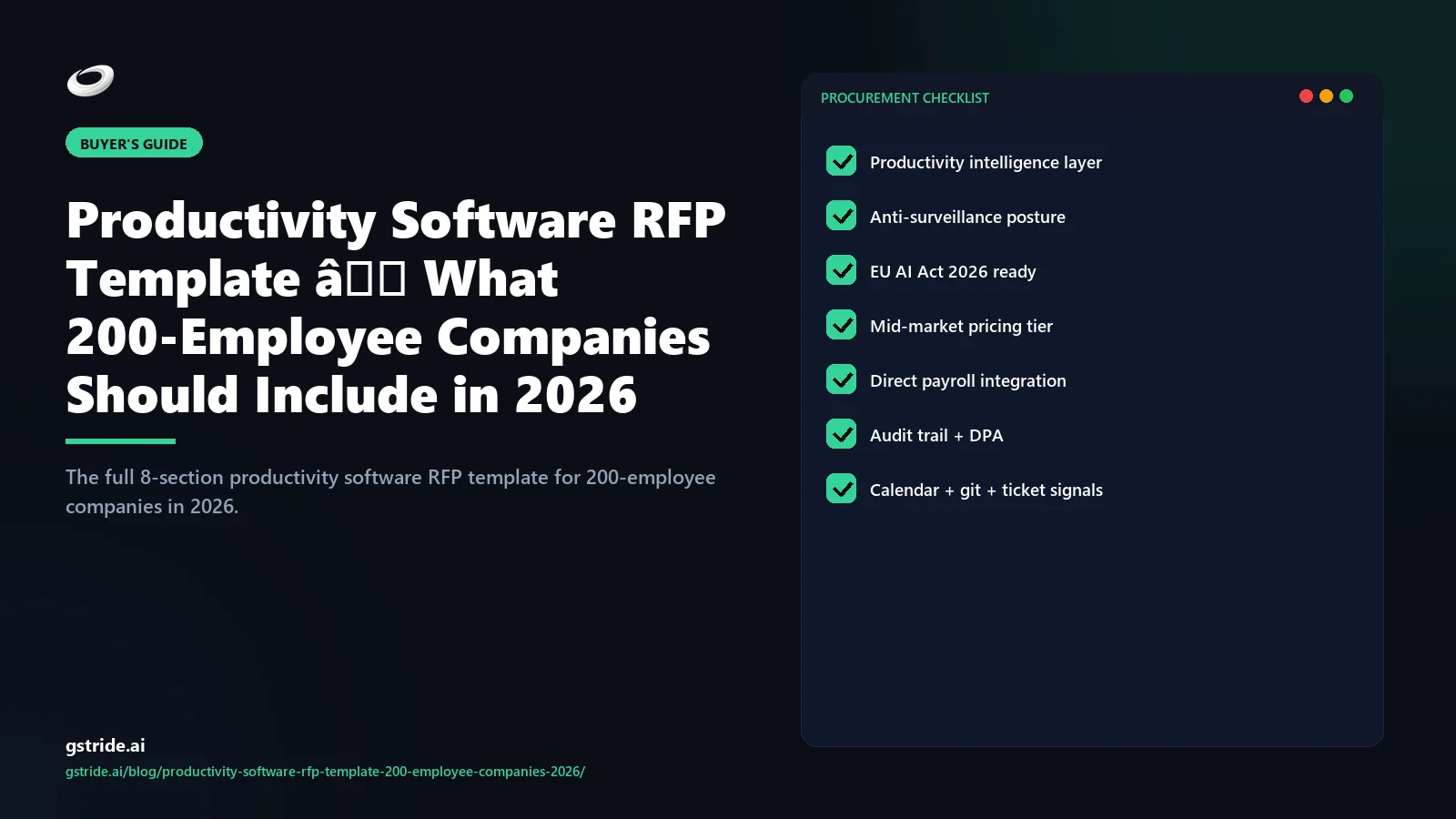
Why a pre-shaped India RFP template, not a generic SaaS RFP
Three procurement realities shape the India employee monitoring RFP in 2026 in a way that the generic North American SaaS RFP boilerplate does not handle. First, the DPDP Act 2023 places fiduciary-versus-processor designation, consent ledger architecture, breach SLA, and cross-border posture inside the compliance section — not in a one-line tick-box. Second, India IT services exporters with EU customers carry a dual GDPR Article 28 obligation that needs to land in the same vendor response so the file serves both regulators. Third, India procurement signs off jointly across HR (scope and capabilities), IT (data and security), and CISO (compliance), so the template must section cleanly for parallel review.
This template is sectioned for those three realities. It pairs with the 15 DPDP Act RFP Questions for the India Vendor Shortlist which populates the compliance section, and the DPDP Vendor RFP Redline Template which converts the accepted responses into contract schedules. The trio — template, questions, redline — covers the full procurement lifecycle. Verify with counsel.
- Up to ₹250 crore per instance — maximum penalty under the DPDP Act 2023 (Schedule) for failure to take reasonable security safeguards, with other listed defaults carrying their own caps; the data architecture and security sections exist to shift this exposure onto a documented vendor commitment (verify current penalty schedule with counsel).
- DPDP Act 2023, Section 8(5)–(6) — a data fiduciary must implement reasonable security safeguards and notify the Data Protection Board and affected persons of a breach; the RFP should require the vendor to state its fiduciary-versus-processor designation and breach-notification SLA in writing (verify designation with counsel).
- Up to EUR 20 million or 4% of global turnover — maximum GDPR fine (Article 83(5)), whichever is higher, applicable to India IT/BPO exporters under a parallel GDPR Article 28 processor obligation, so one RFP file must satisfy both regulators (verify dual-regime scope with counsel).
Cover letter — paste-ready boilerplate
The cover letter sets the scope, deadline, and submission channel. Keep it under one page. Substitute the bracketed placeholders before issue.
Section 1 — Scope of work
The scope section defines what the platform will do and for whom. It is the foundation every other section interprets. Get the scope right and the compliance and pricing sections write themselves.
Define the user population, geography, and timeline.
Buyers state the headcount band, role split (knowledge work, field, hybrid), India versus offshore distribution, and the rollout timeline. Vendors confirm coverage capability and identify any role or geography where their platform does not extend.
List the capability tiers the platform must cover.
Buyers enumerate the capability tiers needed — time tracking, productivity scoring, leave and shift management, payroll integration, capacity planning, real-time profitability for IT services, AI productivity intelligence. Vendors confirm which tiers their platform delivers natively versus via integration.
State what the platform must not do.
Out-of-scope is as important as in-scope. India buyers in 2026 typically scope out keystroke logging, continuous screenshot capture, sentiment scoring, and live webcam monitoring. Stating these as out-of-scope at the RFP stage closes the door on vendors that bundle them by default.
Section 2 — Capabilities matrix
The capabilities section is the feature-by-feature gate. Buyers list the must-have and nice-to-have capabilities; vendors confirm coverage. The mistake to avoid is letting vendors write narrative responses that skip individual rows — use the side-by-side matrix structure so every line gets an answer.
Enumerate must-have capabilities in a single matrix.
Group capabilities into clusters — time and attendance, productivity intelligence, workforce management, payroll and compliance, integrations, administration. Each row gets a vendor confirmation (Yes / Partial / No) plus an evidence pointer. Partial answers require a follow-up clause in the contract.
Separate nice-to-have from must-have to avoid scoring distortion.
Nice-to-have capabilities are scored differently. Buyers list them in a second matrix that does not gate the shortlist but tips the tiebreaker when two vendors clear all must-haves. Mixing nice-to-have into the must-have matrix is the most common procurement-file error.
Section 3 — Compliance & DPDP
The compliance section is the high-leverage section for India buyers in 2026. This is where the 15 DPDP RFP questions land. Buyers populate this section from the question bank; vendors respond in writing with contract-schedule pointers. Do not collapse this section into the security section — compliance and security are distinct procurement concerns.
Confirm fiduciary versus processor designation.
Buyers state their designation expectation; vendors confirm. The 15-question bank covers this in Q1; this section anchors it in the procurement file.
Cover consent ledger, purpose limitation, data principal rights, breach SLA, cross-border.
Use the 15 DPDP Act RFP Questions as the question source. Each vendor response in this section is contract-schedule material.
India IT services exporters with EU customers fold this in.
Where the buyer serves EU customers, every DPDP answer needs a GDPR Article 28 parallel so the single vendor response satisfies both procurement files. The 15-question bank lists the Article 28 parallel for each question. Verify with counsel.
Workforce AI deployers on EU territory carry Annex III Article 6 plus Article 9 obligations.
Where the deployment will reach EU-domiciled employees, the compliance section includes an EU AI Act sub-section. Use the free EU AI Act Vendor Scorecard as the question source for this sub-section.
Section 4 — Data architecture
The data section is where the CISO holds the pen. It covers data residency, data classification, retention, deletion, sub-processor chain, and the data flow map. India procurement teams in 2026 increasingly require a data flow diagram as a mandatory attachment.
State the primary residency and the failover residency.
Buyers require India primary residency for India employee data. EU primary for EU-domiciled workforce data. Vendors state the cloud regions, the failover region, and the contractual binding on residency.
Map the data categories to retention windows.
Buyers list the data categories the platform will capture and the retention window per category. Vendors confirm and state the deletion mechanism.
Disclose every sub-processor with a written change-control commitment.
Vendors list the sub-processors with role, location, and DPA status. Any change to the sub-processor chain requires 30 days written notice to the buyer with right to object.
Section 5 — Security
The security section covers certifications, access control, encryption, vulnerability management, and the incident response architecture. Distinct from compliance, which covers regulatory designation.
List the certifications required.
Standard India procurement requires ISO 27001, SOC 2 Type II, and increasingly ISO 27701 for privacy management. State the renewal cadence required.
SSO, MFA, RBAC, encryption at rest and in transit.
SSO via SAML 2.0 or OIDC. MFA enforceable on admin and on employee self-service. RBAC mapped to four buyer-defined roles minimum. AES-256 at rest, TLS 1.3 in transit, with key management disclosure.
72-hour breach notification with named contact.
DPDP Section 8(6) breach notification SLA is 72 hours. Vendors confirm SLA, name the DPDP-designated breach contact, and commit to a contractual escalation tree.
Section 6 — Support & customer success
Support and customer success differentiates vendors more than feature lists. India deployments at 200 to 2,000 seats need named owners, defined response SLAs, and a documented escalation path.
State the implementation owner, milestones, and acceptance criteria.
Buyers require a named implementation lead with India time-zone availability. Milestones with acceptance criteria. Buyer's right to reject milestone sign-off if criteria fail.
P1 response SLA, named customer success manager, quarterly business review.
P1 response under one hour with India time-zone coverage. Named CSM with continuity commitment. Quarterly business review with documented agenda template.
Admin training, documentation in English, recorded sessions.
Admin training included in implementation fee. Documentation in English with India procurement-friendly screen captures. All training sessions recorded for buyer's audit pack.
Section 7 — Service level agreement
The SLA section converts marketing claims into contractual commitments with credits. Procurement should anchor SLAs to availability, response time, breach notification, data export, and platform-recovery RTO/RPO.
99.9% monthly with measurement methodology.
State the measurement window, exclusions, and credit table. Vendors that publish marketing-style availability claims without contractual credits should be downgraded.
P1 / P2 / P3 / P4 with separate response and resolution SLAs.
Separate the response SLA (vendor acknowledges) from the resolution SLA (vendor fixes). Mixing the two is the most common SLA-clause failure in India procurement files.
30-day export window post-termination, RTO under 4 hours, RPO under 1 hour.
Termination assistance is contractually binding. Data export in machine-readable format within 30 days. Disaster recovery RTO/RPO stated in the contract, not the marketing site.
Section 8 — Pricing & commercial
The pricing section is where most procurement files leak value. Force per-seat pricing into a three-year total cost of ownership table with all implementation, integration, and module fees included. Vendor responses that only quote the per-seat licence cost are incomplete.
List price, volume discount tiers, multi-year discount.
Vendors state the list per-seat per-month, the volume tier discounts (200, 500, 1,000, 2,000, 5,000 seats), and the multi-year discount (annual, 24-month, 36-month).
One-time fees stated up front.
Implementation fee, integration fee per system (HRIS, payroll, SSO), training fee, custom report development. Vendors stating "TBD on scoping" should be down-scored.
Single table aggregating all costs.
Year 1 total (licence + implementation + training + first-year integration) plus Year 2 and Year 3 (licence + ongoing integration + module additions if applicable). The single TCO table is the procurement-file artefact — not the per-seat headline.
Buyers running a switch from an incumbent vendor should also model the migration cost using the free Switch Cost Estimator so the procurement file shows both new-vendor TCO and switch-cost TCO side by side.
Submission mechanics — the three rules that catch India procurement teams
Three submission-mechanics rules that India procurement teams typically learn the hard way.
One. Word in, PDF out. Issue the template as a Word or Google Doc so vendors paste responses inline. Convert the accepted responses to a frozen PDF the day the contract signs. Email attachments are not a procurement file.
Two. Q&A window before responses. Open a five-day clarification window after the RFP issues. Circulate all answers to all vendors. This prevents the dominant vendor from extracting clarifications the smaller vendors do not get.
Three. Reference-call gate. Two India customer references at comparable scale, on a recorded call attended by HR, IT, and CISO. Vendor-supplied case studies are not references; only live customer calls count.
The "we'll send a custom proposal" deflection. Vendors that respond with a non-template proposal rather than filling the side-by-side response fields are signalling either weak compliance posture or a deliberate evaluation-misalignment play. Treat any non-template response as a substantive disqualification, not a formatting quibble.
How this template fits the India procurement lifecycle
Four artefacts cover the full lifecycle. This template is the first.
| Artefact | Use moment | Output |
|---|---|---|
| This template (8 sections + cover letter) | Issue the RFP to the vendor shortlist | Word document for paste-in vendor responses |
| 15 DPDP RFP Questions | Populate the compliance section | Open-form question text mapped to DPDP sections |
| DPDP Vendor Risk Assessment Worksheet | Score vendor responses | Audit-Ready / Process-Led / Tool-Led / Risk-Acceptance band |
| DPDP Vendor RFP Redline Template | Convert accepted responses to contract schedules | 7 must-have DPA clauses with pre-drafted language |
The trio of artefacts plus this template covers RFP issue, compliance question population, vendor response scoring, and contract conversion. Skipping any one creates a documented procurement-file gap that vendors will exploit at audit. Verify with counsel before adopting any of these artefacts into a regulatory submission.
Score every vendor response with the free worksheet
Paste the compliance-section answers in, get a verdict band in under three minutes. Email-gated only at PDF download; the score itself is free.
Frequently asked questions
What is an employee monitoring RFP template and why does an India buyer need one?
An employee monitoring RFP template is the procurement document a buyer issues to the vendor market when shortlisting workforce-AI tools. India buyers in 2026 need a DPDP-shaped template because generic SaaS RFP boilerplates do not surface the data fiduciary, consent ledger, breach SLA, or cross-border architecture that the Data Protection Board will probe during inquiry. A pre-shaped template saves the buyer four to six weeks of in-house drafting and closes architectural gaps that vendor-friendly answers exploit. Verify with counsel.
How is a full RFP template different from a 15-question RFP question bank?
The 15-question bank is the compliance question subset that goes inside one section of the RFP. The full RFP template is the whole document — cover letter, scope of work, capabilities matrix, compliance section, data architecture, security questionnaire, support and SLA terms, pricing schedule, and submission instructions. The buyer typically uses the question bank to populate the compliance section of the full template, not in place of it. The free template on gstride.ai contains both.
How many sections should an India employee monitoring RFP have?
Eight sections plus a cover letter is the operational standard for India HR, IT, and CISO procurement teams in 2026 — scope of work, capabilities matrix, compliance and DPDP, data architecture, security, support and customer success, service level agreement, and pricing and commercial. Buyers running shorter RFPs typically collapse compliance and security or capabilities and scope, but losing either creates a procurement-file gap that vendor responses exploit. Verify with counsel.
Should the RFP template be issued as a Word document or a PDF?
Issue the buyer-side template as a Word or Google Doc so vendors can write responses inline under each question. Capture the final accepted responses as a frozen PDF attached to the master services agreement. The Word-then-PDF workflow lets vendors paste architecture diagrams under each section and lets the buyer freeze the procurement file the moment the contract is signed. Email attachments are not a procurement file — mirror everything into a vendor management system.
What is a side-by-side vendor response template inside an RFP?
A side-by-side vendor response template gives the buyer a two-column structure under each question — left column is the buyer requirement statement, right column is the vendor response field. The structure forces the vendor to answer each requirement explicitly rather than write narrative paragraphs that skip questions. India procurement teams using side-by-side templates report response evaluation time falling from two weeks to three days because the answers line up against the requirements without re-mapping.
Can the same RFP template work for HR-led and CISO-led procurements?
Yes if the template is sectioned so HR owns the scope, capabilities, and pricing sections and the CISO owns the compliance, data, and security sections. The single-template approach prevents the dual-procurement trap where HR signs a contract that the CISO then cannot defend at audit. Joint procurement also produces a stronger negotiating posture because the vendor cannot play sections against each other. The template on gstride.ai is sectioned for joint sign-off.
How long is a realistic RFP response window for India workforce vendors?
Three to four weeks is the operational window for a full RFP response with cover letter, capability matrix, compliance answers, security questionnaire, and pricing schedule. Shorter windows produce thin compliance sections because vendor compliance teams cannot turn architecture answers in under two weeks. Longer windows extend the procurement calendar without proportional answer quality gain. Three weeks for a 200 to 500 seat deployment, four weeks for a 1,000 plus seat or multi-region deployment is the typical India procurement cadence.
Disclaimer. This RFP template reflects the DPDP Act 2023 as enacted; Rules notification is expected during 2026 and may change operational specifics including SLAs, retention windows, and consent mechanics. Penalty figures referenced elsewhere on gstride.ai are statutory ceilings, not expected enforcement values. GDPR Article 28 parallels and EU AI Act references are written for India IT services exporters with EU exposure and do not replace EU counsel review. Verify all clauses with your own legal counsel before issuing the RFP, signing the contract, or relying on any output in a regulatory submission. Questions: [email protected].