
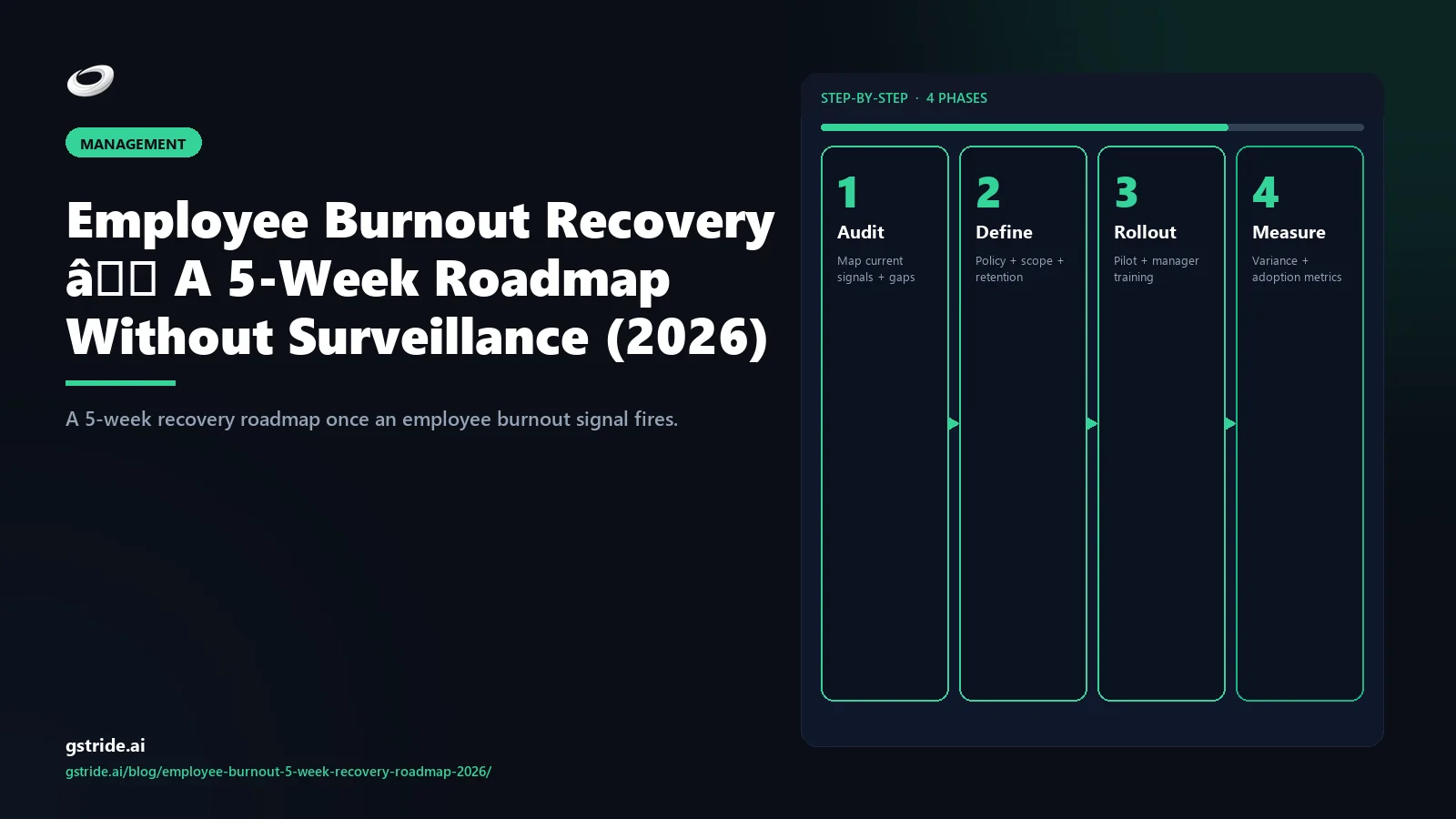
The premise — recovery without surveillance
A surveillance-based recovery loop fails for the same reason surveillance-based detection fails — it erodes the trust the intervention needs in order to work. The employee in week-3 reset rituals does not need a screenshot dashboard watching whether they took the recovery time. They need the manager to honour the scope cut from Week 2 and the calendar guardrails from Week 4. The five outcome signals — calendar, version control, project tracker, async messaging — give the manager enough read on whether the recovery is taking hold without instrumenting the employee's keyboard.
The deeper category context lives in the anti-surveillance productivity stack pillar. The leading signals that fire in Week 1 come from the 5-signal burnout detection guide — read that piece first if the signals are unfamiliar.
Week 1 — Diagnostic
Week 1 is a 60-minute structured 1:1, not a dashboard review. The manager opens with the five signals as conversation prompts. Which ones are firing. How long they have been firing. What the employee names as the driver. The employee sees the same view the manager sees on the signals — same calendar load, same focus depth trend, same after-hours pattern, same output cadence. Shared view is the trust infrastructure.
The output of Week 1 is a written summary of contributing factors and a draft scope-cut proposal for Week 2. The draft is jointly authored — the employee knows which commitments are silently the heaviest. The manager knows which dependencies can absorb the re-assignment. The written artefact matters because it makes the rest of the roadmap auditable.
Week 2 — Workload audit and scope cut
The workload audit lists every meeting, project, on-call rotation, mentoring commitment, hiring loop, code review obligation, and recurring engagement the employee carries. Each item gets categorised — essential, deferrable, transferable, or stoppable. The target is to recover at least one full focus-block day per week and to cut meeting load below 50% of working hours for the recovery window.
The cut happens jointly with the employee, then with the dependency owners. The manager owns the dependency negotiations — the burnt-out employee is not in shape to defend their own scope cut on a Slack thread with a sibling team's lead. The output of Week 2 is a written scope plan with explicit owner re-assignments and a re-balance review date 2 weeks out.
| Category | Action | Owner |
|---|---|---|
| Essential | Keep. Protect on calendar. | Employee + manager |
| Deferrable | Push 6-8 weeks. Communicate to stakeholders. | Manager |
| Transferable | Re-assign to peer with capacity. Manager handles handoff. | Manager |
| Stoppable | Stop. Communicate the trade-off to dependency owners. | Manager |
The 5-Signal Burnout Audit
The same five signals that ran in Week 1 — focus depth, meeting load, output cadence, after-hours pattern, blocker recovery. Use the audit to re-baseline at the end of Week 5 and to spot the next case 4-6 weeks earlier.
Read the 5-signal auditWeek 3 — Reset rituals and recovery time
Week 3 is the most important and the most under-implemented step in the roadmap. The reset rituals make the scope cut from Week 2 real. The manager pushes explicit recovery time — early finishes on at least two days, one full day off if the policy allows, no after-hours messages from the manager during the window, a re-stated commitment that the scope plan from Week 2 holds without negotiation.
The reset rituals to commit to in writing — keep the list short, keep it specific, keep it enforced:
- Calendar guardrail — no meetings booked before 10am or after 4pm for the recovery window.
- One protected focus day — a full day blocked on calendar each week, communicated to dependency owners.
- No after-hours pings from manager — written commitment, modelled by the manager themselves.
- Recovery time — at least two early finishes per week, one full day off where policy allows.
- Re-stated scope — Week 2 scope plan honoured without renegotiation.
The rituals are read against the after-hours pattern signal and the meeting load signal — two of the five from the audit. If the after-hours signal does not improve by end of Week 3, the manager re-runs the diagnostic and considers whether a longer leave-based recovery is the right path.
Week 4 — Reintegration with calendar guardrails
Week 4 brings the employee back to a more typical workload but with the guardrails from Week 3 staying on. The reintegration discipline is to add scope back one category at a time — start with the deferrable items that were pushed in Week 2, never restore a stoppable item without a re-discussion. Meeting load creeps up most easily, which is why the calendar guardrail stays on through Week 4 and the re-baseline at end of Week 5.
The check-in cadence shifts from weekly to twice-weekly during Week 4. The signals continue to fire on the same dashboard — focus depth, meeting load, output cadence, after-hours pattern, blocker recovery — and the manager watches for re-emergence on any of the five. A signal firing again in Week 4 means the scope re-introduction was too fast; pull back one category and re-baseline.
Week 5 — Metric re-baseline
Re-baseline is the step most recoveries skip and the one that determines whether the recovery actually holds. After a five-week window, the employee's normal pattern may have shifted. They may be a 60-minute focus-block person now rather than the 90-minute version they were before. Their tolerable meeting load may be 45% rather than 65%. The new pattern is the legitimate baseline.
The signals continue to surface deltas against this new baseline. A manager who keeps measuring the recovered employee against the pre-burnout baseline is setting up the next case. Re-baseline closes the loop. The next intervention point is calibrated against the recovered employee's honest range — not the range that produced the burnout in the first place.
The anti-surveillance pillar
The deeper category framing — why the recovery roadmap reads outcome signals from work systems rather than instrumenting the keyboard. The pillar covers the EU AI Act, GDPR proportionality, and the configuration discipline that keeps a recovery loop legitimate.
Read the pillarThe five-week timeline at a glance
| Week | Activity | Owner |
|---|---|---|
| Week 1 — Diagnostic | 60-minute 1:1 against the 5 outcome signals. Shared view. Written summary and draft scope-cut proposal. | Manager + employee |
| Week 2 — Workload audit | Categorise every commitment. Cut scope. Re-assign dependencies. Written scope plan with re-balance date. | Manager owns negotiations |
| Week 3 — Reset rituals | Calendar guardrails, protected focus day, recovery time, no after-hours pings. Written and enforced. | Manager + employee |
| Week 4 — Reintegration | Add scope back one category at a time. Guardrails stay on. Twice-weekly check-ins. | Manager + employee |
| Week 5 — Re-baseline | Reset personal baselines on the 5 signals. Calibrate the next intervention point honestly. | Manager + People Ops analyst |
When the roadmap is not enough
Three signals tell the manager the manager-led recovery is not the right level of intervention. First — symptoms beyond fatigue described by the employee, including persistent sleep disruption, withdrawal, or cognitive impairment that does not lift with reduced workload. Second — signals not improving by end of Week 3 despite the scope cut and reset rituals being honoured. Third — the employee themselves asking for clinical support, which should be treated as the clearest possible signal and routed immediately.
In any of those cases, the pathway is occupational health, the employee's GP, the firm's Employee Assistance Programme, and a leave-based recovery plan rather than the manager-led roadmap. The five-signal framework is a management early-detection tool, not a clinical instrument. Recovery cases that need clinical input deserve clinical care.
Catch the next case 4-6 weeks earlier
The 5-signal audit runs as a 30-minute self-check on one team. Focus depth, meeting load, output cadence, after-hours pattern, blocker recovery. The leading signals fire weeks before the recovery roadmap becomes necessary.
Open the 5-signal auditFAQ
Frequently asked questions
How long does it take to recover an employee from burnout?
Five weeks is a realistic working window for the manager-led recovery once a leading signal fires and before the employee needs a recovery leave. Week 1 is diagnostic against the five outcome signals — focus depth, meeting load, output cadence, after-hours pattern, blocker recovery. Week 2 is workload audit and scope cut. Week 3 is reset rituals and explicit recovery time. Week 4 is reintegration with calendar guardrails. Week 5 is metric re-baseline against the personal pre-burnout pattern. Severe or late-stage cases require occupational health involvement and often a longer leave-based plan.
Why a recovery roadmap without surveillance?
Because surveillance-based recovery monitoring undermines the recovery itself. The employee in week-3 reset rituals does not need a screenshot dashboard watching whether they took the recovery time. Surveillance during recovery sends the opposite signal — that the trust required for honest engagement with the workload audit and the calendar guardrails has not been restored. The five outcome signals (calendar, version control, project tracker, async messaging) give the manager enough read on whether the recovery is taking hold without instrumenting the employee's keyboard.
What does Week 1 — the diagnostic — actually involve?
Week 1 is a structured conversation, not a dashboard review. The manager runs the five outcome signals — focus depth drop, meeting load spike, output cadence flattening, after-hours pattern shift, blocker recovery time growing — as conversation prompts in a 60-minute 1:1. The employee sees the same view the manager sees. The diagnostic surfaces which signals are firing, how long they have been firing, and which workload or scope factors the employee names as the driver. The output is a shared written summary of contributing factors and a draft scope-cut proposal for Week 2.
What goes in the workload audit in Week 2?
The workload audit lists every meeting, project, on-call rotation, mentoring commitment, hiring loop, and recurring obligation the employee carries. Each item gets categorised as essential, deferrable, transferable, or stoppable. The target is to recover at least one full focus-block day per week and to cut meeting load below 50% of working hours for the recovery window. The audit happens jointly with the employee — they know which commitments are silently the heaviest. The output is a written scope plan with explicit owner re-assignments and a date for re-balance review.
What is the re-baseline step in Week 5 for?
Re-baseline sets the new personal range on the five outcome signals so the next intervention point is calibrated honestly. After a recovery window, the employee's normal pattern may have shifted — they may be a 60-minute focus-block person now rather than the 90-minute version they were before, and the new pattern is the legitimate baseline. The signals continue to surface deltas against this new baseline, not against the pre-burnout one. Re-baseline avoids the silent failure mode where the manager keeps measuring the recovered employee against a standard the employee has already moved on from.
Related reading on gStride
- How to detect employee burnout without surveillance — 5 signals
- The anti-surveillance productivity stack — pillar guide
- The real cost of employee burnout — board-deck math framework
- The alternative to keystroke tracking — 5 signals that predict productivity
- Measuring deep work without screenshots — 5 outcome signals
Run the recovery without watching the keyboard
gStride reads the five leading burnout signals from systems your team already runs. Same view for employee and manager. Surveillance is absent from every step on purpose.
See the platform Book a 30-min call