
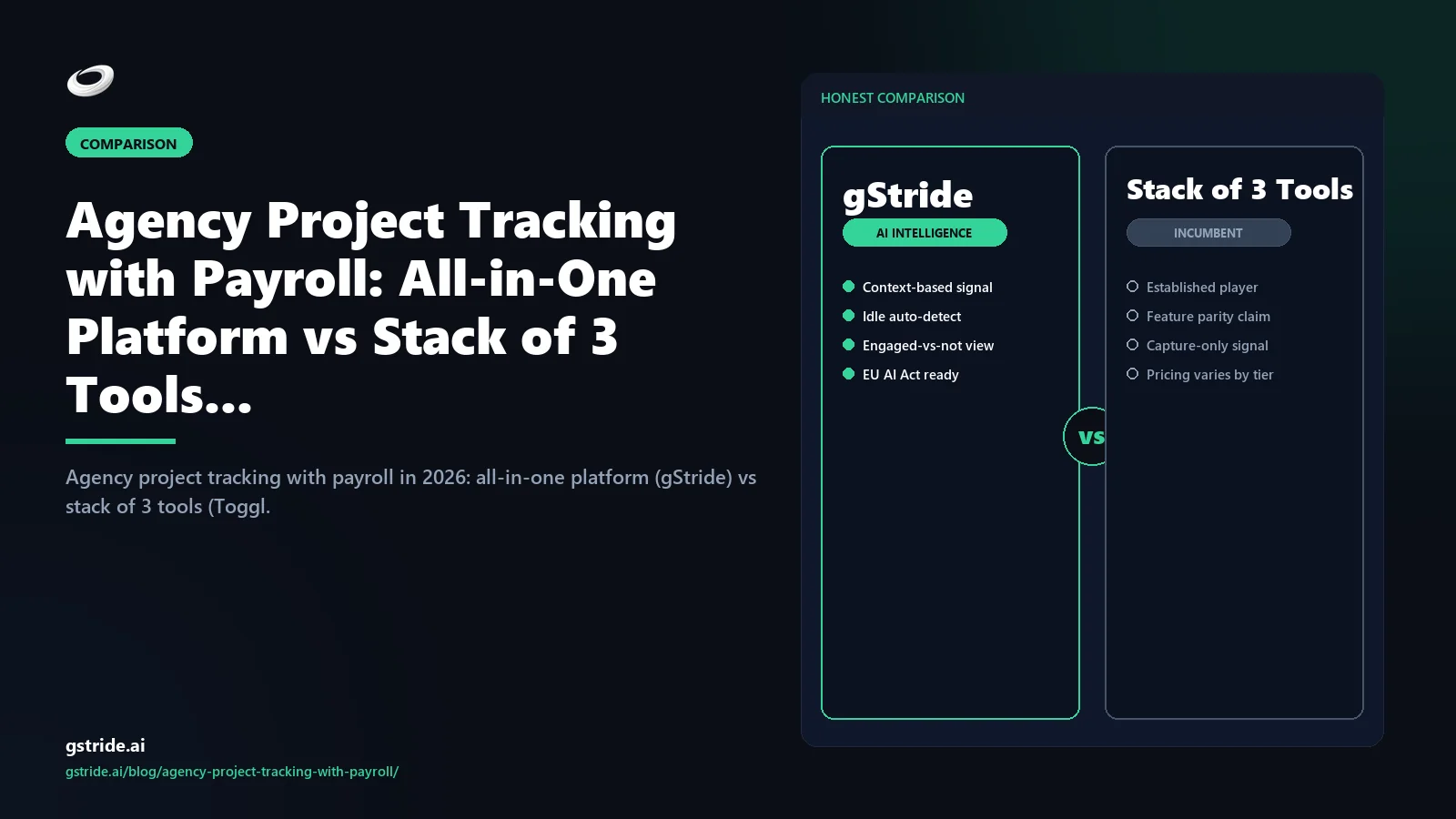
The 3-tool agency stack problem
The default 2026 agency stack is Toggl Track for time, Gusto for payroll, and Asana for project management — three best-in-class single-purpose products glued together with Zapier or a custom middleware layer. At 30 seats this stack runs roughly $1,790/month before integration costs, creates five integration seams (Toggl ↔ Asana, Toggl ↔ Gusto, Asana ↔ QuickBooks, Gusto ↔ QuickBooks, Asana ↔ client invoicing), and produces three independent sources of truth for “how many hours did this person work this week.” The reconciliation work falls on the operations lead, who spends 6-10 hours per payroll cycle making the numbers agree. Most agencies do not cost this in when they buy the stack. They discover it in month four and quietly absorb it into “just how we run things.”
The unified alternative is one platform that bundles automated time capture, project tracking, payroll-ready exports, leave management, and AI signal in a single schema — what we call, structurally, an AI productivity intelligence platform in the category-canonical sense (capture plus signal plus recommendation plus action, not a timer with insights bolted on). gStride was built for this 10-50 person agency band specifically because the integration tax on the 3-tool stack is the largest hidden cost in agency operations and nobody else priced it cleanly. The trade-off is real: a unified platform locks in the project schema (you cannot trivially swap project tools every 18 months), and best-in-class enthusiasts will argue that no single product matches the depth of three specialised ones. This article runs the math on both sides and describes the cases where stacked still wins. (Adjacent verticals: if you bill by matter rather than project — for example a 20-50 attorney firm — the analogous comparison is in law firm time tracking and billing software, where the timesheet is also the legal artefact and the integration choices skew differently. If you are running a 20-50 clinician medical practice, the HIPAA-grade equivalent is in our healthcare practice productivity software guide — encounter-coded time replaces project time and the BAA changes the vendor shortlist.)
What “agency project tracking with payroll” actually requires
Most agencies underspecify this category at the buying stage. The keyword “agency project tracking with payroll” sounds like one feature, but it is actually six capabilities working in lockstep. Specify any of them poorly and the operations lead inherits the cleanup work in perpetuity.
| # | Capability | What it does for an agency | Failure mode if missing |
|---|---|---|---|
| 1 | Per-project automated time capture | Captures hours by client, project, and task — automatically, not via timer-start clicks | 30-40% of agency hours go unrecorded; invoices under-bill |
| 2 | Per-client billable rollups | Hours grouped by client + retainer + project + role for invoicing | Operations lead exports CSVs and pivots in Excel monthly |
| 3 | Payroll-ready exports | Hours, leave, overtime mapped to QuickBooks, Xero, ADP, Gusto, Rippling | Finance manually reconciles 3 spreadsheets per cycle, 4-6 hrs lost |
| 4 | Leave + PTO approval flow | One queue for sick, vacation, comp-off, tied to same hour ledger | Slack DMs and Google Sheets; leave uncounted in payroll exports |
| 5 | Per-role billable rates + cost tracking | Designer at $120/hr billable, $45/hr cost; senior dev $180/$70 | Margin per project unknown until quarter close |
| 6 | Single source of truth | One schema for hours, one report for client invoices and payroll | Toggl says 38hr, Asana says 42hr, Gusto pays 40hr — no one reconciles |
The 3-tool stack ships capabilities 1, 3, and parts of 2 well — that is what each tool was designed for. Capabilities 4, 5, and 6 sit in the integration seams and become operations work. The unified platform ships all six in one schema; the trade-off is that capability 5 (per-role rates) is harder to customise than a hand-built spreadsheet, and capability 4's leave UX is rarely as polished as a dedicated HR tool. That is the actual decision. The most-confused buyer-question that comes up at this stage is whether the AI capture layer means you can stop running formal timesheets at all — the honest answer in does AI productivity software replace timesheets is no, you still need them for client billing and audit, but the manual entry tax goes to near zero.
All-in-one option: gStride
The unified product collapses the time-to-payroll loop into one schema. Hours captured by the desktop app are tagged to a project (pulled from Asana, Jira, ClickUp, or Linear via native integration), rolled into a per-client billable view for invoicing, and exported into the payroll cycle without leaving the platform. Leave requests live in the same hour ledger so PTO does not get double-counted or missed at payroll cutover. The AI signal layer adds focus blocks, blocker patterns, and burnout alerts on top of the capture layer — features that the 3-tool stack can only approximate with custom dashboards built on top of Zapier-piped data.
| Agency need | gStride feature | Notes for agencies |
|---|---|---|
| Project tracking | Project & task management with Asana/Jira/ClickUp/Linear sync | Keeps the PM tool you have; adds the time + cost layer |
| Time capture | Automated time tracking — desktop, browser, mobile, calendar-aware | 30-40% capture lift vs manual timers |
| Payroll exports | Payroll & payments — QuickBooks, Xero, ADP, Gusto, Rippling, India PF/ESI | One export, no Zapier middleware |
| Productivity signal | Focus blocks, blocker patterns, burnout flags, meeting overhead | Replaces the “how is the team doing” standup blind spot |
| Leave + PTO | Approval queue tied to hour ledger | Leave deducts from payroll automatically, no manual reconciliation |
| Pricing model | Banded $399-599/mo for the 25-100 employee band | 30-50% under per-seat math at this size |
The honest counter-positioning: gStride does not replace the project-management UI that delivery teams already use. Most agencies keep Asana, Jira, ClickUp, or Linear for task management and Kanban boards — the integration pulls project metadata in for time allocation. The unified value sits in the time-to-payroll loop, not in replacing the tool that designers and engineers already have muscle memory in.
Stack option: Toggl + Gusto + Asana — cost + integration math
The 3-tool stack is not wrong, but it is more expensive than agencies typically estimate. Run the actual arithmetic at 30 seats and the per-month bill triples once integration overhead is counted.
| Tool | Tier | Per-seat / base | 30-seat monthly | 30-seat annual |
|---|---|---|---|---|
| Toggl Track | Premium | $20/user/mo | $600 | $7,200 |
| Gusto | Plus | $80 base + $12/employee | $440 | $5,280 |
| Asana | Business | $24.99/user/mo | $749.70 | $8,996 |
| Zapier (middleware) | Professional | $73/mo flat | $73 | $876 |
| Stack total | — | — | $1,862 | $22,352 |
| gStride banded | Mid-market band | $499 flat at 30 | $499 | $5,988 |
The headline gap is $16,364/year — gStride at this size runs about 27% of the stacked stack. The hidden cost is operations time. The five integration seams (Toggl-Asana, Toggl-Gusto, Asana-QuickBooks, Gusto-QuickBooks, Asana-invoicing) each fail roughly 4-6 times per year — Zapier expires a token, an API version deprecates, a payroll cycle date shifts, a project rename breaks a mapping. Each failure costs 30-90 minutes of investigation plus a recovery cycle. Add 25-50 hours of operations work per year, valued at $50-80/hr loaded cost, and the stacked option carries another $1,250-4,000/year in integration tax. The total gap widens to $17,500-20,000/year at 30 seats. Before the cost math even matters, the structured 12-question vendor scorecard in how to choose employee productivity software rules out about half the candidate list on configurability and integration depth alone.
The defence of the stack: each component is best-in-class. Toggl's reporting depth on time is genuinely better than most embedded time modules. Gusto's HR layer (benefits, onboarding, compliance) is deeper than any unified platform's payroll module. Asana's project UI has 10 years of polish. If your agency has the operations bandwidth to maintain three vendor relationships and the workflows in each tool are load-bearing, the depth premium can be worth the cost. The argument fails for agencies under 50 employees because the operations bandwidth is the constraint, not the depth.
Switching cost analysis
Migration is the second-largest cost in this decision after annual platform fees. Most agencies on a 3-tool stack stay on it past the point where switching makes financial sense because the migration spec is opaque. Here is the actual cost breakdown for a 30-person agency moving from Toggl + Gusto + Asana to a unified platform.
| Migration phase | Time | Cost (loaded) | Notes |
|---|---|---|---|
| Project metadata import (Asana → gStride) | 4-6 admin hours | $200-300 | Active projects only; archive the rest |
| Desktop app rollout (30 employees × 2hr) | 60 employee hours | $3,000-4,200 | Includes onboarding training |
| Payroll integration setup + parallel run | 8-12 finance hours | $400-700 | One billing cycle of validation |
| Contract overlap (4 weeks Toggl + Gusto + gStride) | — | $1,600 | Cannot prorate; eat the overlap |
| Asana retained for PM UI; not cancelled | 0 | $0 | Ongoing; pulls project data via API |
| Total switching cost | ~80-90 hrs | $5,200-6,800 | One-time |
Annual savings of $14,000-16,000 against a one-time switching cost of $5,200-6,800 means payback inside 4-6 months. After that, every quarter is pure margin recapture. The catch — and this is the only number agencies routinely get wrong — is that the desktop rollout phase has to be project-managed. If the operations lead skips the 2-hour-per-employee onboarding step, capture rates degrade for 4-6 weeks and the productivity signal layer cannot do its job. Budget the time honestly or do not start the migration.
For agencies considering a partial migration (replace Toggl with gStride, keep Gusto + Asana), the math is different. The Toggl-only switch is the cheapest and fastest move — 2 weeks instead of 3, no payroll-cycle validation, no Gusto cancellation. See the gStride vs Toggl Track deep-dive for the time-only comparison; the savings are smaller (~$3,500/year at 30 seats) but the switching risk is also lower.
When stacked beats unified (and vice versa)
The unified platform does not always win. Three specific cases produce a stronger ROI for keeping the 3-tool stack, and an honest comparison names them.
When stacked wins
Sub-8 employee agency. Below 8 people, the integration tax is trivial — there is one operations lead who can hold the whole picture mentally and the per-seat cost on Toggl + Gusto + Asana is small enough that the unified platform's banded pricing does not show its advantage. Stay stacked until you cross 10-12 employees.
Best-in-class workflows already wired. If your agency has spent 2+ years building custom Asana templates, Toggl tag taxonomies, and Gusto benefits configurations that load-bear on the business, the switching cost may exceed 12-18 months of platform savings. The math flips. A unified platform's project schema is necessarily more opinionated than a 10-year-old PM tool's flexibility.
Project-tool churn. Some agencies swap project tools every 2-3 years (Asana → ClickUp → Linear → back) as workflows evolve. The unified platform locks in the project schema; if you expect to swap PM tools again inside 24 months, the stacked option preserves optionality at the cost of integration overhead.
When unified wins
10-50 employee growth band. This is the sweet spot. Operations bandwidth is the constraint, integration tax is real, and a unified platform priced by band (not seat) cuts the bill 60-70% with a 4-6 month payback. gStride pricing was designed around this band specifically.
Operations lead spending >5hrs/week on reconciliation. If your ops lead is exporting Toggl CSVs, pivoting in Excel, cross-checking against Asana hours, and manually reconciling for payroll — that is 250+ hours/year of senior operations time at $80-120/hr loaded. The unified platform reclaims that time.
You want the productivity signal layer. Focus blocks, blocker patterns, and burnout signals require unified data — the 3-tool stack cannot reproduce them via Zapier middleware. If “how is the team doing” is a question your delivery leads cannot answer from the stack, the unified platform pays for itself in management visibility alone.
Free: 5-Signal Productivity Self-Audit Worksheet
30-min audit on your team. Focus depth + commit cadence + meeting load + flow-state + blocker recovery. PDF + Google Sheets calc. For Ops Heads, Founders, Eng Managers.
Frequently asked questions
What is the best agency project tracking software with payroll built in?
For a 10-50 person digital agency in 2026, the choice is between a stack of three single-purpose tools (Toggl Track for time, Gusto for payroll, Asana for projects) and a unified platform that bundles project tracking, time capture, and payroll exports in one product. The stacked option costs $720-1,400/month at 30 seats with five integration seams; the unified option (gStride) costs $399-599/month with one schema and zero middleware.
How much does Toggl + Gusto + Asana cost for a 30-person agency?
At 30 seats: Toggl Track Premium runs $20/user/month = $600/month; Gusto Plus runs $80/month base + $12/employee = $440/month; Asana Business runs $24.99/user/month = $749.70/month. Total: roughly $1,790/month or $21,480/year before any integration middleware. With Zapier or a custom-built bridge layer to keep timesheets flowing into payroll and project hours flowing into invoicing, add another $50-200/month. Most agencies underestimate this stack at the buying stage and discover the all-in cost only after their first quarter of operation.
What does agency project tracking with payroll actually require?
Six things: (1) per-project time capture, automated rather than timer-based; (2) per-client billable-hour rollups for invoicing; (3) payroll-ready exports mapped to QuickBooks, Xero, ADP, Gusto, or Rippling; (4) leave and PTO approval flow tied to the same hour ledger; (5) per-role billable rates with cost tracking; (6) a single source of truth so timesheets, invoices, and payroll do not drift. Single-purpose tools handle one or two of these; a unified platform handles all six in one schema. See automated time tracking and payroll & payments for the unified approach.
When does the stacked approach (Toggl + Gusto + Asana) beat a unified platform?
Three cases: (1) the agency has fewer than 8 employees and the integration overhead is trivial; (2) the agency already has best-in-class workflows in each tool and switching cost exceeds 12 months of savings; (3) the agency is project-tool agnostic and needs to swap project tools every 2-3 years (the unified platform locks in the project schema). Outside those cases, the unified platform wins on cost, on data integrity, and on the operating picture.
What is the switching cost from a 3-tool stack to a unified platform?
For a 30-person agency: 4-6 hours of admin time to migrate active projects, 2 hours per employee for desktop install and onboarding (60 hours total), 1 payroll cycle of parallel-run to validate exports (8-12 finance hours), and 4 weeks of contract overlap on the legacy stack (~$1,600 sunk cost). Total switching cost is roughly $5,000-7,000 in time and overlap fees. Payback against $14,000-16,000/year savings happens in 4-6 months.
Does gStride replace Asana or just Toggl + Gusto?
gStride replaces Toggl (time capture), Gusto (payroll exports), and the project-time-tracking layer of Asana — but not Asana's task management UI itself. Most agencies keep Asana, Jira, ClickUp, or Linear for task and Kanban management and use gStride's native integrations to pull project metadata in for time allocation. The unified value is in the time-to-payroll loop, not in replacing the project-management UI that delivery teams already use. See project & task management for the integration model.
How long does it take to migrate from Toggl + Gusto + Asana to gStride?
A 30-person agency typically completes migration in 2-3 weeks. Week 1: gStride desktop apps deployed, Asana/Jira/ClickUp project metadata integrated, payroll integration configured (QuickBooks/Xero/ADP credentials). Week 2: parallel-run on Toggl + gStride for one billing cycle to validate hour totals match. Week 3: full cutover, Toggl and Gusto cancellations scheduled at end of contract. The unified schema means there is no data-mapping middleware to debug, which is where most multi-tool migrations stall.
Related reading on gStride
- Project & task management — Asana, Jira, ClickUp, Linear sync
- Payroll & payments — QuickBooks, Xero, ADP, Gusto, Rippling
- Automated time tracking — desktop, browser, mobile, calendar-aware
- gStride vs Toggl Track — solo tool vs unified platform
- gStride pricing — banded mid-market tiers, all features included
- gStride home — productivity intelligence for 25-200 employee operations
See the time-to-payroll loop in one platform
The fastest way to test unified vs stacked is a 30-minute walkthrough of the actual export — hours captured, billable rollup, payroll cycle, all in one screen. The math answers itself.
See agency pricing Read gStride vs Toggl TrackPricing comparisons reflect publicly stated vendor pricing as of May 2026 (Toggl Track Premium, Gusto Plus, Asana Business, Zapier Professional). Verify current tiers with each vendor before purchase. Integration seam estimates are typical for 30-employee agencies and vary based on tool taxonomy, payroll cycle complexity, and existing automation depth. Switching cost estimates assume one operations lead, standard payroll integration (QuickBooks/Xero/ADP), and a 2-week parallel-run window.