
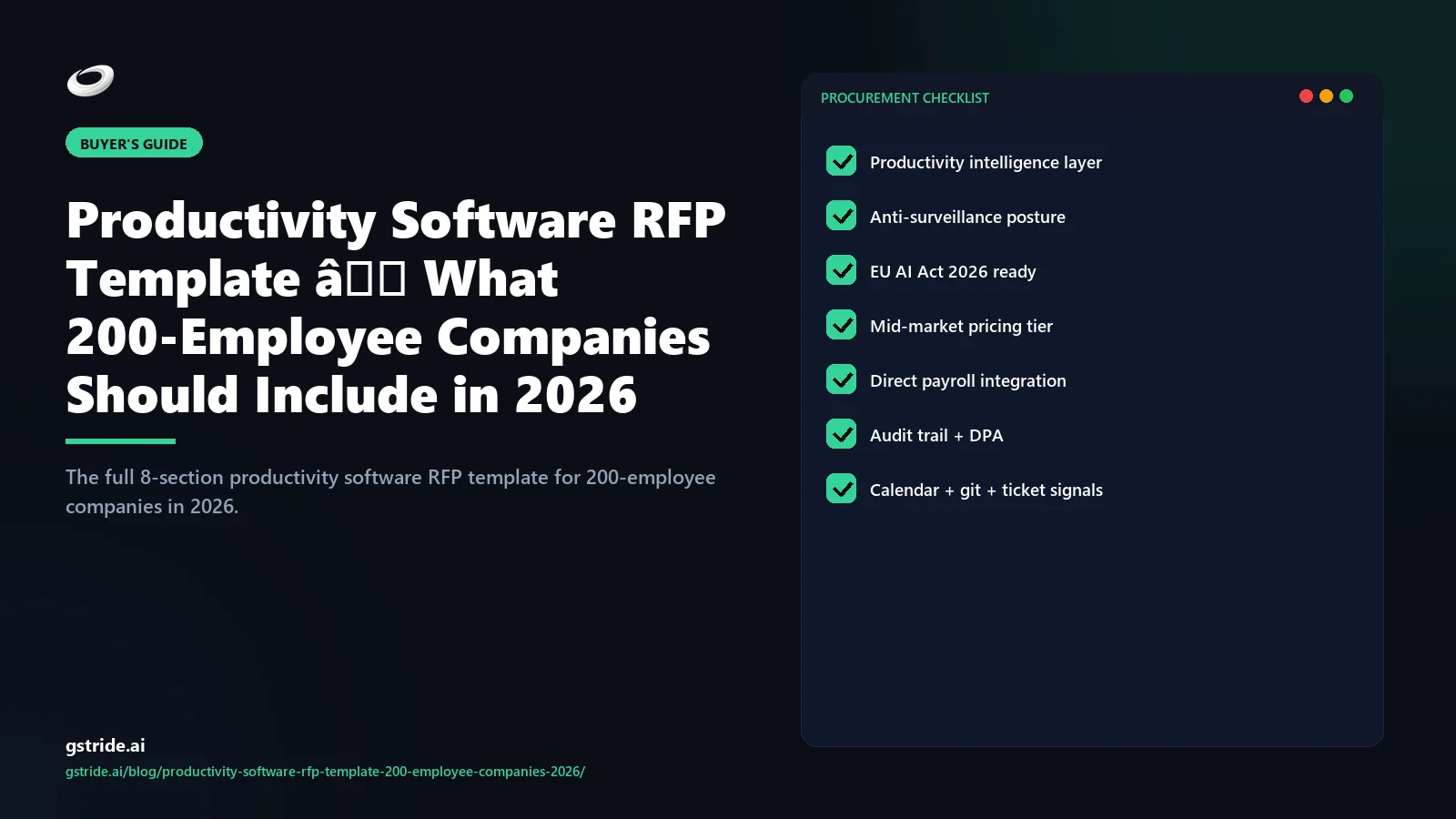
Productivity Software RFP Template — What 200-Employee Companies Should Include in 2026

A productivity software RFP at 200-employee scale is no longer a one-page capability sheet. It is an 8-section document that aligns HR, IT, CISO, and CFO on the requirements, surfaces vendor weakness on architecture and compliance, and produces a scoring-rubric output the buyer can defend to the board. The full template below is copyable into your own RFP cycle this week.

A productivity software RFP for a 200-employee company should include 8 sections — Requirements, Architecture, Compliance, Pricing, SLA, Integration, Migration, Vendor References — with copyable structured text per section and a weighted scoring rubric (capability 30%, compliance 25%, pricing 20%, implementation 15%, references 10%). Send to 5-7 vendors, allow a 21-day response window, score over 14 days, pilot the top two for 30 days, decide. Full template and rubric below.

Productivity software RFP template for 200-employee companies in 2026, gStride AI
Productivity software RFP template — 8 sections, copyable text, vendor scoring rubric. gStride AI.
The short answer. An effective RFP for productivity software at 200-employee scale aligns four stakeholders (HR, IT, CISO, CFO) on one document, sets the timeline and the scoring rubric upfront, and produces a vendor-comparable response across 8 structured sections. The copyable template below is the working version we have iterated across 12 mid-market evaluations between Q4 2025 and W4 2026.

Why a 200-employee company needs an RFP, not a checklist

At 50 employees, a procurement checklist is sufficient — one stakeholder owns the decision and the contract value is small enough to absorb a mismatch. At 500+ employees, a full enterprise RFP with vendor presentations and proof-of-concept work is the norm. The 200-employee inflection point is where the buyer needs RFP-grade structure without enterprise-grade complexity.

The 200-employee buyer has three properties simultaneously — multi-stakeholder alignment (HR, IT, CISO, CFO all weigh in), contract value above USD 18-25K/year (CFO signature required), and existing tooling (timesheet, payroll, project tracker) that must integrate. None of those three are addressed by a procurement checklist alone. They all require a structured RFP that produces a written vendor response across all dimensions under a uniform scoring rubric.

The 8-section RFP template

The eight sections below are the working RFP shape. Each section has copyable structured text you can adapt to your company's specifics. Replace bracketed placeholders with your specifics; keep the structural skeleton intact.

Section 1 — Requirements

Define the operational pain, the capability set, and the success metrics. This is the section that sets vendor framing for the rest of the response.

1. REQUIREMENTS 1.1 Operational pain (one paragraph) [Company name] is a [industry] company with [200] employees across [locations]. Our operational pain is [specific articulation — e.g., contested appraisal cycles tied to absent year-round signal; throughput drop unexplained by current metrics; EU client RFP requiring documented productivity reporting]. The platform must address this pain with measurable improvement within 90 days of deployment. 1.2 In-scope capabilities (must-have) - AI-based productivity scoring with per-signal decomposition (focus density, meeting load, commit cadence, ticket flow, blocker recovery) - Employee self-view dashboard available on the same day as the manager dashboard - Configurable monitoring features (screenshots, URL capture, keystroke) all off by default - Year-round per-employee signal trend (6-12 month minimum retention) - Payroll integration with [Keka / Zoho / Razorpay / current vendor] - SSO/SAML, SCIM provisioning - Audit log with exportable, immutable, 12-month-minimum retention 1.3 In-scope capabilities (should-have) - Per-project profitability signal - Meeting-load alerts to manager and employee - Flow-state minutes trend per employee - Anomaly detection on focus density drops - API access for custom dashboards 1.4 Success metrics (90-day post-deployment) - 10%+ throughput delta on pilot team (shipped tickets, resolved tickets, or equivalent industry metric) - 70%+ active self-view usage across deployed employees - 0 GDPR/DPDP audit findings on platform usage - 80%+ employee NPS on the self-view dashboard

Section 2 — Architecture

2. ARCHITECTURE 2.1 Deployment model - Cloud-only / Hybrid / On-prem — vendor must specify primary deployment model and percentage of customer base on each - Single-tenant or multi-tenant — vendor must specify 2.2 Desktop agent specifications - RAM footprint at idle and at peak (vendor to provide benchmark numbers) - CPU footprint sustained and peak (vendor to provide benchmark numbers) - Network bandwidth per agent per day - Supported OS versions (Windows, macOS, Linux distribution support) - Auto-update mechanism and rollback path 2.3 AI model architecture - On-vendor models or third-party LLM (OpenAI/Anthropic/Google) — vendor to specify - If third-party, vendor must specify which models, which API endpoints, which regions, and how data residency is preserved on AI inference calls - Explainability layer — vendor must demonstrate per-signal decomposition in the demo 2.4 Update cadence - Minor release cadence (weekly/biweekly/monthly) - Major release cadence (quarterly/semi-annual) - Downtime SLA on platform updates

Section 3 — Compliance

3. COMPLIANCE 3.1 Data residency - Vendor must specify physical hosting region(s) and cloud provider (AWS Mumbai, Azure Hyderabad, GCP Frankfurt, etc.) - Vendor must confirm in writing that no operational metadata transits outside the contracted region - Vendor must specify whether AI inference calls (if using third-party LLMs) preserve regional data residency 3.2 Certifications and frameworks - SOC 2 Type II (current report under NDA) - ISO 27001 (current certificate) - EU AI Act gap assessment (Article 14 explainability, Article 22 automated decision) - GDPR Article 22 alignment documentation - DPDP Act compliance checklist (Indian buyers) - HIPAA (if applicable to industry) 3.3 Audit log - Who-saw-what-when-why event capture - Exportable in open format (CSV/JSON) - Immutable (vendor must confirm append-only architecture) - Retention period (minimum 12 months, vendor to specify maximum) 3.4 Breach notification SLA - Vendor must specify notification window (DPDP 72 hours, GDPR 72 hours) - Vendor must specify whether notification covers material incidents or only confirmed breaches 3.5 Sub-processor list - Full sub-processor list with country-of-operation - Process for sub-processor change notification

Section 4 — Pricing

4. PRICING 4.1 List pricing structure - Entry tier per-user-per-month list price - Mid tier per-user-per-month list price - Required add-ons (SSO, SCIM, custom dashboards, support tier) — itemized - INR pricing option (Indian buyers) — required as "should respond" 4.2 Fully-loaded 3-year TCO - Vendor must provide a 3-year TCO sheet on letterhead - Year 1 must include integration setup, onboarding, and any one-time fees - Years 2 and 3 must include the assumed renewal increment - TCO sheet must be denominated in both INR and USD for Indian buyers 4.3 Renewal increment - Vendor must propose a renewal increment cap (5-15% per year is industry standard) - Vendor must specify currency-fluctuation pass-through clauses (Indian buyers) 4.4 Payment terms - Annual upfront, quarterly, monthly — vendor to specify acceptable terms - Late payment terms - Refund policy on early termination

Section 5 — SLA

5. SLA 5.1 Uptime SLA - Vendor must commit to minimum 99.5% uptime (99.9% preferred) - Vendor must specify measurement window (monthly/quarterly) and downtime exclusions 5.2 Support response SLA - P1 (platform down) — response time, resolution time - P2 (degraded function) — response time, resolution time - P3 (general support) — response time, resolution time - Support tier matrix (standard / premium / enterprise) with pricing 5.3 Customer success - Named CSM at what tier - Onboarding playbook (documented week-by-week) - Quarterly business reviews — what tier includes them 5.4 Escalation matrix - Vendor must provide a named escalation contact list at each tier - Vendor must specify escalation triggers and timelines

Section 6 — Integration

6. INTEGRATION 6.1 Required native integrations - Communication: Slack, Microsoft Teams - Source control: GitHub, GitLab, Bitbucket - Ticketing: Jira, Linear, Asana, ClickUp - Calendar: Google Calendar, Microsoft 365 (Outlook) - Payroll: Keka, Zoho People, Razorpay Payroll (Indian buyers) - Identity: SAML SSO, SCIM v2 provisioning 6.2 Custom integration capability - API access (REST/GraphQL) — vendor to specify - Webhooks — vendor to specify event coverage - Custom dashboard / data export — vendor to specify 6.3 Integration setup time per integration - Native integrations — target 1-3 days - Custom integrations — vendor to specify timeline and professional-services cost 6.4 Integration support model - Self-service / vendor-assisted / vendor-owned — vendor to specify

Section 7 — Migration

7. MIGRATION 7.1 Data import from existing tools - Vendor must specify import support for [list current tools — timesheet, payroll, project tracker] - Historical data import — what timeframe, what format 7.2 Parallel-run period - Vendor must propose a parallel-run period (typically 30-60 days) during which old and new platforms run simultaneously - Vendor must specify support model during parallel run 7.3 Change management - Manager training playbook (documented sessions, agenda) - Employee onboarding for self-view (in-app, video, documentation) - Workers' council notification template (EU buyers) - Consent flow documentation (Indian buyers per DPDP Act) 7.4 Decommissioning support - Process for decommissioning replaced tools - Data export from old tools — vendor support - Communication template for the transition

Section 8 — Vendor References

8. VENDOR REFERENCES 8.1 Required references - Minimum 3 customer references - Of similar size (150-300 employees) and same or adjacent industry - With contact details (name, title, email, phone) - Deployment timeline documented 8.2 Reference call structure - Buyer will conduct 30-minute reference calls within 14 days of RFP response - References must agree to discuss deployment timeline, throughput delta, employee NPS, support quality, renewal posture 8.3 Reference quality signal - Vendor responses without references = automatic 0 on this section - References from companies smaller than 50 employees or unrelated industries = partial credit - Reference unwilling to take the call = treated as no reference

Vendor scoring rubric

SectionWeightScore 0-10Weighted
1. Requirements / Capability fit30%____/300
2. Architecture10%____/100
3. Compliance25%____/250
4. Pricing20%____/200
5. SLA5%____/50
6. Integration5%____/50
7. Migration5%____/50
8. Vendor References10%____/100
Total__/1000

Pass threshold: 700+. Anything below 500 has a structural gap. Shortlist top two scorers for the 30-day pilot. Weights can be adjusted +/-5% per section based on company-specific risk profile (e.g., EU client work weights compliance higher).

RFP cycle timeline (60 days)

DayActivityOwner
1-10Build RFP, internal review, vendor longlistProcurement + HR + IT
11Issue RFP to 5-7 vendorsProcurement
11-3121-day vendor response windowVendors
32-45Score responses, reference calls, shortlist top twoScoring committee
46-5530-day pilot kicks off on top two vendorsHR + Pilot team
56-60Decision, contract negotiation, MSA signatureProcurement + CFO

Free: CISO Procurement Checklist for AI Productivity Vendors

10 questions every CISO and IT-services CEO should ask before signing — data residency, DPIA, AI auditability, breach SLA, retention, SCIM/SSO, sub-processors, right to audit. Includes scoring rubric and pass / hold / walk thresholds.

Further reading on gStride

Frequently asked questions

What is a productivity software RFP and when do you need one?

A productivity software RFP (Request for Proposal) is a structured document that asks vendors to respond to a defined requirements, architecture, compliance, and pricing set under a uniform scoring rubric. You need one when the procurement spend exceeds USD 15-20K/year (typical inflection at 150-200 employees), when multiple stakeholders (HR, IT, CISO, CFO) need to be aligned on the requirements, or when the procurement involves regulated client work (EU AI Act, GDPR, HIPAA, DPDP Act) that requires documented vendor due-diligence.

How is a productivity software RFP different from a buyer's guide or procurement checklist?

A buyer's guide is positioning content. A procurement checklist is a question set. An RFP is a formal document the vendor responds to under a defined timeline and scoring rubric. The RFP is the only artefact that produces a vendor-side written response across all dimensions — architecture, compliance, pricing, SLA, integration, migration — under a single document. Buyer's guides and checklists are inputs; the RFP is the framework that converts inputs into a vendor-comparable output.

How long should a productivity software RFP take from issue to decision?

60 days for 200-employee companies — 10 days RFP build and internal review, 21 days vendor response window, 14 days scoring and shortlist, 10 days pilot or deep-dive on top two, 5 days decision. Shorter cycles tend to compromise the response quality; longer cycles tend to lose vendor engagement (top vendors deprioritize 90+ day cycles).

How many vendors should an RFP be sent to?

5-7 vendors, narrowed from a longlist of 10-12. Fewer than 5 risks losing competitive pressure; more than 7 stretches the scoring effort beyond what is recoverable in the 14-day shortlist window. The longlist should mix established platforms (ActivTrak, Hubstaff, Insightful, Teramind), India-native or India-priced options (gStride), and 1-2 emerging vendors to surface roadmap signal.

What sections must a productivity software RFP include?

Eight sections — Requirements (the operational pain and capability list), Architecture (deployment model, agent footprint, AI architecture), Compliance (data residency, EU AI Act, GDPR, DPDP, SOC 2), Pricing (entry tier, mid tier, fully-loaded TCO, renewal cap, INR option), SLA (uptime, breach notification, support response), Integration (Slack, GitHub, Jira, calendar, payroll, SSO, SCIM), Migration (data import, change management, training), Vendor References (3 customers of similar size and industry).

Should the RFP require an INR pricing tier from non-Indian vendors?

Require it as a 'should-respond' item, not a 'must-have'. Non-Indian vendors usually cannot provide an INR list price, but they can provide a USD price with a currency-cap clause that protects against fluctuation. The RFP should ask for both options and score the response on TCO impact — a USD price 35-60% above an INR-tier vendor at SMB scale should pull the vendor down the scorecard regardless of feature posture.

What is the right weighting for the scoring rubric?

30% capability fit, 25% compliance, 20% pricing/TCO, 15% implementation and migration, 10% vendor references. Weighting reflects the multi-stakeholder priority — HR weights capability, CISO weights compliance, CFO weights pricing, IT weights implementation, all four weight references as a tiebreaker. Adjust within +/-5% per category based on the company's specific risk profile.

What happens if no vendor scores above the threshold?

Two options. First, re-evaluate the threshold — if the weighting was too aggressive on a dimension where the market is structurally constrained (e.g., requiring on-prem deployment in a cloud-dominant category), the threshold itself may be unrealistic. Second, reissue the RFP to a different vendor set, or run a buy-vs-build evaluation. A 'no winner' outcome is itself signal — either the requirements are misaligned with the market or the buyer is too early.

Should the pilot be inside the RFP cycle or after?

After. Run the RFP to shortlist 2 vendors, then run a 30-day pilot on those 2. Running pilots inside the RFP cycle stretches the timeline and dilutes the structured comparison the RFP is designed to produce. The pilot is the decision-making instrument; the RFP is the shortlisting instrument.

What is the most-missed section of a productivity software RFP?

Migration. Buyers focus on capability and compliance and skip the section that documents how the platform replaces or augments existing systems. A 200-employee company usually has 2-3 existing tools (timesheet, payroll, project tracker) that the new platform must integrate with or replace. Missing the migration section produces a 6-month deployment surprise where the actual integration work was not scoped in the RFP.

Walk the 8-section RFP against gStride live

Bring the RFP shortlist criteria, we walk the platform end-to-end on a 30-minute call — architecture, compliance, pricing, integration, migration. Self-view day one, INR pricing, no screenshots.

Book a 30-min RFP walkthrough Read the CFO checklist

RFP template structure is illustrative and reflects mid-market buyer practice as of 2026-05-19. Adapt section weighting and threshold to your company's specific risk profile and industry context. Regulatory references (EU AI Act, GDPR, DPDP Act) are informational and should be confirmed with your in-house counsel; this article is not legal advice. Pricing references are list prices as of 2026-05-19 and require verification on the vendor site.