
The pain — verbatim from the advisor call
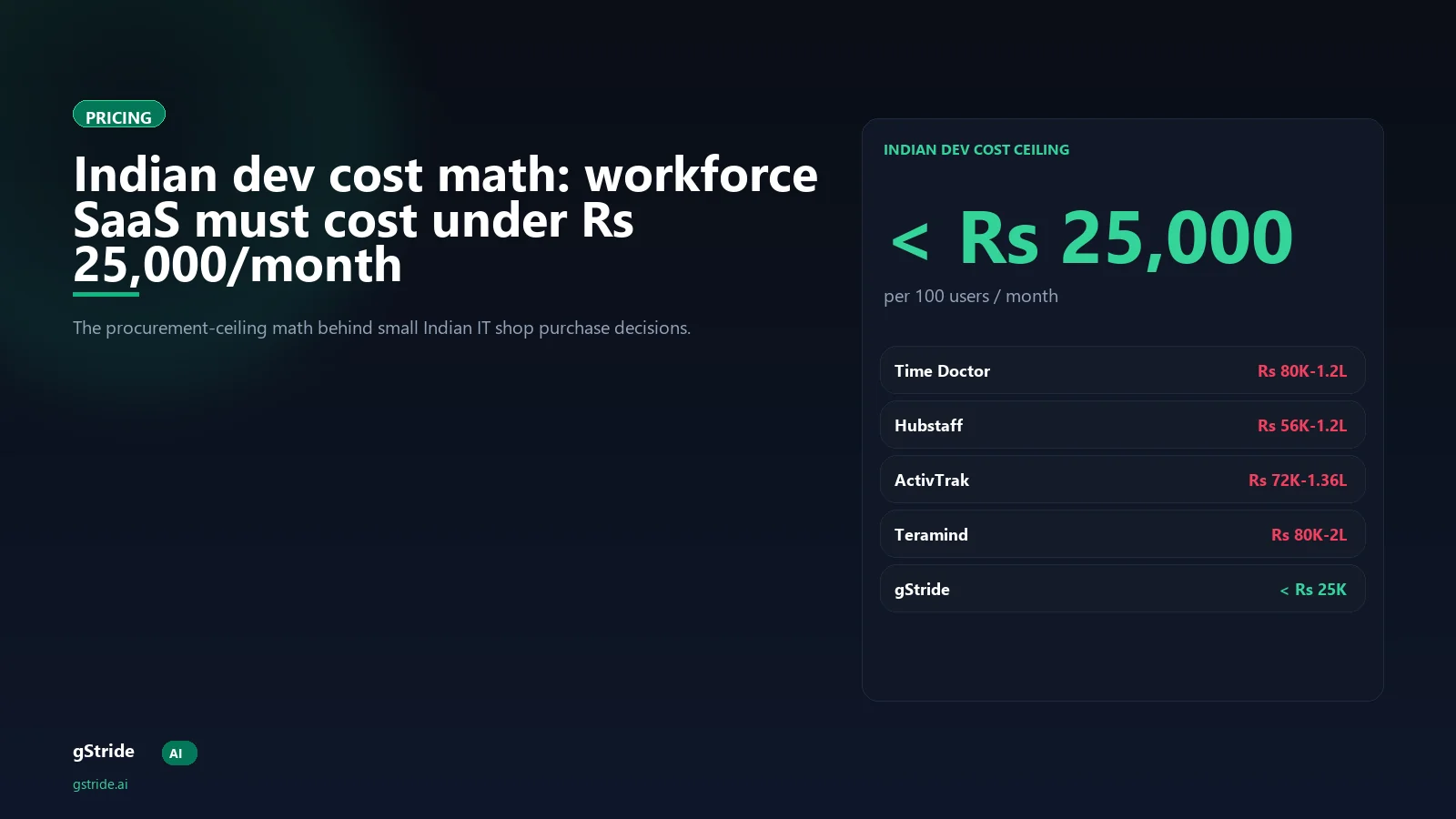
"An Indian developer costs Rs 2,00,000-3,50,000/month. If your tool costs more than Rs 1,00,000, nobody will buy. It must stay under Rs 25,000/month for small companies."
— An Ahmedabad IT services CEO and IT company owner, on an advisor call, April 2026
That sentence is the most accurate procurement frame for the Indian small-IT market in 2026. The advisor who said it has run a services shop for over a decade, has bought and rejected dozens of workforce tools, and was speaking from the buyer side of the table. The Rs 25,000/month figure is not a wishlist; it is the threshold below which a single signature clears the purchase and above which it routes to a board conversation that small shops do not have an appetite for.
Indian dev cost benchmarks — per-city 2026 table
The Rs 25,000/month ceiling is only meaningful when anchored against the local cost benchmark. The table below is the working salary range across the five largest Indian IT cities in 2026, sourced from a blend of recruiter desks, in-house HR data we have seen during pilots, and Naukri / LinkedIn comp data through Q1 2026.
| City | Fresher (0-1 yr) | Mid (3-5 yr) | Senior (7+ yr) |
|---|---|---|---|
| Ahmedabad | Rs 35,000-55,000 | Rs 70,000-1,20,000 | Rs 1,80,000-2,80,000 |
| Pune | Rs 40,000-65,000 | Rs 85,000-1,50,000 | Rs 2,20,000-3,40,000 |
| Hyderabad | Rs 42,000-68,000 | Rs 90,000-1,55,000 | Rs 2,30,000-3,60,000 |
| Mumbai | Rs 48,000-72,000 | Rs 1,00,000-1,80,000 | Rs 2,60,000-4,20,000 |
| Bangalore | Rs 50,000-75,000 | Rs 1,20,000-2,00,000 | Rs 2,80,000-4,50,000 |
The blended median across small Indian IT shops (10-150 employees) in 2026 sits at Rs 80,000-1,20,000 per developer per month. Procurement teams do not price-anchor against this median. They anchor against the fresher rate, because the single-tool spend has to clear the question "is this tool less than the cheapest person on the team?" That anchoring is the operative reality behind the Rs 25,000/month figure.
The Rs 25,000/month ceiling — the procurement math
Small Indian IT shops run procurement on a single-signature model up to a per-vendor monthly threshold; above that threshold, the spend routes to a multi-signature approval that includes the CEO and (in firms above 100 employees) a board approval. The threshold is anchored against the fresher rate using a roughly 50% rule: a tool worth more than half of a single fresher's monthly cost gets escalated. Half of Rs 50,000 is Rs 25,000.
This is not policy that any single firm publishes. It is the emergent reality across the small-IT segment, validated across the dozens of pilots and customer rollouts we have run since 2024. The same firm that signs a Rs 20,000/month tool in a single afternoon will spend 4-12 weeks "evaluating" a Rs 80,000/month tool before silently dropping it.
What you get for Rs 25,000/month at gStride
The gStride pricing model sits inside the Rs 25,000/month ceiling for a 100-employee Indian team. Detailed per-team pricing is on the pricing page; the headline composition for a 100-employee Indian IT shop is below.
- Productivity intelligence on 100 users: focus depth, commit cadence, meeting load, flow-state minutes, and blocker recovery per employee — full productivity monitoring feature across the team
- Year-round signal for the appraisal cycle: 12-month per-employee dashboards that replace last-two-months perception in the increment decision
- CEO + CFO + CTO dashboards: role-based views with per-project profitability, headcount-vs-velocity, and team-level focus heatmap
- DPDP Act + EU AI Act compliance: audit log, data residency in India, per-signal weights visible to the employee being measured (self-view day one), no screenshot capture by default
- Free pilot: 30-day deployment with no credit-card requirement
Why US-priced SaaS fails in India — the 100-user math
The US workforce-SaaS benchmark sits at $10-15/seat/month. Translated to a 100-employee Indian team, that is Rs 60,000-1,20,000/month. The table below shows the per-tool clearance picture for small Indian IT shops.
| Tool | Per-seat /mo (USD) | 100 emp / month (INR) | Procurement outcome |
|---|---|---|---|
| Time Doctor | $10-15 | Rs 80,000-1,20,000 | Escalates to board, 4-12 wk eval, ~70% silent reject |
| Hubstaff | $7-15 | Rs 56,000-1,20,000 | Escalates, 4-10 wk eval, ~60% silent reject |
| ActivTrak | $9-17 | Rs 72,000-1,36,000 | Escalates, 6-14 wk eval, ~75% silent reject |
| Teramind | $10-25 | Rs 80,000-2,00,000 | Almost always escalates, ~80% silent reject in small-IT |
| gStride (100-emp tier) | Rs 250-side equivalent | ≤ Rs 25,000 | Single-signature clearance, 1-2 week eval, 30-day pilot |
The category-correct comparison for the Indian small-IT market is not Time Doctor's per-seat rate. It is the local procurement ceiling. A tool that prices at the US benchmark in the Indian market is not "premium-priced"; it is structurally non-purchasable at the single-signature tier, and the alternative path (board escalation) is a low-yield route that small IT shops rarely complete.
ROI for a 100-employee Indian IT shop
Procurement clears the tool on the single-signature rule; ROI clears the renewal on the annual review. The ROI math for a 100-employee Indian IT shop at the Rs 25,000/month tier:
| Team size | Annual tool cost | Annual recovery (signal-driven) | Net |
|---|---|---|---|
| 50 emp | Rs 1,80,000 | Rs 9,00,000-14,00,000 | 5x-7.7x |
| 100 emp | Rs 3,00,000 | Rs 18,00,000-28,00,000 | 6x-9.3x |
| 250 emp | Rs 6,00,000 | Rs 45,00,000-70,00,000 | 7.5x-11.7x |
Recovery comes from three sources: meeting-load reduction (typically Rs 30,000-50,000/employee/year on a 12-month signal cycle), early blocker detection (typically Rs 15,000-25,000/employee/year on engineering teams), and project-profitability visibility that triggers re-scope decisions 4-6 weeks before late-signal would have surfaced them. Full per-team calculation is on the ROI calculator.
What this means for the founder we opened with
The Ahmedabad IT services CEO who set the Rs 25,000/month ceiling is articulating a procurement rule that every small Indian IT shop founder runs by, whether or not they have ever named it. The implication for workforce SaaS vendors is that pricing for the Indian market is not a matter of being cheap. It is a matter of being below the single-signature procurement threshold. Cross that threshold by even Rs 10,000/month and the sales cycle multiplies by 4-6x with a lower close rate at the other end.
The implication for Indian small-IT buyers is simpler: the Rs 25,000/month tier is the right tier for productivity intelligence across the full team, not a stripped-down subset of features. Tools that price above this and try to "negotiate down" almost always come with a feature gap (lower seat limits, regional restrictions, manual-onboarding fees) that defeats the rationale for the lower price. The correct purchase is the tool that is natively priced at the procurement-ceiling tier and ships the full feature set there.
Free: 5-Signal Productivity Self-Audit Worksheet
30-min audit on your current team using five behaviour signals — focus depth, commit cadence, meeting load, flow-state minutes, blocker recovery. PDF + Google Sheets calc. Built for Ops Heads, Founders, Eng Managers at 25-300 emp Indian IT shops.
Free: Employee Monitoring Policy Template
8-section policy template covering consent, data retention, audit log, employee self-view, DPIA, and EU AI Act + DPDP Act compliance. Editable for any 50-500 emp Indian IT shop.
Further reading on gStride
Frequently asked questions
What is the Rs 25,000/month ceiling rule for workforce SaaS in India?
Workforce SaaS priced above Rs 25,000/month for a 100-employee team faces automatic procurement rejection at small Indian IT shops in 2026. The rule comes from a procurement math anchored on Indian developer cost benchmarks: a fresher developer costs Rs 50,000/month, and procurement will not approve a single tool that exceeds half of a fresher developer's monthly salary for the entire team. Tools that price at the US benchmark of $10-15/seat (Rs 800-1,200/seat) blow through this ceiling on contact.
What does an Indian developer cost in 2026?
Per-city monthly benchmarks for 2026: Ahmedabad fresher Rs 35,000-55,000, mid Rs 70,000-1,20,000, senior Rs 1,80,000-2,80,000. Bangalore fresher Rs 50,000-75,000, mid Rs 1,20,000-2,00,000, senior Rs 2,80,000-4,50,000. Mumbai/Pune/Hyderabad fall between the two. The blended median across small Indian IT shops in 2026 sits at Rs 80,000-1,20,000 per developer per month. Procurement teams price-anchor tooling against the fresher rate, not the senior rate.
Why do US-priced workforce tools fail in the Indian market?
US-priced tools at $10-15/seat translate to Rs 80,000-1,20,000/month for a 100-employee team. That is one fresher developer's entire monthly salary for a single tool. Indian procurement teams categorise this as "enterprise-priced" and route it to a board approval that small IT shops do not have a sponsor for. The same tool at Rs 25,000/month (Rs 250/seat for 100 users) clears procurement at the IT-head level in a single signature. Pricing for the Indian market is not about being cheap; it is about being below the procurement-escalation threshold.
How does the Rs 25,000/month rule scale to 250 or 500 employees?
The ceiling stretches sub-linearly. For 100 employees, Rs 25,000/month (Rs 250/seat). For 250 employees, Rs 50,000-60,000/month (Rs 200-240/seat) is the typical clear-procurement band. For 500 employees, Rs 90,000-1,20,000/month (Rs 180-240/seat). Above 500 employees, the ceiling tracks the per-seat rate but procurement gains the headroom to spend Rs 1.5-2.5L/month on workforce platforms. The Rs 25,000 figure is the small-IT-shop fingerprint; the per-seat rate is the universal anchor.
What does gStride charge a 100-employee Indian IT shop?
gStride pricing for a 100-employee team in India sits inside the Rs 25,000/month procurement ceiling, with a no-credit-card 14-day trial and a 30-day pilot that does not require board approval. Live per-team pricing is on the pricing page; the ROI calculator gives a per-team annual cost vs annual recovery comparison for free.
What is the cost comparison vs hiring a productivity analyst?
Hiring one productivity analyst at Rs 80,000-1,20,000/month covers one report cycle per quarter on a 100-employee team. The same workforce intelligence platform at Rs 25,000/month delivers daily signal on focus density, commit cadence, meeting load, and project profitability for the entire team — 12 months of signal for less than 3 months of analyst salary. The break-even is in week 6 of the first quarter.
What about Time Doctor, Hubstaff, ActivTrak pricing in India?
US-headquartered workforce tools price at $10-15/seat globally — Time Doctor at $10-15, Hubstaff at $7-15, ActivTrak at $9-17, Teramind at $10-25. For 100 Indian employees that is Rs 60,000-2,00,000/month. All of these clear procurement at US/EU buyers but stall at small Indian IT shops on the price-ceiling rule. The category-correct comparison for the Indian market is not Time Doctor's seat-rate; it is the local procurement ceiling.
Is the Rs 25,000 rule the same across India?
Within 15% across Ahmedabad, Pune, Hyderabad, and Jaipur small IT shops (10-150 employees). Bangalore and Mumbai shops at the same headcount tier sit 15-25% higher because their fresher developer benchmark is higher. Above 200 employees, procurement gains more headroom in every city and the rule loosens to the per-seat anchor. Below 30 employees, the rule tightens — many shops will not sign anything above Rs 15,000/month for a single tool.
See the 100-emp Rs 25,000/month tier on real data
15-minute walkthrough on a 100-employee Indian IT shop. Live pricing, full feature set, 30-day pilot, no credit card.
Book a 15-min demo See pricingThe Indian dev cost benchmarks above are blended ranges from recruiter desks, in-house HR data seen during pilots, and Naukri/LinkedIn comp data through Q1 2026. Individual roles and skill stacks vary. The Rs 25,000/month procurement ceiling is an emergent reality across small Indian IT shops, not a published policy at any single firm; it is validated across dozens of pilots and customer rollouts since 2024. Quotes are anonymised from a private advisor call.